

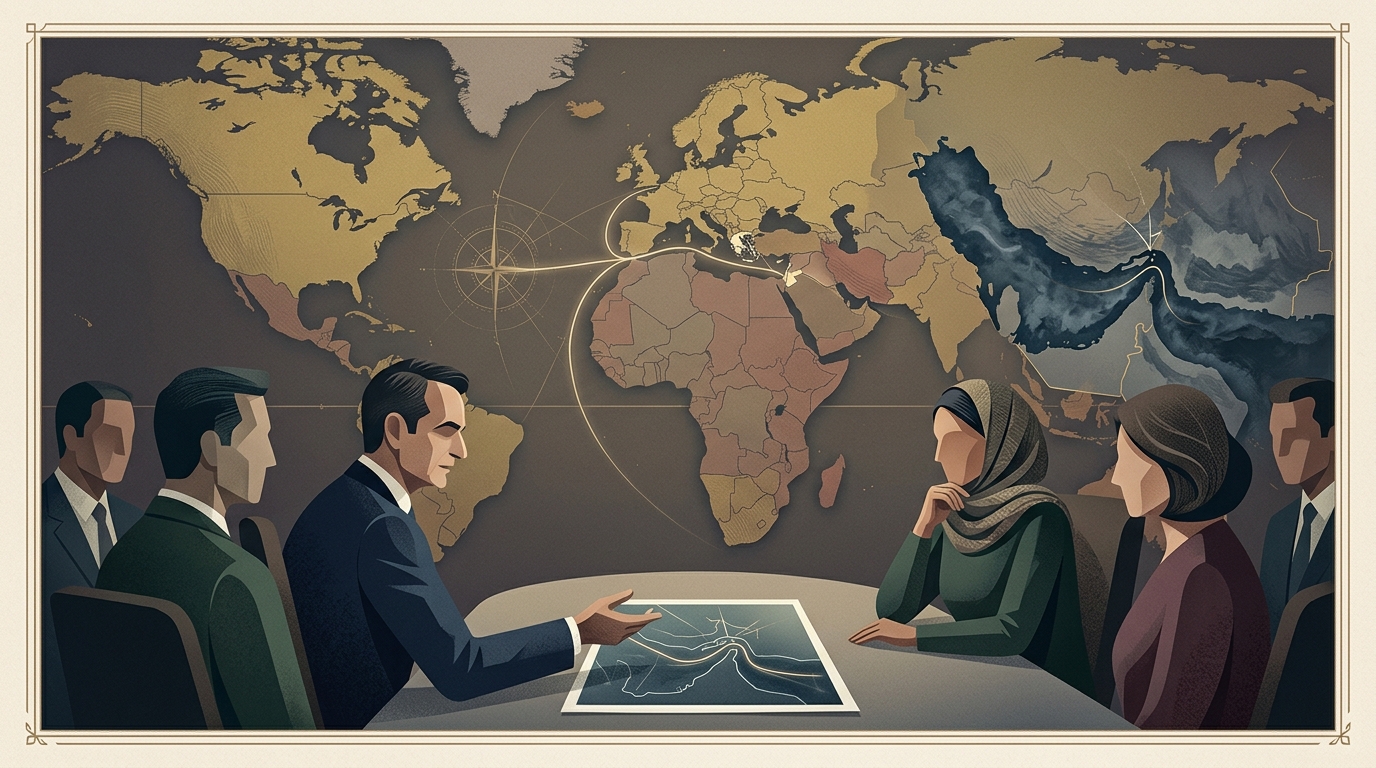
At a time when the geopolitical architecture of the Middle East is being tested by cascading crises, the 5th Greece-Cyprus-Jordan Trilateral Summit in Amman was not merely a routine diplomatic meeting, but a strategic declaration of presence. Greek Prime Minister Kyriakos Mitsotakis, joined by Cypriot President Nikos Christodoulides and King Abdullah II of Jordan, sent a clear message: the security of maritime routes, from the Red Sea to the Strait of Hormuz, is a non-negotiable priority for the global economy and regional peace.
The choice of Amman as the host city underscores Jordan's pivotal role as an "anchor of stability" in a volatile region. For Athens and Nicosia, strengthening ties with the Hashemite Kingdom is not just about bilateral cooperation; it is about creating an "arc of reason" connecting the European Union with the Arab world. The discussions centered on the urgent need to protect freedom of navigation, an issue that has gained critical importance following attacks in the Red Sea and persistent threats in the Strait of Hormuz.
The Strategic Significance of the Strait of Hormuz
Kyriakos Mitsotakis emphasized the issue of the Strait of Hormuz, describing it as one of the world's most critical trade arteries. Greece, as the world's leading shipping power, has a direct and vital interest in the unhindered passage of vessels. The Prime Minister stressed that any disruption to the flow of energy or trade at this chokepoint would have disastrous consequences for global inflation and Europe's energy security. This reference was deliberate, as Tehran frequently utilizes the Strait as a leverage point on the international chessboard.
In this context, Greece and Cyprus are positioning themselves as natural bridges for the EU toward the region. Greece's participation in Operation "ASPIDES" in the Red Sea was cited as a practical example of the country's commitment to upholding international law and maritime security. Mitsotakis highlighted that trilateral cooperation can act as a power multiplier, enhancing the EU's ability to intervene constructively in Middle Eastern developments.
Energy and the Eastern Mediterranean Corridor
Beyond security, energy served as the second major pillar of the Summit. Cyprus and Greece, through electrical interconnection projects and the development of natural gas infrastructure, aim to establish the Eastern Mediterranean as a reliable energy corridor for Europe. Jordan, for its part, is keenly interested in joining these networks as it seeks to diversify its energy sources and bolster its own energy sufficiency.
- Promotion of the Great Sea Interconnector to link Europe and Asia.
- Cooperation in Renewable Energy Sources (RES), with Jordan offering vast areas for solar parks.
- Exchange of expertise in water resource management, a critical issue for arid Jordan.
This strategic convergence is creating a new economic ecosystem. As Nikos Christodoulides pointed out, the trilateral format is not directed against anyone but serves as an "open invitation" for regional cooperation based on International Law and the United Nations Convention on the Law of the Sea (UNCLOS).
The Palestinian Issue and the Humanitarian Crisis
The situation in Gaza could not be absent from the agenda. King Abdullah briefed the two leaders on Jordan's efforts to prevent further humanitarian catastrophe. The Greek Prime Minister praised Amman's role in maintaining the status quo of the Holy Sites and reiterated the need for a two-state solution, which remains the only viable prospect for lasting peace. Greece and Cyprus, maintaining traditionally good relations with both Israel and the Arab world, claim the role of an "honest broker" in the region.
"Stability in our region is not a luxury; it is a prerequisite for our survival. Greece, Cyprus, and Jordan constitute an axis of moderation in an ocean of uncertainty," Kyriakos Mitsotakis stated during the joint press conference.
In conclusion, the Amman Summit confirmed that Greek foreign policy has gained depth and continuity. The transformation of Greece from a "passive observer" to an "active shaper" of developments in the Southeastern Mediterranean and the Middle East is now a reality recognized by international partners. The challenge now lies in translating these political declarations into tangible results in the fields of security and economic cooperation.





