

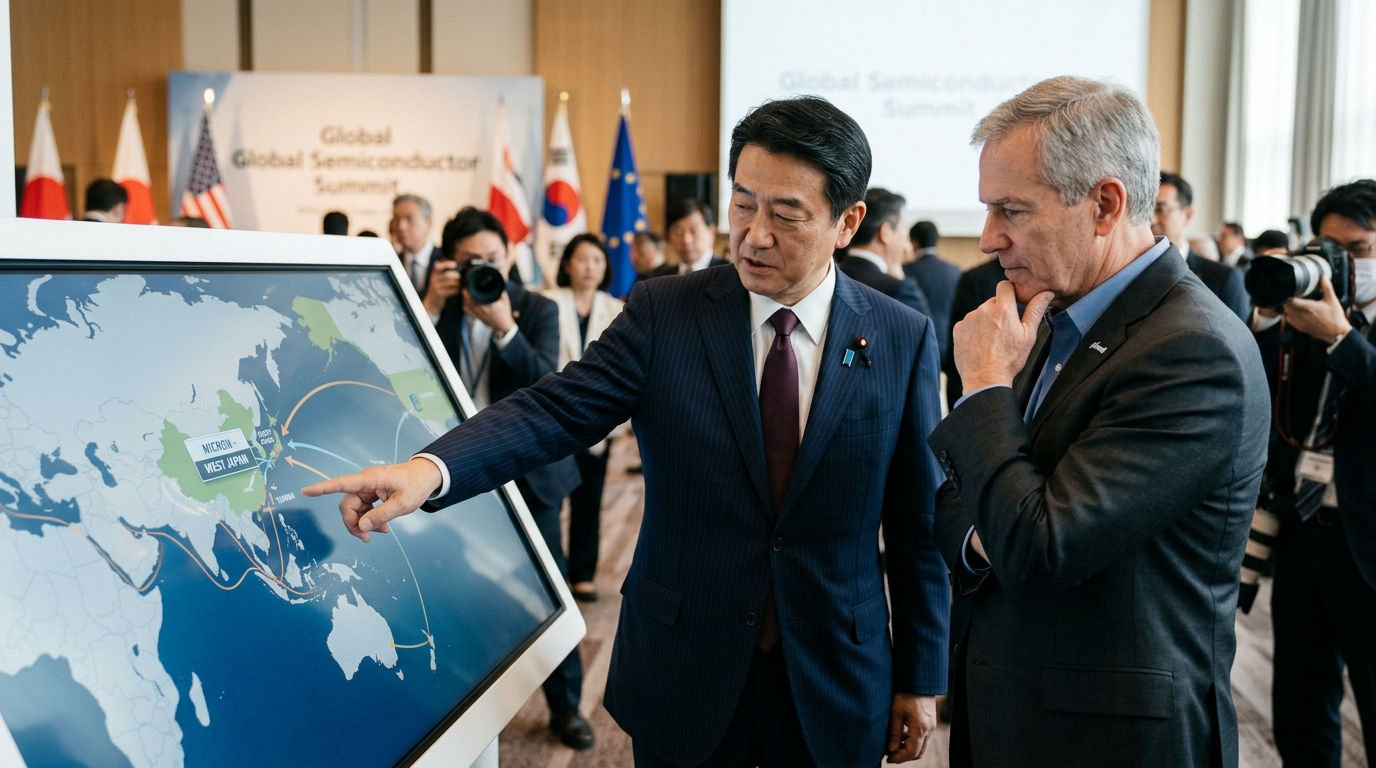
In a move that underscores the growing convergence between technological prowess and national security, Micron Technology Inc. held a groundbreaking ceremony on Saturday for the expansion of its factory in western Japan. The investment, totaling 1.5 trillion yen (approximately $9.3 billion), represents one of the most ambitious industrial undertakings in Japan’s recent history and marks a critical turning point on the global semiconductor chessboard.
The new facility in Hiroshima is not merely an expansion of production capacity; it is the epicenter of Micron’s strategy to dominate the High Bandwidth Memory (HBM) market. HBM chips are indispensable for training large language models and supporting the AI processors designed by the likes of Nvidia and AMD. As demand for AI infrastructure skyrockets, the ability to produce these specialized chips on stable, geopolitically secure soil is becoming an existential priority for the West.
The US-Japan Strategic Alliance
This investment would not have been possible without the generous support of the Japanese government. Japan’s Ministry of Economy, Trade, and Industry (METI) has committed billions in subsidies as part of a broader strategy to revive the nation as a global semiconductor hub. Japan, which once dominated the chip market in the 1980s, is now seeking to regain lost ground by partnering closely with American firms.
From a geopolitical perspective, this move is a cornerstone of the "de-risking" strategy away from China. With tensions in the Taiwan Strait remaining high, Washington and Tokyo are keen to ensure that the supply chain for the world’s most advanced chips does not rely solely on TSMC in Taiwan. Hiroshima is thus being transformed into a bastion of technological resilience for the democratic alliance.
Technological Supremacy and Competition
Micron is locked in a fierce battle with South Korean rivals SK Hynix and Samsung Electronics for leadership in HBM memory. The new facility will utilize Extreme Ultraviolet (EUV) lithography technology, which is essential for manufacturing the world’s densest and most energy-efficient memory chips. The adoption of EUV in Japan is a milestone, bringing the most advanced manufacturing methods to the heart of Japanese industry.
- Production of 1-gamma DRAM, the most advanced in the world.
- Integration of EUV technology for the first time on Japanese soil.
- Creation of thousands of high-skilled jobs.
- Strengthening the local ecosystem of suppliers and research centers.
“Today’s groundbreaking is not just about concrete and steel; it’s about laying the foundation for the future of artificial intelligence and the security of global supply chains,” a Micron executive stated during the ceremony.
Economic and Social Implications
For the Hiroshima region, Micron’s investment acts as a catalyst for economic rebirth. The influx of capital and talent is expected to turn the area into a "Silicon Island," similar to what is emerging in Kyushu with TSMC’s new plant. However, challenges remain, particularly regarding the recruitment of sufficient labor in a country with an aging population.
In conclusion, Micron’s expansion in Japan is a statement of intent. In a world where data is the new oil and semiconductors are the new internal combustion engines, possessing production capacity is the ultimate form of power. Hiroshima, a city that symbolizes rebirth from the ashes, is now becoming the laboratory where the digital intelligence of the 21st century is forged.





