

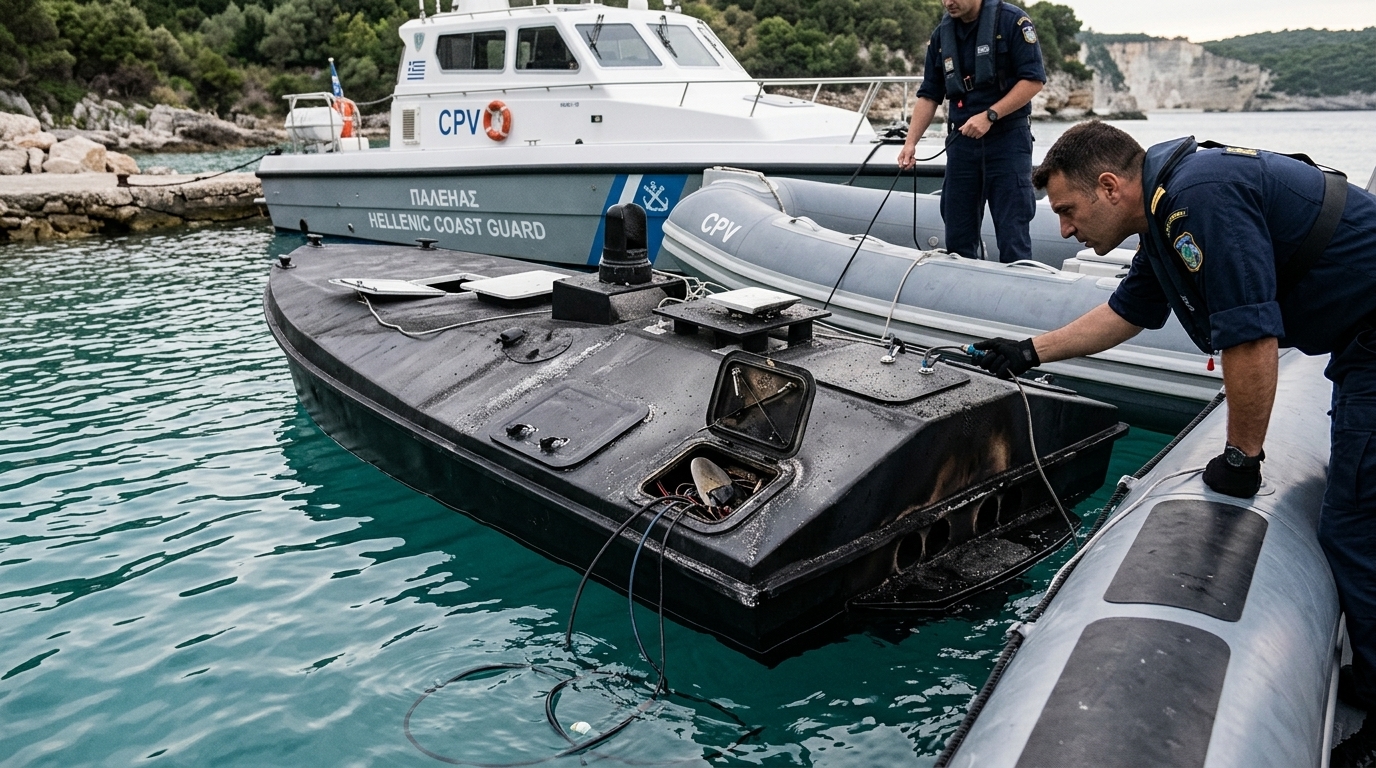
The idyllic tranquility of the Ionian Sea was violently disrupted in recent hours as news of an unmanned aerial vehicle (drone) carrying a significant payload of explosives off the coast of Lefkada sent Greek authorities and the global diplomatic community into a state of high alert. The incident, initially treated as a random find by local fishermen, is evolving into a complex geopolitical thriller that highlights the fragility of regional security and the unpredictable nature of modern warfare.
The Discovery and Technical Profile
It all began when fishermen in the area between Lefkada and Meganisi spotted an object floating in the sea. The immediate mobilization of the Coast Guard and the involvement of a Special Forces unit revealed a disturbing reality: it was a Ukrainian-made drone, likely a UJ-22 Airborne model, carrying an explosive device. This specific model is renowned for its ability to perform "kamikaze" missions, with an operational range reaching up to 800 kilometers under normal conditions.
The presence of explosives inside the drone suggests that the aircraft was not on a simple reconnaissance flight but was programmed for a strike. The neutralization of the payload was carried out under strict secrecy by Army explosive ordnance disposal (EOD) experts, while the wreckage was transported to military facilities for further laboratory examination. Preliminary assessments suggest a mechanical failure or fuel exhaustion led the drone to crash into the sea before reaching its—as yet unknown—destination.
The Geographical Paradox: A 1,000-Kilometer Mystery
The most difficult question facing analysts from the National Intelligence Service (EYP) and the Hellenic National Defense General Staff (GEETHA) is the route the aircraft followed. Lefkada is more than 1,000 kilometers away from the nearest conflict zones in Ukraine. To reach the Ionian, the drone would have had to cross the airspace of at least two or three NATO member states, such as Romania, Bulgaria, or Albania, without being detected by air defense systems.
- Scenario 1: The drone suffered a severe navigation system failure (GPS spoofing) and deviated from its course by hundreds of miles.
- Scenario 2: The aircraft was launched from a vessel in the Mediterranean, which would imply a much closer and more targeted operation.
- Scenario 3: It was a long-range test that ended in failure.
The possibility that the drone crossed the Balkans undetected is causing intense concern in Brussels and Athens. If an armed aircraft can travel such a distance over European territory without being intercepted, then the gaps in the Alliance's integrated air defense are more than evident.
Diplomatic Pressures and National Security
At the political level, the government is maintaining a wait-and-see stance, avoiding public accusations against Kyiv, with which it maintains close defense ties. However, behind the scenes, the pressure for explanations is intense. The Greek side is demanding clarification on whether the drone belonged to Ukraine's regular forces or one of the many semi-autonomous groups operating on the front lines.
"The safety of our citizens and the integrity of our airspace are non-negotiable. We are examining every aspect of this serious incident with due gravity," a Ministry of National Defense source stated.
The incident brings to mind the crash of a similar drone in Zagreb, Croatia, in 2022, which had also crossed the airspace of NATO countries unhindered. The repetition of such a phenomenon in the heart of Greece's tourist season adds an extra layer of concern, as Lefkada is one of the most popular destinations worldwide.
Conclusions and the "New Normal"
The Lefkada case serves as a reminder that the war in Ukraine is not a "local" conflict, but a fire whose sparks can reach every corner of Europe. Drone technology has democratized access to precision weapons but has simultaneously created a gray zone of accountability. Whether an accident or something more sinister, the Lefkada "kamikaze" is a warning that Athens cannot ignore. The need to strengthen anti-drone systems and revise surveillance protocols on the country's western borders has now become imperative.




