

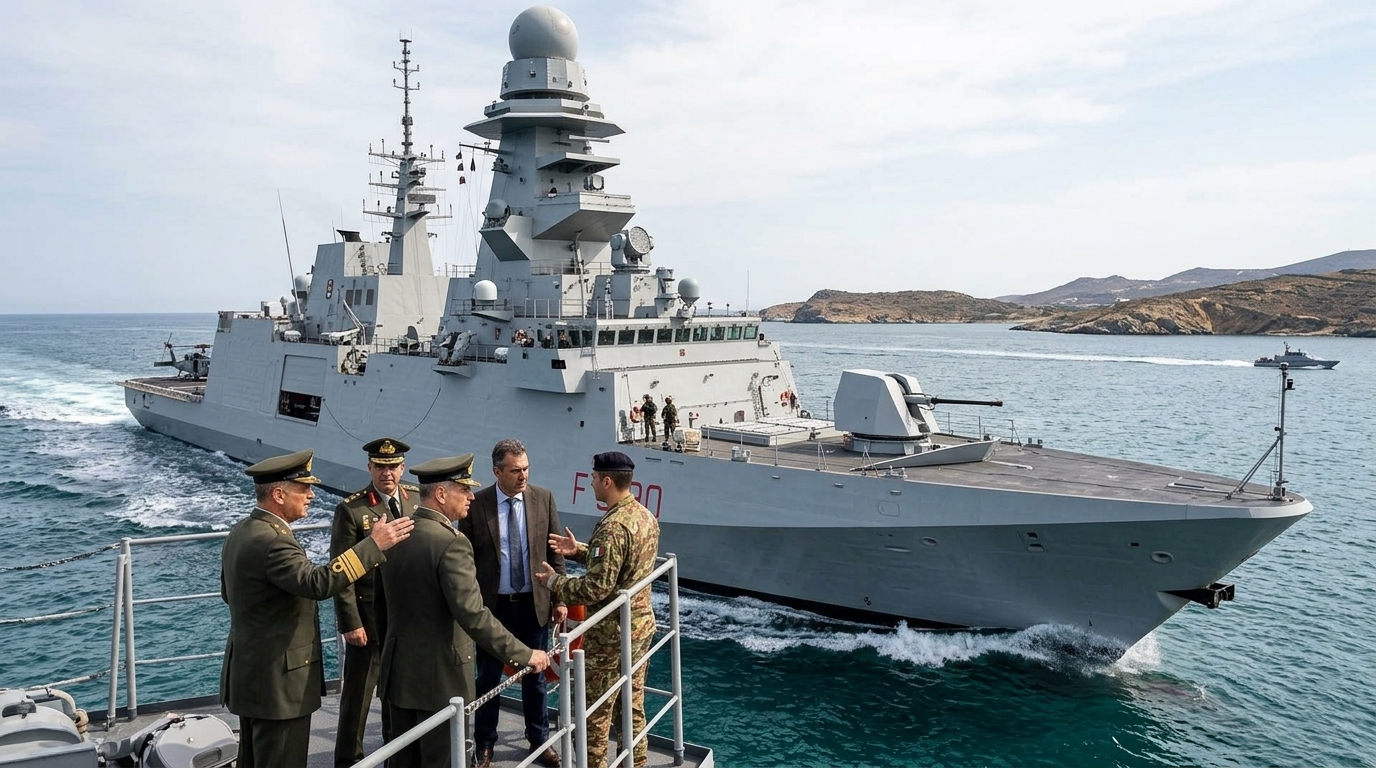
The recent meeting of the Government Council for Foreign Affairs and Defense (KYSEA), chaired by Prime Minister Kyriakos Mitsotakis at the Maximos Mansion, was far from a routine review of defense policy. At the heart of the discussions was the acceleration of procedures for acquiring Italian Bergamini-class frigates (FREMM-IT), a move aimed at shifting the balance of power in the Eastern Mediterranean and shielding the country's critical energy infrastructure. This decision comes at a time when geopolitical instability in the Middle East and ongoing challenges from Ankara demand a holistic approach to national security.
The Strategic Significance of the Bergamini Class
The Bergamini-class frigates represent the pinnacle of Italian naval engineering. These multi-role vessels are equipped with advanced anti-submarine warfare (ASW) and area air defense systems. Their integration into the Hellenic Navy, alongside the French Belharra frigates, creates a "two-tier" fleet capable of operating effectively in both the confined environment of the Aegean and the open waters of the Eastern Mediterranean. According to Ministry of National Defense sources, Athens is considering the acquisition of two to four units, with the background of the government-to-government (G2G) agreement with Rome involving significant trade-offs in the domestic shipbuilding sector.
The choice of Italy is strategic. The Meloni government has shown a keen interest in Mediterranean stability, and the relationship between the two prime ministers is at an all-time high. Beyond defense, this agreement serves as a response to recent Turkish legislation regarding maritime zones, which seeks to legitimize arbitrary claims against Greek sovereign rights.
Energy Security and Maritime Strategy
A key pillar of the KYSEA discussion was the interconnection between military power and energy security. Greece is gradually transforming into an energy hub, with projects like the Great Sea Interconnector (the Greece-Cyprus-Israel electrical link) and hydrocarbon exploration south of Crete being of strategic importance. Protecting this infrastructure requires ships with high endurance and advanced capabilities for detecting threats beneath the sea surface.
- Protection of undersea cables and pipelines.
- Surveillance of hydrocarbon exploration areas.
- Deterrence of hybrid threats to critical infrastructure.
- Enhanced presence in the Cyprus EEZ.
The Bergamini frigates feature the CAPTAS-4 sonar, considered the world's best for detecting modern, silent submarines. In a region where underwater competition is intensifying, this capability is crucial for ensuring freedom of navigation and uninterrupted energy flows.
Shipyard Revival and the Middle East "Crash Test"
The agreement with Italy and Fincantieri is expected to breathe new life into Greek shipyards, most likely those in Elefsina. The model of co-production or maintenance on Greek soil is a "red line" for Athens, which seeks to return the country to the global shipbuilding map. The transfer of know-how and the creation of high-skilled jobs are parallel benefits that cannot be ignored.
"National defense is not just about equipment; it is about the strong industrial base that supports it," a government source stated after the meeting.
Finally, the situation in the Middle East serves as a constant "crash test" for the Greek armed forces. Greece's participation in Operation "Aspides" in the Red Sea has already demonstrated the need for ships that can withstand saturation attacks from drones and missiles. The Bergamini class, with the Aster 30 system, provides the exact protective umbrella required in the modern battlespace. The final KYSEA decision is expected within the coming months, as Athens carefully weighs the cost and geopolitical benefits of such a move.





