

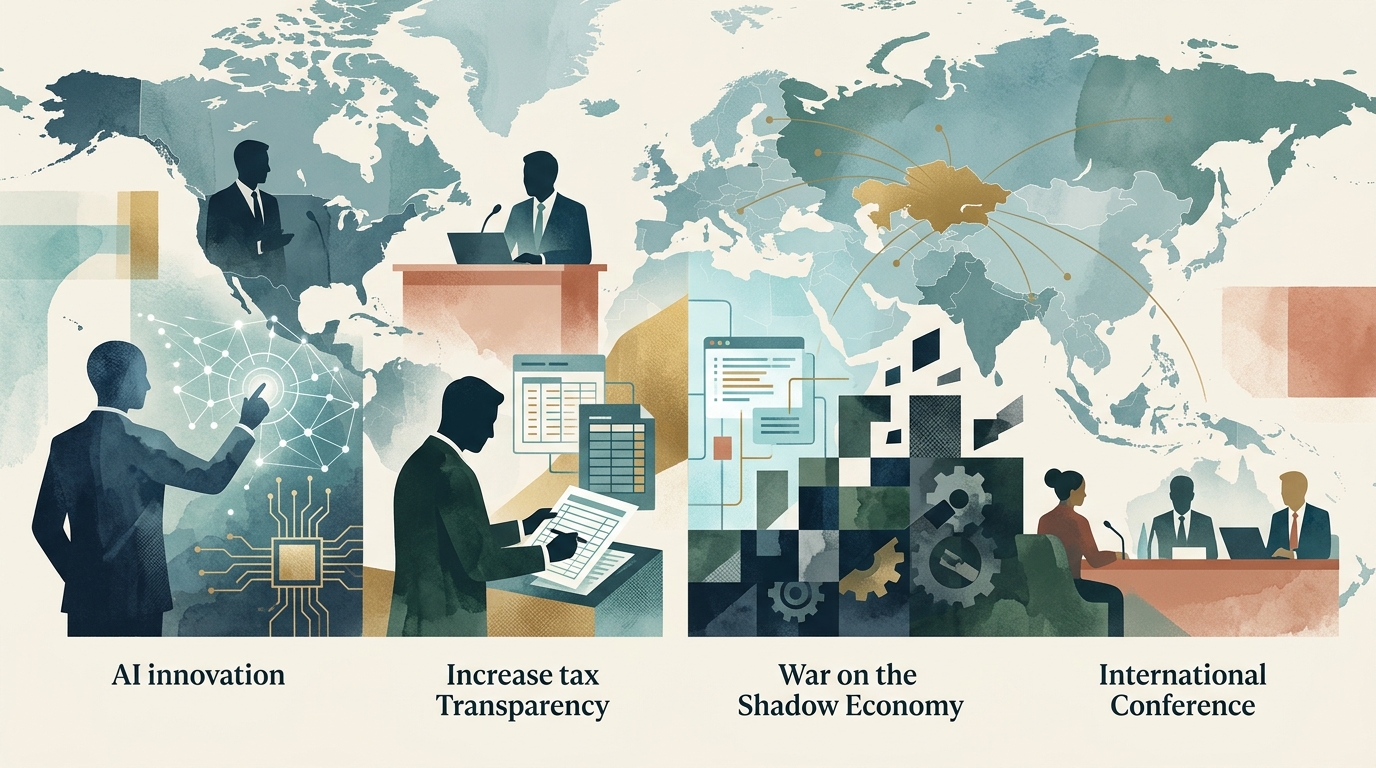
In the heart of Eurasia, a quiet but radical revolution is unfolding. Kazakhstan, a nation traditionally associated with the wealth of hydrocarbons and minerals, is making a bold pivot toward the digital economy. The government in Astana no longer views Artificial Intelligence (AI) merely as a tool for innovation, but as the central pillar for modernizing the state, attracting startup investment, and, crucially, sanitizing the national economy through the digitalization of tax administration.
Digitalization as a Weapon Against the Shadow Economy
For decades, the shadow economy was one of the greatest challenges to Kazakhstan's economic stability. Informal transactions and tax evasion deprived the state of valuable resources for infrastructure and social welfare. Today, the country is implementing one of the most advanced digital transaction monitoring systems in the world. By integrating machine learning algorithms, tax authorities can now identify anomalies in real-time, cross-referencing data from bank movements, customs declarations, and digital invoices.
The use of AI in tax administration is not just about enforcement; it's about simplification. The "Smart Data Ukimet" system allows for the automated analysis of massive volumes of data, reducing the need for intrusive audits on businesses that demonstrate high compliance. This "soft power" approach through technology has already begun to yield results, with the reduction of the shadow economy's share being a key success indicator for the Tokayev administration.
Astana Hub: The Incubator for AI Startups
Parallel to state reform, Kazakhstan is strategically investing in the startup ecosystem. "Astana Hub," the country's international tech park, has become a magnet for talent from across Central Asia and Eastern Europe. With tax exemptions reaching 100% for certain categories and a favorable legal framework based on English Law (via the Astana International Financial Centre - AIFC), the country offers a unique environment for developing AI applications.
Investments are focused on sectors like GovTech, FinTech, and AgriTech. The government recognizes that for an AI startup to survive, it needs access to Big Data and computational power. For this reason, partnerships with international giants are being launched to create hyper-scale data centers, while the training of thousands of young programmers is being promoted through the "Tech Orda" program.
Geopolitical Significance and Technological Sovereignty
Kazakhstan's turn toward AI also has a deep geopolitical dimension. Situated between Russia and China, Kazakhstan seeks to maintain a "multi-vector" foreign policy. Developing domestic technological infrastructure and using AI in governance allows the country to reduce its dependence on foreign software and strengthen its digital sovereignty.
"Technology is the new language of diplomacy. Whoever controls the algorithms, controls the future of their economy," analysts in Astana note.
However, challenges remain. Rapid digitalization raises questions about personal data protection and the potential use of these tools for stricter social control. Furthermore, the shortage of specialized human capital in advanced levels of AI research remains an obstacle that the country is trying to overcome through international academic collaborations.
Conclusions for the Future
Kazakhstan's experiment is being closely watched by other developing economies. If the country succeeds in combining strict tax discipline via AI with a free and creative innovation ecosystem, it will create a new growth model for the 21st century. The transition from a resource-based economy to a knowledge-based economy is not easy, but Kazakhstan is showing that with the right political will and technological tools, the path is open.
- Digitalization of services has already reduced bureaucracy by 70% in some sectors.
- Astana Hub now hosts over 1,000 technology companies.
- The use of AI in customs administration increased revenues by 20% last year.





