

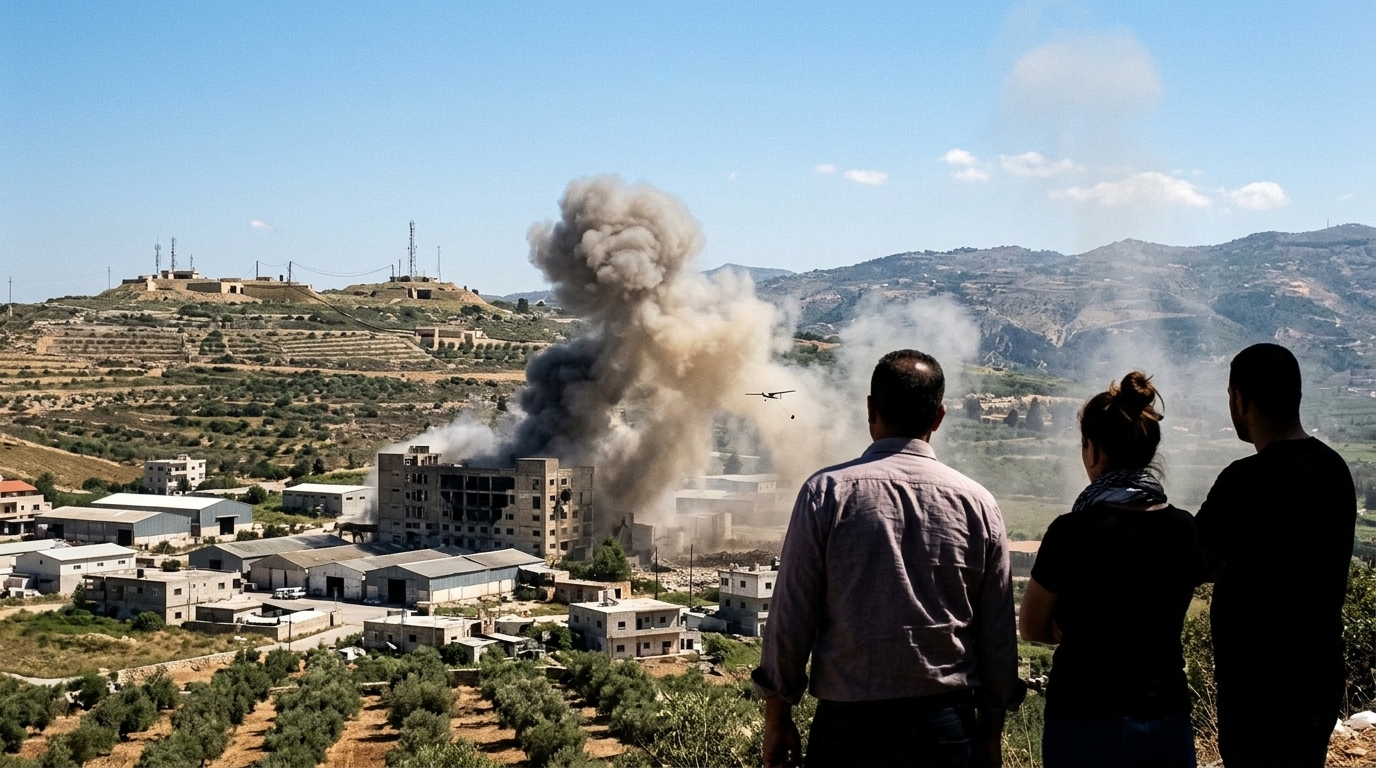
The conflict along the Israel-Lebanon border has entered a sophisticated new phase as Hezbollah adopts tactics that neutralize one of Israel’s most formidable assets: electronic warfare (EW) dominance. Despite a fragile ceasefire framework, tensions remain explosive, with the group launching over 200 projectiles and drones this past weekend. However, the news unsettling Tel Aviv isn't the volume of fire, but the nature of the delivery systems: fiber-optic drones.
The Technology Behind the Wire
Fiber-optic guided First Person View (FPV) drones represent a return to a "wired" logic that, in the age of AI and high-frequency jamming, offers a lethal advantage. Unlike conventional drones that rely on radio frequencies (RF) for video transmission and command reception, these drones unspool a thin fiber-optic cable during flight. This physical connection means they emit no signal that can be detected or jammed by Israeli EW systems, such as the Iron Dome’s sensors or localized jammers protecting IDF convoys.
The use of this technology is not unprecedented globally—similar applications have been observed in the Ukraine-Russia conflict, particularly by Russian forces—but its appearance in Hezbollah’s arsenal marks a significant escalation. Fiber optics allow for ultra-high-definition video feed with zero latency, enabling the operator to pilot the drone with surgical precision even inside buildings or bunkers where GPS and RF signals would typically fail.
The Challenge for the IDF and Geopolitical Gridlock
For the Israel Defense Forces (IDF), countering these drones is an operational nightmare. Traditional countermeasures, which focus on "blinding" the drone by disrupting its communication frequencies, are rendered entirely obsolete. The only solution is a "hard kill"—physically destroying the drone with kinetic fire or lasers—which is exceptionally difficult given the small size and high velocity of FPVs. Furthermore, because Hezbollah can operate in total electronic silence, locating launch sites before an attack becomes nearly impossible.
Geopolitically, the deployment of these weapons undermines the sense of security the Israeli government is attempting to restore in the north. Hezbollah is sending a clear message: even under the constraints of a fragile agreement, they possess the means to deliver precision strikes that Israel’s technological shield cannot intercept. Analysts see the hand of Iran in this technological leap, as Tehran continues to use Lebanon as a laboratory for new weapon systems intended for broader export or use in other regional theaters.
The Anatomy of Asymmetric Attrition
Hezbollah’s strategy is rooted in attrition. With the cost of such a drone rarely exceeding a few thousand dollars, the organization can force Israel to expend millions on interceptor missiles or expose its personnel to lethal risks. While the fiber-optic cable does limit range—typically to between 5 and 10 kilometers due to the weight and tension of the spool—this distance is more than sufficient for the rugged terrain of southern Lebanon, where proximity to IDF positions is often minimal.
In conclusion, the emergence of fiber-optic drones represents the next chapter in the evolution of modern warfare. This is no longer a "David vs. Goliath" conflict in the traditional sense, but a battle where David possesses a "smart" sling that radars cannot see. Israel is now forced to re-evaluate its entire defensive doctrine, as its technological superiority is challenged by a technology once considered antiquated, now proven to be the ultimate solution on the modern battlefield.




