

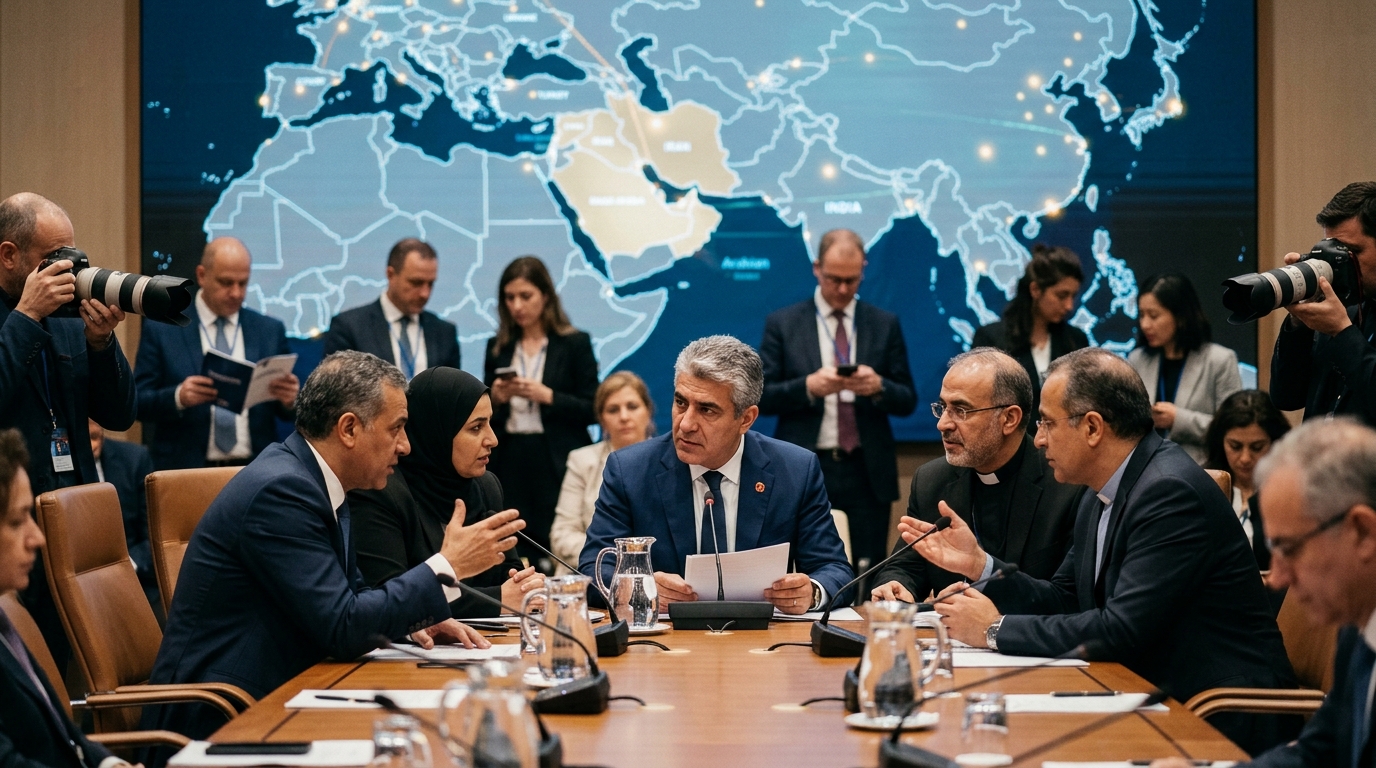
The summer of 2026 finds the global economy at a critical crossroads, where ancient conflicts over territorial sovereignty meet the digital revolution of the future. The escalation of tensions between Iran and its regional adversaries, combined with the relentless rise of Artificial Intelligence (AI) technologies, has created an unprecedented situation in the markets: a "balance of terror" where oil prices and semiconductor stocks move in a violent, yet often counter-intuitive dance.
The Shadow of War and Energy Uncertainty
The recent flare-up in the Middle East, centered on Iran, has brought back fears of a generalized conflict that could close the Strait of Hormuz. For analysts on Wall Street and in the City of London, this is not just a humanitarian issue, but a direct threat to global supply chains. Brent crude prices have shown intense volatility, directly impacting inflation expectations and central bank decisions on interest rates.
However, the market's reaction differs significantly from previous decades. Despite the threat of war, investors are not fleeing exclusively to gold or government bonds. Instead, there is a marked shift toward companies offering security solutions through AI and autonomous systems. The geopolitical crisis is acting as a catalyst to accelerate investment in defense technology, making AI an indispensable part of national security frameworks.
Artificial Intelligence as a Crisis Counterweight
While missiles threaten physical infrastructure, algorithms promise a new era of productivity. The AI boom, which gained momentum in 2023, has now reached a phase of maturity where Big Tech companies are beginning to demonstrate the tangible ROI of their massive investments. The demand for computational power is so insatiable that markets seem willing to overlook, to some extent, the surrounding geopolitical risks.
- The dominance of Nvidia and chip manufacturers remains unchallenged, as AI requires ever-increasing hardware resources.
- "Sovereign AI" is becoming a national priority for states seeking to reduce dependence on foreign technology stacks.
- Automated trading (algo-trading) now utilizes advanced AI models to predict market movements during crises, though this often exacerbates short-term volatility.
This "AI mania" functions as a sort of digital safe haven. Investors are betting that, regardless of the outcome of Middle Eastern conflicts, the march toward automation is irreversible and will yield enormous long-term profits.
The Convergence: When Geopolitics Meets Algorithms
The real challenge for the future lies in how these two forces will interact. We are already seeing AI being used in psychological warfare and disinformation campaigns, influencing market sentiment in real-time. A rumor of an attack, amplified by deepfakes or sophisticated bots, can trigger a "flash crash" on stock exchanges before human analysts have time to intervene.
"We are in an era where risk is asymmetric. A drone costing a few thousand dollars can threaten billion-dollar infrastructure, while an algorithm can protect or destroy entire economies in seconds," notes a senior analyst at a global investment bank.
In conclusion, the global market of 2026 is more complex than ever. The combination of traditional kinetic warfare and the technological revolution requires investors and citizens alike to possess a new form of "digital and geopolitical literacy." Optimism for the future of AI is currently the only force keeping markets buoyant against the specter of a major new conflict.





