

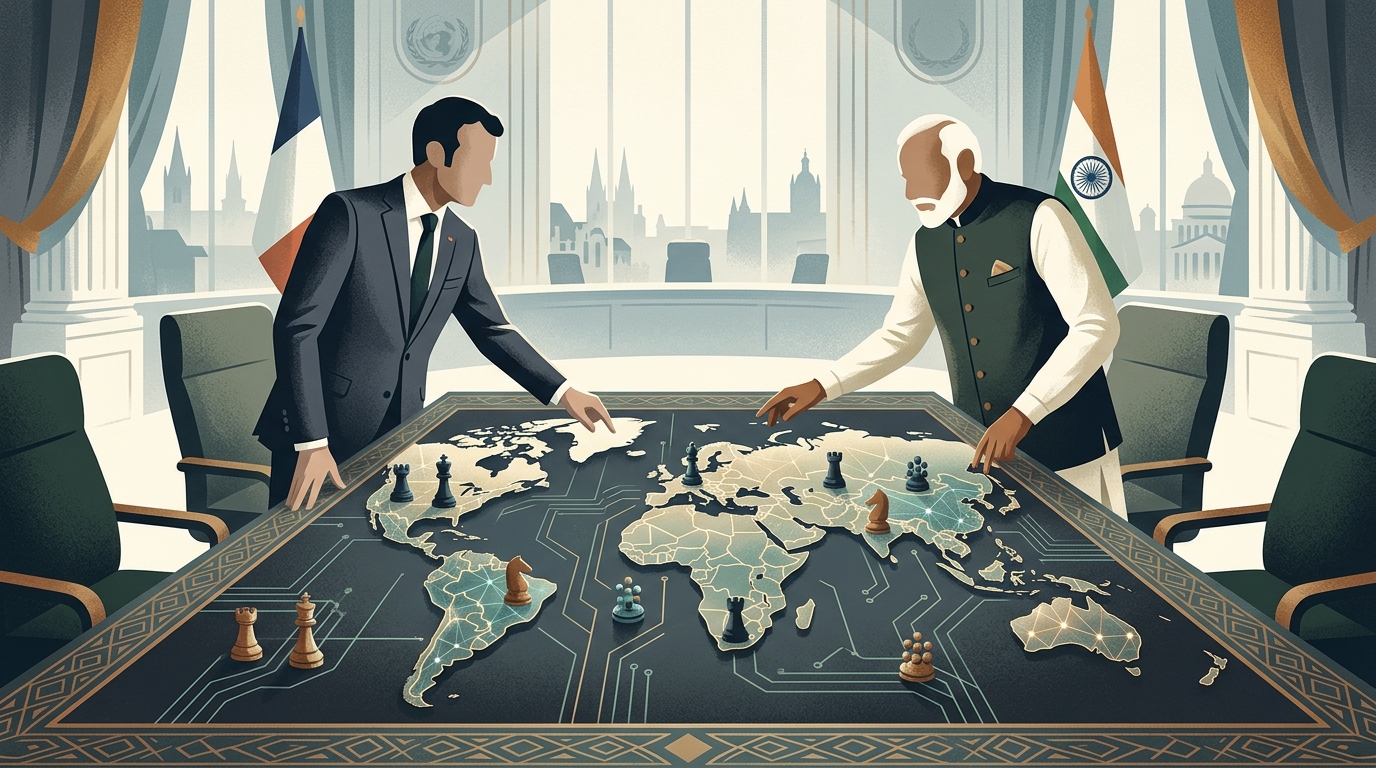
In the twilight of the first decade of the Artificial Intelligence explosion, the geopolitical chessboard looks nothing like the past. While the United States and China remains the undisputed titans of code and silicon, a new generation of leaders, led by Emmanuel Macron and Narendra Modi, is attempting to carve out a third way. It is no longer just about economic growth, but about the very concept of "Sovereign AI" – a nation's ability to produce, control, and utilize technology without depending on foreign powers.
The French Counter-Offensive: Macron’s Vision for Europe
Emmanuel Macron has made it clear that France does not intend to watch the developments from the sidelines. Under the slogan "Choose France," the French President has successfully turned Paris into a global nursery for AI. The success of Mistral AI, now considered the European rival to OpenAI, was no accident. It was the result of a coordinated state strategy that combined research tax credits with the attraction of giants like Microsoft and Google to establish data centers on French soil.
Macron’s strategy rests on three pillars: talent, infrastructure, and regulation. Understanding that the European Union often "suffocates" innovation with excessive rules, Macron pushed for a balanced approach to the AI Act, ensuring that European startups would have the space to grow before facing the full weight of bureaucracy. "If we don't have our own models, we will be forced to consume the values of others," he stated at a recent forum, highlighting the risk of cultural and technological colonization by Silicon Valley.
India as the "Data Powerhouse" under Modi
On the other side of the planet, Narendra Modi is following a different but equally ambitious path. India may not have the raw computing power of the US, but it possesses something equally valuable: the world's largest population and an ocean of data. The "IndiaAI" mission is the vehicle through which Modi seeks to democratize technology. For the Indian government, AI is not a tool for generating text or images, but a lever for solving problems in healthcare, agriculture, and education.
Modi has invested billions in domestic semiconductor production, seeking to break the dependence on Taiwan and China. At the same time, India is promoting "Bhashini," an AI project aimed at breaking down linguistic barriers between dozens of Indian dialects. This approach makes India the natural leader of the Global South, offering a development model based not on Big Tech speculation, but on social inclusion.
"Artificial intelligence must be for everyone, not just for the few. India will lead the way in ethical and inclusive AI," Modi emphasized during the recent G20 summit.
The Competition for Capital and the Geopolitics of Chips
The competition between governments has taken the form of a global auction. States are offering billions in subsidies to attract Nvidia, Intel, and TSMC. However, the game is not just about money. It is about access to energy. AI requires massive amounts of electricity, and here France, with its nuclear arsenal, possesses a comparative advantage that Macron is leveraging to the fullest.
On the other hand, India offers scale. AI companies know that whoever wins the Indian market will have access to a dataset that can train the most accurate models in the world. This dynamic is creating a new form of diplomacy, where AI agreements are as significant as defense deals or oil trade treaties.
Conclusion: The New Era of State-Driven Tech
As we head toward the second half of the decade, it is clear that the era of unchecked dominance by tech corporations is ending. The state has returned, and it has returned as an investor, regulator, and protector. Macron and Modi, despite their different starting points, share a common belief: that artificial intelligence is the ultimate power tool of the 21st century. Whoever controls the algorithms will control the future of their national sovereignty.





