

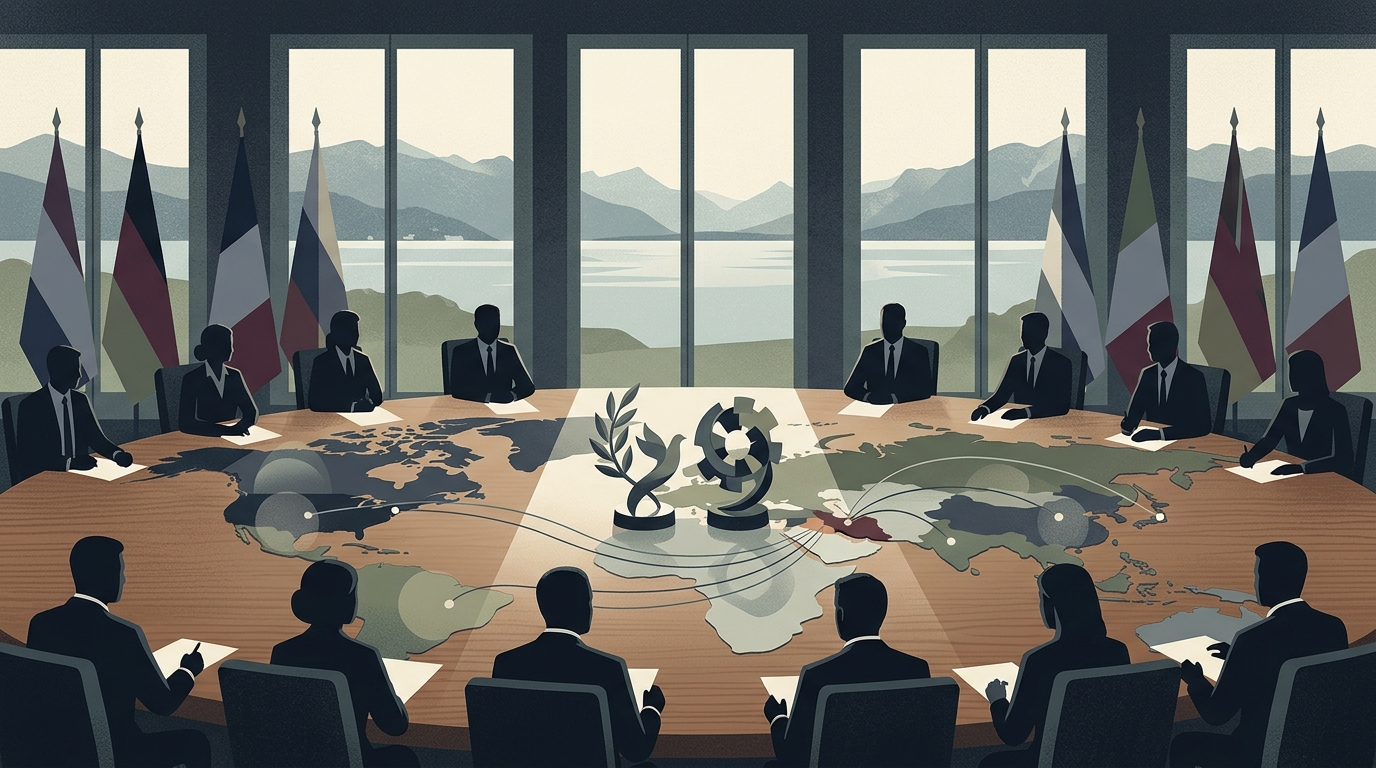
The idyllic town of Evian on the shores of Lake Geneva has been transformed this week into the epicenter of global diplomacy. The G7 summit commenced in a context that many analysts describe as a "historic turning point." Despite the traditionally broad agenda of the world's most powerful economies, this year's event is dominated by a single development: the recent, surprise agreement between Washington and Tehran regarding the nuclear program and the lifting of sanctions.
This accord, reached after months of back-channel deliberations, is not merely a bilateral success but a geopolitical earthquake reshaping balances in the Middle East and, by extension, the strategic priorities of the West. In Evian, the French President, acting as host and informal mediator for Europe, is attempting to capitalize on this momentum by promoting an agenda of "strategic stability."
The Strait of Hormuz and Energy Security
The most critical issue on the negotiating table concerns the freedom of navigation in the Strait of Hormuz. With the re-entry of Iranian oil into international markets, ensuring the unhindered flow of energy becomes vital for a global economy still grappling with inflationary pressures. G7 leaders are seeking explicit guarantees that Tehran will refrain from any actions that could disrupt trade in this crucial artery.
According to diplomatic sources, the discussion is not limited to oil. The agreement paves the way for new trade routes and investments in natural gas infrastructure that could further reduce Europe's dependence on other sources. However, suspicion remains. Japan and Germany expressed reservations about the long-term viability of the deal, emphasizing that trust is built through actions, not just signatures on official documents.
The French Initiative and European Strategic Autonomy
Emmanuel Macron used the summit to bring the doctrine of "European Strategic Autonomy" back to the forefront. For Paris, the US-Iran deal presents an opportunity for the European Union to play a more active role as a guarantor of international order, independent of the internal political fluctuations of the United States. The presence of EU leadership at the Evian talks underscores this intention.
Discussions within the summit also focus on how the funds released by the lifting of sanctions on Iran could be directed toward green energy projects and technological development, rather than armament programs. It is an ambitious, perhaps even utopian approach, yet it reflects France's desire to lead a new form of "ethical diplomacy."
Challenges and Domestic Reactions
Despite the climate of cautious optimism, the G7 summit is not without its tensions. The American delegation is under pressure from Congress, where reactions to the deal with Iran are intense. Republicans, as well as some Democrats, warn that granting economic resources to Tehran without stricter oversight of its regional activities is a dangerous risk.
Furthermore, regional allies not participating in the summit, such as Israel and Saudi Arabia, are watching with evident concern. The G7 is tasked with squaring the circle: supporting the deal without alienating their traditional partners in the Middle East. The summit's final communique is expected to include strong language on regional security in an attempt to alleviate these concerns.
Conclusion: A World in Transition
The Evian summit is not just an economic meeting. It is a test for multilateral diplomacy in an era of fragmentation. The US-Iran accord acts as a catalyst forcing the G7 to re-evaluate their alliances and their role in the 21st century. If the Evian experiment succeeds, we might see the beginning of a new period of decompression in international tensions. If it fails, instability in the Strait of Hormuz will be the least of the problems facing the global community.
- Securing the Strait of Hormuz remains the ultimate priority for global trade.
- The US-Iran deal changes the facts on the ground for the global oil market.
- France seeks to upgrade the EU's role as a global mediator.
- Domestic political reactions in the US pose the greatest risk to the deal's longevity.





