

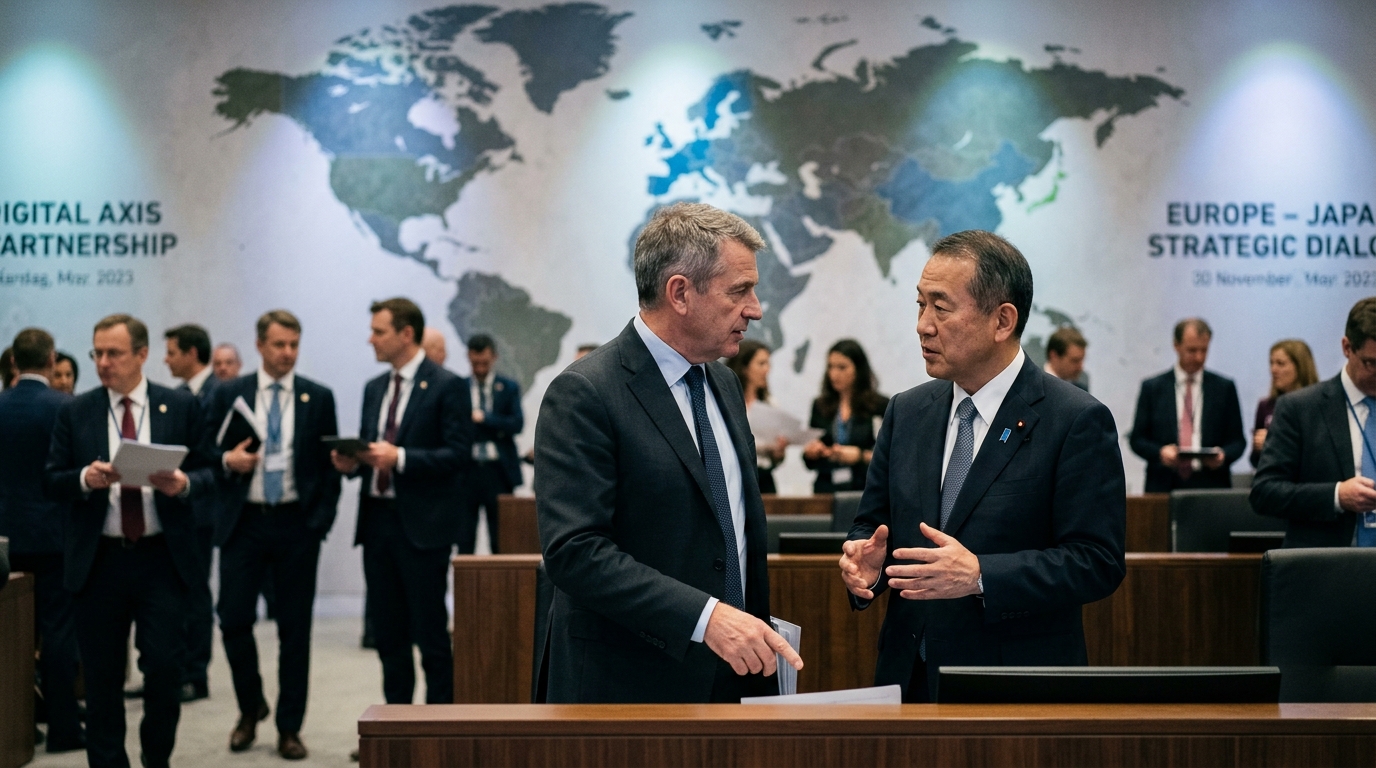
In an era where technological prowess translates directly into geopolitical dominance, the European Union and Japan have decided to join forces, creating a formidable counterweight to the US-China bipolar system. The recent deepening of their cooperation in semiconductors, artificial intelligence, and 6G networks is not merely a commercial agreement; it is an existential necessity for the digital sovereignty of democratic states.
The agreement, coming at a critical juncture for global supply chains, aims to avoid the mistakes of the past. Following the chip crisis that paralyzed industries over the last few years, both sides are now investing in an early warning mechanism for shortages, while coordinating subsidies to prevent a wasteful "bidding war" for manufacturing plants.
The Semiconductor Renaissance and Strategic Autonomy
Semiconductors are the "oil" of the 21st century. Europe, through the European Chips Act, and Japan, through state support for giants like Rapidus, seek to regain lost ground in cutting-edge chip manufacturing (below 2nm). The partnership includes the exchange of research personnel between Japan’s LSTC (Leading-edge Semiconductor Technology Center) and European research hubs like IMEC in Belgium.
This convergence is not just about production but also resilience. Both partners recognize that dependence on Taiwan represents a geopolitical risk that can no longer be ignored. By creating a "security corridor" between Europe and Japan, they aim to ensure that their automotive and defense industries remain functional even during periods of extreme instability in the Pacific.
AI Governance and Data Free Flow with Trust
On the AI front, the stakes are about values. While China uses AI for social control and the US largely leaves its development to market forces, the EU and Japan are promoting a model of "human-centric" AI. The concept of "Data Free Flow with Trust" (DFFT), a Japanese initiative warmly adopted by the EU, serves as the cornerstone of this effort.
- Harmonizing regulatory frameworks for AI, based on the European AI Act.
- Collaborating on the development of Large Language Models (LLMs) that respect copyright and privacy.
- Joint actions to combat disinformation and deepfakes, particularly during election cycles.
This cooperation also extends to undersea connectivity. The creation of new cable routes through the Arctic, connecting Europe to Japan without passing through vulnerable chokepoints, is considered of strategic importance for data security.
The 6G Bet: Defining Future Standards
While 5G was largely dominated by Chinese firms like Huawei, the EU and Japan are determined not to let the same happen with 6G. Their collaboration focuses on setting global standards based on open architecture (Open RAN) and cybersecurity. The goal is clear: creating a technological ecosystem where equipment is interchangeable and secure from foreign government "backdoors."
"Our partnership with Japan is not just technical; it is an alliance of values in an increasingly fragmented world," stated a senior Commission official.
In conclusion, the convergence of Brussels and Tokyo marks the birth of a "third way" in the digital age. A path that combines technological excellence with democratic accountability, offering an alternative to authoritarian digital control and unregulated techno-capitalism. The success of this partnership will determine whether Europe and Japan remain protagonists or become mere consumers of technology developed elsewhere.





