

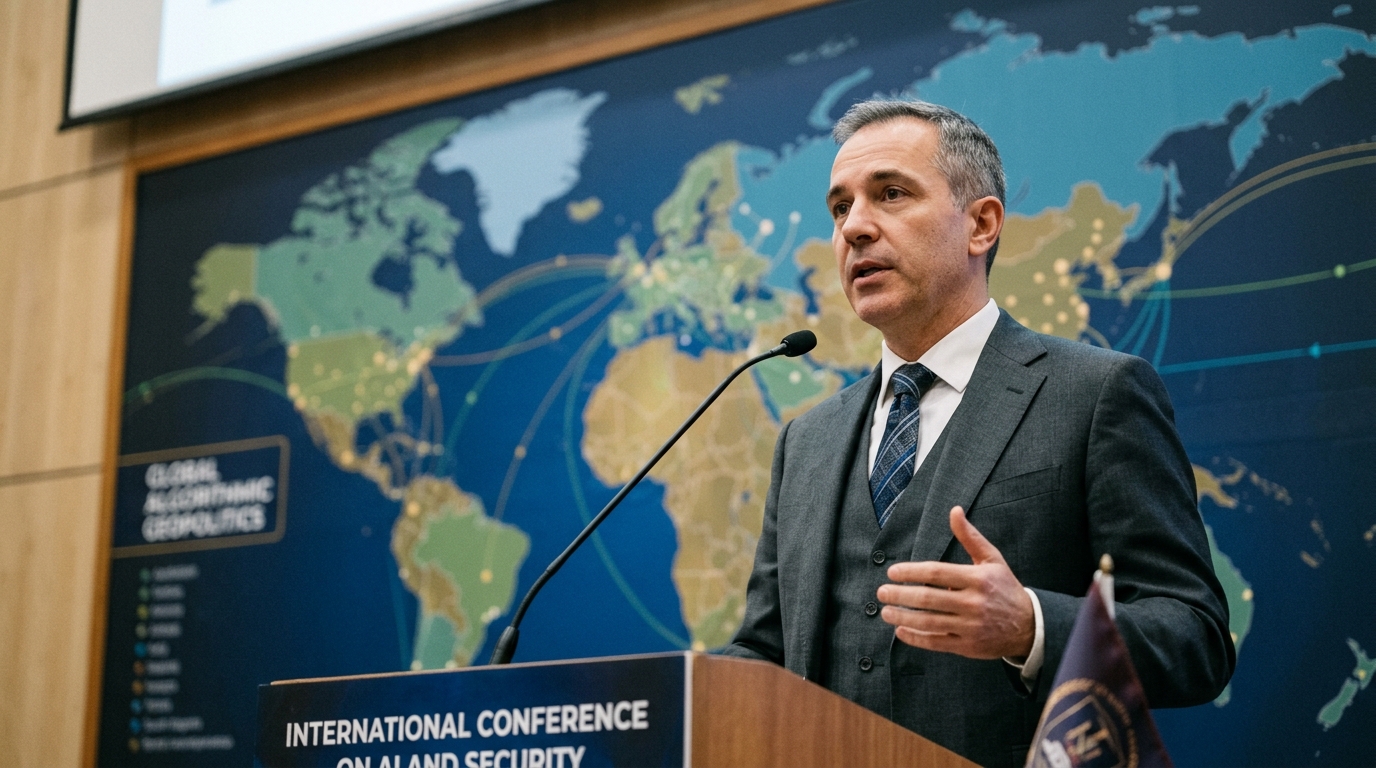
In an era where technological supremacy translates directly into political and military power, the statements made by CIA Director William Burns resonate through the corridors of global diplomacy with the intensity of a warning siren. By likening the evolution of Artificial Intelligence (AI) to the development of nuclear weapons during the Cold War, Burns is not merely engaging in rhetorical hyperbole; he is setting the stage for a new world order. This comparison suggests that AI is not just a productivity tool, but a "general-purpose technology" that will rearrange the balance of power, much as the splitting of the atom did in the mid-20th century.
The "Oppenheimer Moment" of Technology
The analogy to nuclear weapons focuses on three key pillars: deterrent power, speed of evolution, and the risk of total destruction. Just as the Manhattan Project changed the nature of warfare, the race for General Artificial Intelligence (AGI) is changing the nature of espionage and national security. The CIA Director emphasizes that a nation's ability to process vast amounts of data, predict adversary moves, and automate decision-making on the battlefield is the modern equivalent of a nuclear arsenal. The difference, however, lies in accessibility. While building an atomic bomb requires rare materials and massive industrial facilities, AI relies on code and computing power that, while expensive, are much harder to control through international treaties.
According to CIA analysis, we are at a tipping point where the "strategic ambiguity" of AI could lead to miscalculations. If an algorithm misinterprets a move in cyberspace as a precursor to a physical attack, escalation could be instantaneous and irreversible. This scenario echoes the darkest days of the Cuban Missile Crisis, with the difference that now the "red telephone" might not be fast enough to stop an autonomous algorithm.
Espionage and Counter-Intelligence on the Digital Chessboard
For the CIA, Artificial Intelligence is simultaneously the ultimate weapon and the ultimate threat. Burns points out that the use of AI in Open Source Intelligence (OSINT) analysis has already changed the way intelligence agencies operate. The ability to comb through billions of data points in real-time allows for the identification of patterns that the human mind would be unable to grasp. However, the same technology is being used by adversaries to create deepfakes and disinformation campaigns aimed at destabilizing democratic institutions. The comparison with nuclear weapons extends here as well: the spread of AI-driven disinformation can have "radioactive" consequences on the social fabric, poisoning public trust in governments for decades.
Furthermore, the field of counter-intelligence faces a new challenge. AI can be used to break traditional methods of agent cover by analyzing biometric data and digital footprints in a way that makes anonymity nearly impossible. In the world of intelligence, AI is the "all-seeing eye," and whoever possesses the most sophisticated algorithm holds the strategic advantage.
The Geopolitical Race: US vs. China
It is no secret that Burns' reference is primarily aimed at Beijing. China has set a national goal to become the global leader in AI by 2030, investing billions in research and development. The CIA views this effort as a direct challenge to American hegemony. If China manages to be the first to develop a "super-intelligence" that can bypass Western encryption or autonomously manage weapon systems, the balance of power will be permanently overturned. This competition is reminiscent of the Space Race, but with much higher stakes, as AI affects every aspect of the economy and society.
Europe, on the other hand, is trying to balance the need for innovation with the imposition of ethical barriers through the AI Act. However, Burns implies that in a world where AI is equated with nuclear weapons, ethical rules may take a backseat to the necessity of survival. "AI non-proliferation" is a concept being discussed more frequently, but its implementation remains an unsolved puzzle, as the lines between civilian and military use are extremely blurred.
Conclusion: Towards a New International Treaty?
The CIA Director's warning leads to an inevitable conclusion: the world urgently needs a governance framework for AI that resembles arms control treaties. Just as major powers agreed on rules to avoid nuclear catastrophe, a common code of ethics for the use of AI in international relations must now be found. The challenge is immense, as technology moves faster than bureaucracy and trust between global players is at its lowest point in years. Artificial Intelligence is humanity's new frontier, and how we cross it will determine whether we lead to a new era of prosperity or a digital catastrophe.





