

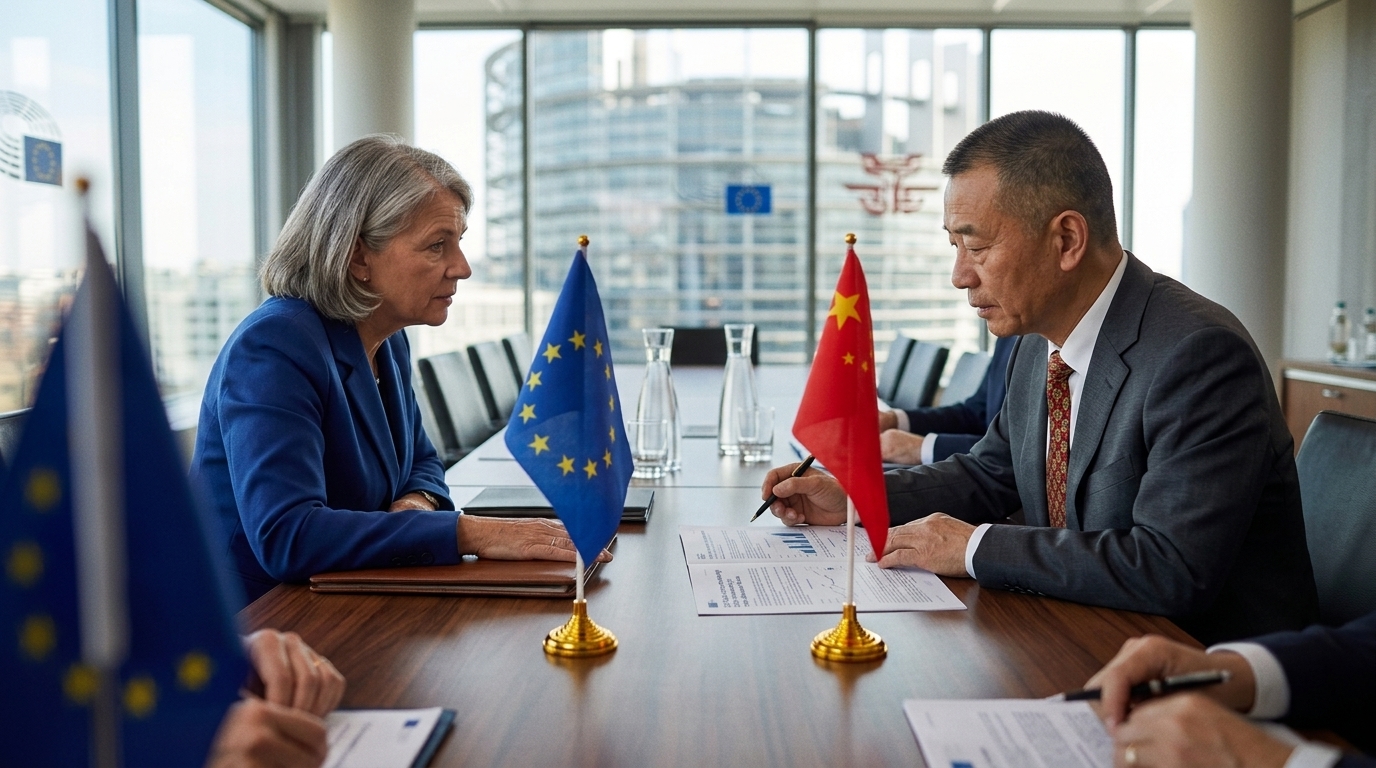
In a move signaling a shift towards pragmatism, the European Union and the People's Republic of China have announced the creation of a new, permanent consultation mechanism for trade and investment. This development, following months of intense negotiations and escalating tariff tensions, aims to institutionalize communication in critical areas such as export controls, intellectual property protection, and World Trade Organization (WTO) reform. At a time when the global economy seeks stability, this move by the two trading giants is interpreted as an effort to avoid an all-out trade war that would have disastrous consequences for the global supply chain.
The Anatomy of a New Relationship
The new mechanism is not merely a discussion forum but a structured process involving regular meetings at both technical and political levels. At its core is the need for transparency. Brussels has repeatedly voiced concerns over China's opaque state subsidies, particularly in the green energy and electric vehicle (EV) sectors. Conversely, Beijing views the Commission's "de-risking" strategy with suspicion, considering it a facade for protectionism.
The mechanism will operate through working groups focusing on specific friction points. For instance, the group on export controls will examine how restrictions on critical raw materials and cutting-edge technologies affect their respective markets. It is clear that the EU seeks to ensure that European companies in China do not face discrimination, while China wishes to maintain access to Europe's vast single market, especially as its relations with the US remain strained.
From De-risking to Cooperation
The concept of de-risking, introduced by Ursula von der Leyen, remains the central pillar of European strategy. However, the new mechanism shows that the EU recognizes that full decoupling from the Chinese economy is impossible and undesirable. European automakers, for example, are heavily dependent on the Chinese market and Chinese battery technology. This mechanism aspires to be the "pressure relief valve" during times of crisis.
"Stability in our trade relations with China is not a luxury; it is a necessity. The new mechanism allows us to discuss our differences before they escalate into tariff conflicts," said a European Commission source.
Furthermore, cooperation on WTO reform is vital. Both sides have a vested interest in a functional multilateral trading system, especially as protectionism gains ground globally. A joint commitment to strengthening WTO rules could send a powerful message to the international community.
Challenges and Geopolitical Background
Despite the positive outlook, the challenges remain immense. The geopolitical stage in 2026 is more complex than ever. China's stance towards Russia, tensions in the Taiwan Strait, and concerns over human rights in Xinjiang continue to cast a long shadow over economic relations. The EU is called to balance its economic needs with its values, an exercise that often causes internal friction among member states.
Moreover, competition in future technologies—such as AI and quantum computing—means that trade is no longer just a matter of profit, but also a matter of national security. The new mechanism must prove it can produce tangible results rather than just diplomatic niceties. Its success will be judged by whether it manages to reduce barriers for European investments in China and whether it curbs Beijing's aggressive trade practices.
Conclusions for the Future
The establishment of this mechanism is an admission that the era of unchecked globalization has ended, giving way to an era of "managed competition." For the EU, these developments have a direct impact on infrastructure and energy investments. The ability of Brussels and Beijing to keep communication channels open will largely determine the continent's economic path in the coming years. It is a difficult road, but perhaps the only one available to avoid global economic fragmentation.





