

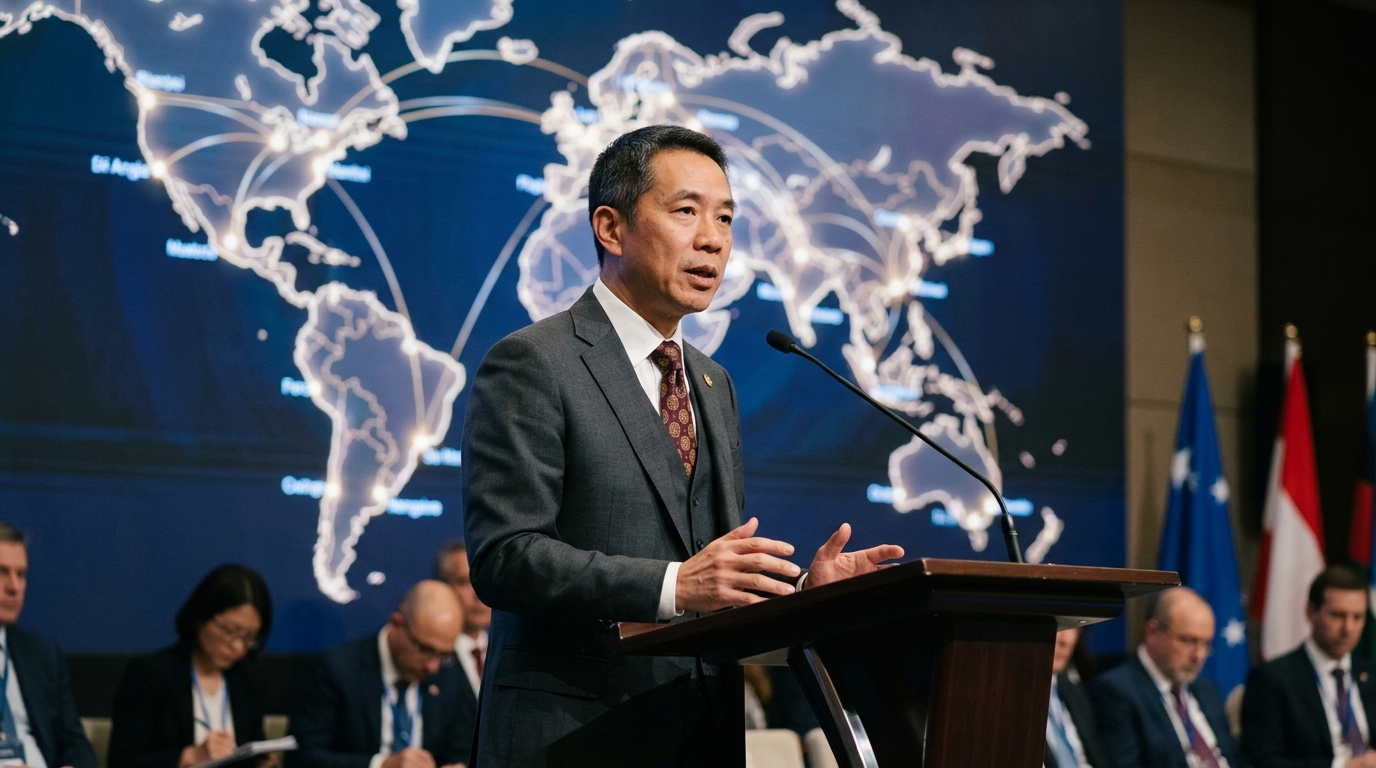
In the height of June 2026, the global geopolitical chessboard is being shaken by news that confirms China’s long-standing ambitions: the announcement of a colossal investment program worth $295 billion (approximately 2.1 trillion yuan) dedicated exclusively to Artificial Intelligence. This move is not merely a financial injection; it is a declaration of sovereignty in an era where digital power is synonymous with national survival.
This investment, channeled through state-led funds and public-private partnerships, aims to cover the entire spectrum of AI—from advanced semiconductor manufacturing and the creation of massive data centers to the development of domestic Large Language Models (LLMs) that can compete on equal terms with OpenAI’s GPT-5 and Google’s Gemini.
The Strategy of 'Digital Self-Reliance'
Beijing appears to have learned from the constraints imposed by the United States on high-tech chip exports. The new investment prioritizes the development of a domestic supply chain. Analysts suggest that a significant portion of these funds will be directed toward the RISC-V architecture, an open-source platform that allows China to design AI processors without relying on Western licenses from ARM or Intel.
- Development of domestic GPUs capable of training models with trillions of parameters.
- Investment in quantum computing to accelerate AI algorithms.
- Creation of 'smart cities' that serve as testbeds for autonomous driving and real-time resource management.
This move marks the end of an era where China was viewed simply as the world’s 'factory.' Now, it claims the role of the architect. The 'Made in China 2025' strategy is evolving into 'AI Sovereignty 2030,' aiming for total independence from Western technology.
Geopolitical Implications and the Global South
The $295 billion investment is not just about China's internal market. Beijing plans to export its expertise through the 'Digital Silk Road' initiative. By offering affordable AI infrastructure to countries across Asia, Africa, and Latin America, China is building an alternative digital ecosystem, far from the influence of Silicon Valley.
"This is no longer an arms race in the traditional sense, but a race to define the rules of 21st-century intelligence," states a senior official from China's Ministry of Industry and Information Technology.
However, challenges remain. The lack of access to the most sophisticated Extreme Ultraviolet (EUV) lithography machines from the Dutch company ASML remains a major hurdle. China is betting that raw financial power and its vast data pool—thanks to its population of 1.4 billion—will compensate for the technological gap in hardware manufacturing.
Social Restructuring and Ethical Dilemmas
Beyond economics, this investment aims at social stability. AI is being integrated into the Social Credit System and healthcare. While Western debates on AI often focus on privacy protection, China emphasizes collective efficiency and state security. Mass automation of production is also critical, as the country faces a shrinking demographic. AI is expected to fill the labor gap, ensuring China remains the world’s manufacturing powerhouse.





