

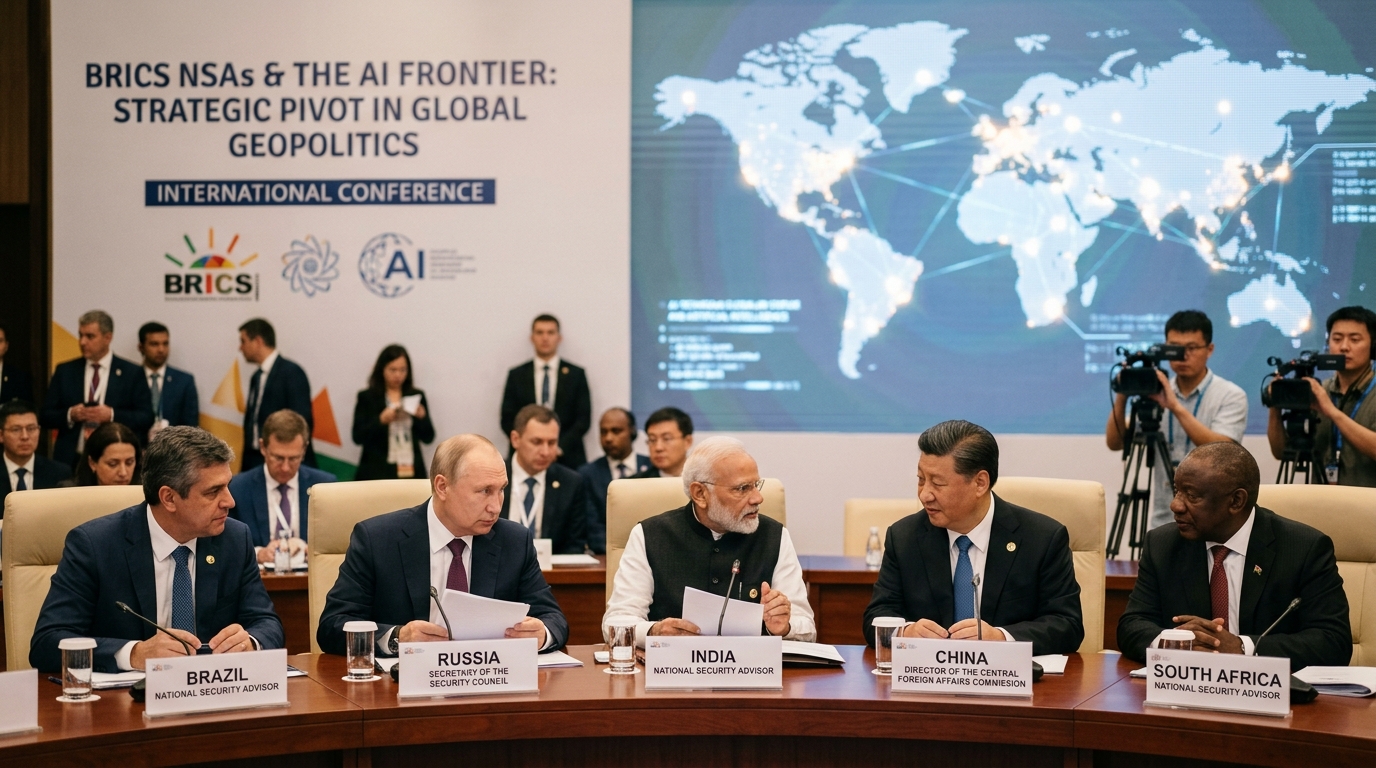
In an era where digital sovereignty is becoming as critical as territorial integrity, the recent gathering of National Security Advisors (NSAs) from the BRICS nations marks a significant historical pivot. As the world transitions toward a multipolar reality, Artificial Intelligence (AI) is no longer merely a tool for economic growth; it has become the central battlefield of a new geopolitical confrontation. The meeting, held against a backdrop of mounting tensions between the West and the 'Global South,' focused on the urgent need for a collective framework to address the existential and strategic risks posed by the unbridled development of AI.
Technological Sovereignty in the Age of AI
The expansion of BRICS, now including influential players like the UAE, Egypt, and Iran, has injected a fresh dynamic into the bloc. The NSAs collectively recognized that over-reliance on Western-controlled technological platforms and proprietary algorithms poses a fundamental threat to national security. The deliberations went beyond traditional cybersecurity, touching upon 'cognitive security'—the defense of societies against foreign-led disinformation campaigns and the manipulation of public discourse through deepfakes and generative AI models.
For China and Russia, AI is the strategic key to dismantling American technological hegemony. India, conversely, seeks to navigate a complex path, leveraging its status as a global tech powerhouse while demanding robust regulatory frameworks to protect the data of its 1.4 billion citizens. The convergence of these diverse interests under the BRICS banner suggests a concerted effort to establish a new set of rules for the AI era, directly challenging the dominance of the G7 and the Silicon Valley monopolies.
The Spectrum of Threats: From Autonomous Weapons to Cyber-Terrorism
A primary focus of the agenda was the weaponization of AI. The proliferation of Lethal Autonomous Weapons Systems (LAWS) remains a profound concern, as the lack of a global consensus on their regulation could trigger an unprecedented arms race. The BRICS NSAs emphasized that AI capabilities could be harnessed by non-state actors and terrorist organizations to launch precision cyber-attacks against critical infrastructure, such as power grids, water supplies, and financial networks.
"Artificial Intelligence is the nuclear weapon of the 21st century. Those who control the algorithms will dictate the future of the international order," a senior official noted during the sessions.
Furthermore, the discussion highlighted the necessity of building 'secure and resilient supply chains' for semiconductors. The U.S.-led efforts to restrict China's access to high-end chip technology have accelerated the drive within BRICS to seek alternative manufacturing hubs and foster intra-bloc cooperation in R&D, aiming for a self-sufficient technological ecosystem.
Defining a Non-Western AI Governance Model
The BRICS meeting was not just a defensive posture; it was an attempt to articulate an alternative narrative for the future of technology. While the European Union prioritizes human rights through the AI Act, and the United States focuses on market-led innovation, BRICS is promoting a model that emphasizes state sovereignty and social stability. This approach often prioritizes Digital Public Infrastructure (DPI) that remains under national jurisdiction rather than the control of multinational corporations.
In conclusion, the mobilization of BRICS National Security Advisors signals that AI has matured into a top-tier diplomatic and security issue. The ability of these nations to synchronize their policies, despite their internal geopolitical frictions, will determine whether the world descends into a 'Digital Cold War' or moves toward a more balanced global governance structure. What is certain is that the period of Western unilateralism in setting the standards for technological evolution is coming to an end. The Global South is no longer just a consumer of technology; it is demanding a seat at the table where the codes of the future are written.




