

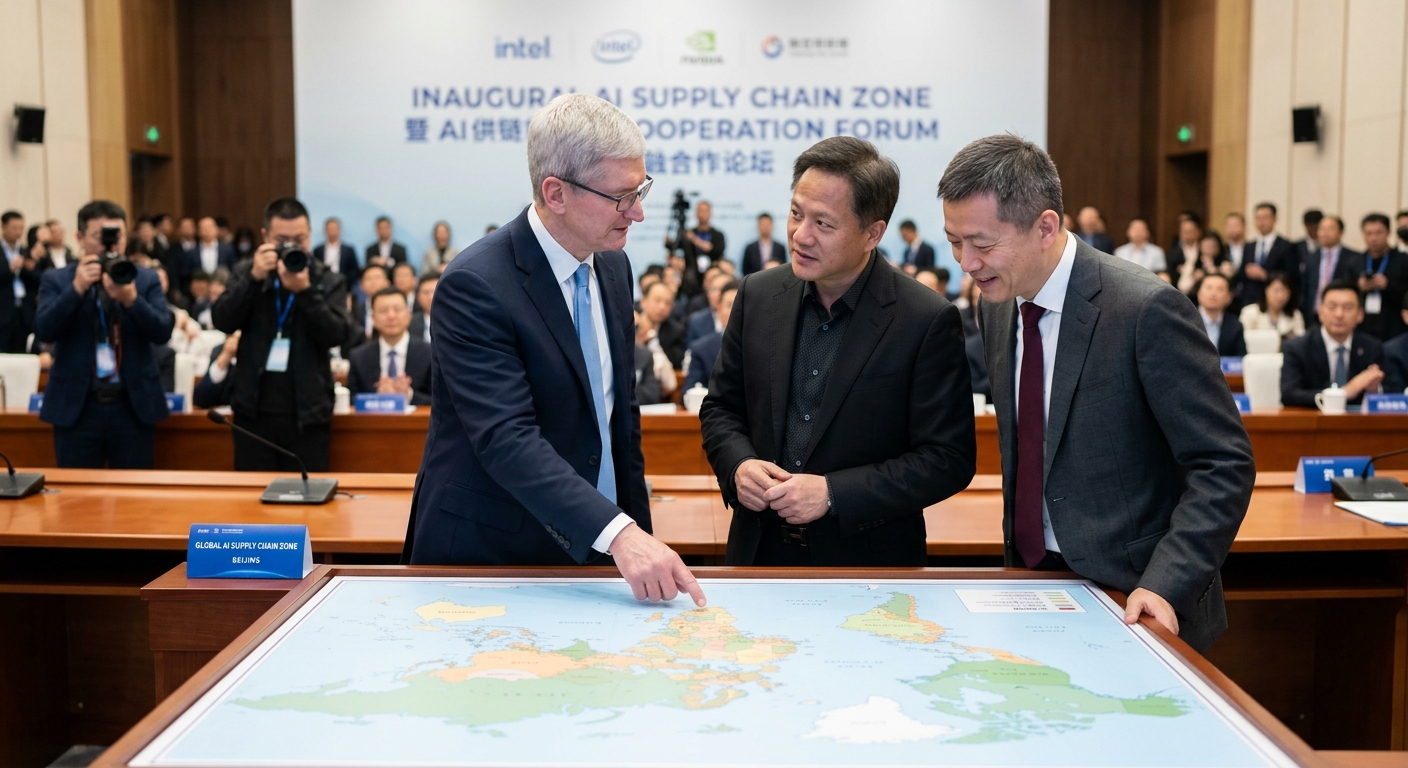
In the heart of Beijing, where political power intersects with technological ambition, the China International Supply Chain Expo (CISCE) has marked a historic turning point this year. For the first time, the expo inaugurated a dedicated "AI Zone," which served not merely as a showcase for local innovations but as a meeting ground for the industry’s fiercest rivals. The simultaneous presence of Nvidia and Intel alongside Chinese giant Alibaba sends a resounding message: the global AI supply chain is far too deeply interconnected to be severed by political decrees.
AI as the New Backbone of Global Manufacturing
The creation of the AI Zone at CISCE is no coincidence. As we move through 2026, artificial intelligence has ceased to be an experimental tool and has transformed into the central nervous system of global production. From demand forecasting to fully automated warehouse management, AI now determines who remains competitive in international trade. The participation of Nvidia, despite the stringent export controls imposed by Washington, proves that the Chinese market remains an indispensable pillar for the revenues of American semiconductor companies.
- Nvidia showcased AI solutions tailored to local regulatory requirements, focusing on supply chain network optimization.
- Intel focused on integrating AI into industrial environments (Industrial AI), promoting its new chips for edge computing.
- Alibaba Cloud presented its upgraded Tongyi Qianwen model, which is already being utilized by thousands of Chinese enterprises to automate logistics.
This convergence highlights a paradoxical reality. While governments speak of "de-risking" and "decoupling," the companies themselves are searching for ways to build bridges. The AI supply chain is not a linear path but a complex web where American design meets Chinese manufacturing scale and application.
The Geopolitical Chessboard: Between Sanctions and Cooperation
The presence of Nvidia and Intel at the Beijing expo occurs at a time when the US has intensified export controls on advanced chips to China. However, the strategy of US tech giants appears to be "compliance through adaptation." By creating product versions that fall just below the restriction thresholds, they maintain their footprint in the world's second-largest economy.
"Technology knows no borders, but politics tries to impose passports on it. At the end of the day, supply chain efficiency will triumph over ideology," a senior expo official stated during the opening ceremony.
For its part, China is using the CISCE to project itself not just as the "factory of the world," but as the "brain of the world." Alibaba, acting as the domestic champion, demonstrates how AI can reduce shipping costs and increase delivery speeds globally, making Chinese platforms indispensable to global commerce.
The Challenge of Autonomy and Dependence
Despite the glitz of the expo, the tension remains subterranean. China is investing billions in developing its own semiconductors through companies like Huawei and SMIC, seeking full self-sufficiency. The AI Zone at CISCE thus serves as a reminder to the West: if American companies withdraw, the vacuum will be swiftly filled by state-backed domestic players.
The participation of Nvidia and Intel is, therefore, a move of self-preservation. If they lose contact with the Chinese AI ecosystem, they risk losing their ability to influence global technological standards. The supply chain of the future will be hybrid, and the first AI Zone in Beijing is the living proof of this new, albeit fragile, equilibrium.





