

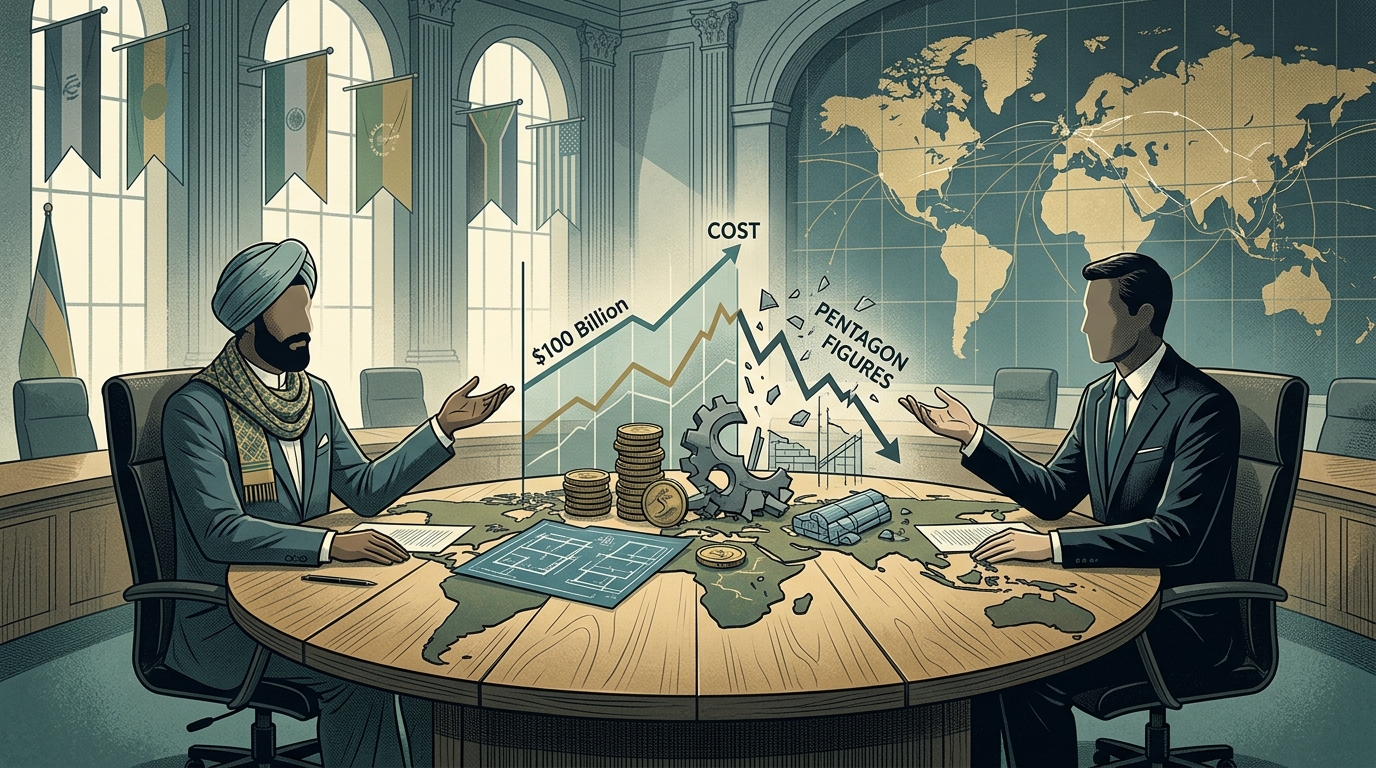
In a period where the Middle East resembles a powder keg ready to ignite, Iranian Foreign Minister Abbas Araghchi has chosen to shift the conflict from the battlefield to the realm of economic accounting. In a resonant intervention, the head of Iranian diplomacy claimed that the Pentagon and the U.S. government are systematically underestimating the true cost of their involvement in regional conflicts, placing the figure at a staggering $100 billion.
The Arithmetic of Conflict and Tehran's Rhetoric
Araghchi, a career diplomat well-versed in Western political parlance, did not limit himself to vague accusations. According to him, U.S. aid to Israel, which officially hovers around a few billion dollars annually, is merely the tip of the iceberg. "American taxpayers need to know where their money is going," he stated, implying that the costs of military deployments, heightened readiness in the Red Sea, and supplemental arms packages have sent the total bill skyrocketing.
Iran's strategy is clear: it is targeting the U.S. domestic public opinion. In an era where American society is deeply polarized and the economy is the primary concern for voters, highlighting the "cost of war" serves as a potent soft power tool. Araghchi seeks to create friction in the Washington-Tel Aviv alliance by presenting it as a financial hemorrhage that deprives resources from U.S. domestic development.
The Pentagon Under Pressure: Transparency vs. National Security
For its part, the Pentagon maintains that support for Israel is an investment in regional stability and the deterrence of a broader war. However, Araghchi's claims add to a growing chorus of criticism within Congress, where some lawmakers are demanding greater transparency in spending. The gap between the $3.8 billion in regular annual aid and the $100 billion cited by the Iranian Foreign Minister is vast, but the truth may lie somewhere in the middle when indirect costs are factored in.
- The cost of Operation Prosperity Guardian in the Red Sea.
- The deployment of aircraft carriers and troops to the region.
- The replenishment of ammunition stocks depleted by Israeli operations.
These "hidden" costs are what Araghchi is attempting to capitalize on politically. His references to Benjamin Netanyahu and the Trump administration (referring to the legacy of the "maximum pressure" policy) indicate that Tehran is trying to influence the political climate in the U.S. by framing current policy as a disastrous economic choice.
Geopolitical Implications and the 'Battle of Narratives'
Araghchi's intervention is not merely an economic observation but a piece of psychological warfare. At a time when Iran faces its own severe economic challenges due to sanctions, the attempt to flip the narrative and present the U.S. as the "economically defeated" party in the crisis is noteworthy. As regional tensions persist, the control of information and the interpretation of numbers become just as critical as missiles and drones.
"The cost of war is not measured only in blood, but also in the prosperity sacrificed on the altar of hegemony," appears to be Tehran's message to the West.
In conclusion, Abbas Araghchi's statement serves as a reminder that in modern geopolitics, spreadsheets are often as lethal as weapons. Whether the $100 billion figure is accurate or a product of propaganda, the debate over the economic price of U.S. foreign policy in the Middle East is wide open, and Iran intends to keep it high on the agenda.




