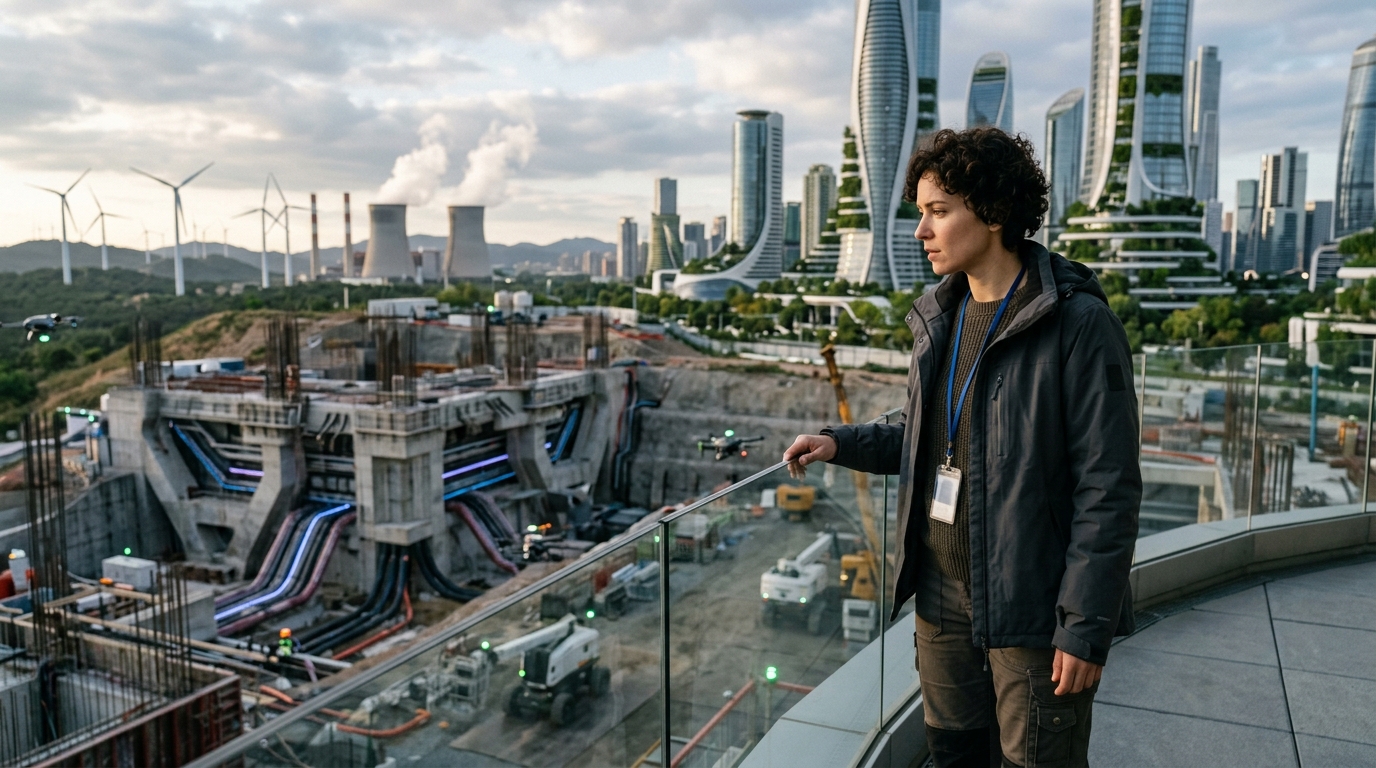
By mid-2026, the promise of Artificial Intelligence (AI) as a "dematerialized" tool destined to solve humanity’s woes has fractured against the unyielding reality of physics. As large language models and autonomous agents become foundational to the global economy, their material footprint—massive data center complexes consuming gigawatts of power—reveals a profound contradiction. The "Thermodynamics of Capital," a term linking economic accumulation with increasing entropy, has moved to the center of political and ecological discourse.
The Myth of Dematerialization
For decades, the digital economy was marketed as a "clean" alternative to heavy industry. However, AI is the most energy-intensive technology ever devised by humanity in peacetime. Every query posed to an advanced AI model is not merely a mathematical operation; it is a thermodynamic process that converts electricity into heat. According to recent studies, training a single next-generation model now requires as much energy as a small European city consumes in an entire year.
The problem extends beyond electricity. Cooling these "digital brains" requires millions of liters of fresh water, often in regions already suffering from water scarcity. Instead of dematerializing production, AI intensifies it, demanding more minerals, more silicon, and more energy than ever before. What we are witnessing is the application of the law of entropy to economics: the order that AI creates in information leads to a corresponding (or greater) disorder in the physical environment.
The Jevons Paradox and AI
One of the most concerning phenomena is the "Jevons Paradox." History teaches us that as the use of a resource becomes more efficient, the total consumption of that resource actually increases. Tech giants argue that AI will make factories and grids more efficient, thereby reducing emissions. However, the very efficiency of AI makes it so useful that its application expands everywhere, leading to a net increase in energy demand that cancels out any efficiency gains.
- Data center demand is projected to triple by 2030.
- Water usage for server cooling threatens local ecosystems in the US and Europe.
- The mining of rare earth elements for AI chips causes geopolitical tensions and ecological destruction in the Global South.
Capitalism and Entropy
The logic of capital requires constant expansion. AI is the ultimate engine of this expansion, accelerating the cycle of production and consumption. Yet, on a finite planet, perpetual growth crashes into the laws of thermodynamics. The accumulation of "digital capital" translates into ecological debt. Big Tech promises "net-zero" through carbon credit schemes, but physics is not deceived by accounting tricks. The heat dissipated and the resources extracted are real and irreversible.
"We cannot have infinite digital intelligence on a finite biological base without triggering the collapse of the latter," notes an analysis from Countercurrents.
The challenge for 2026 and beyond is decoupling technological progress from energy waste. We require an "Ecological AI" that operates within planetary boundaries, perhaps sacrificing speed and ubiquity for the sake of sustainability. Unless we change the economic model that drives AI toward unbridled consumption, the "intelligence" we are building will be the accelerator of our own obsolescence.