

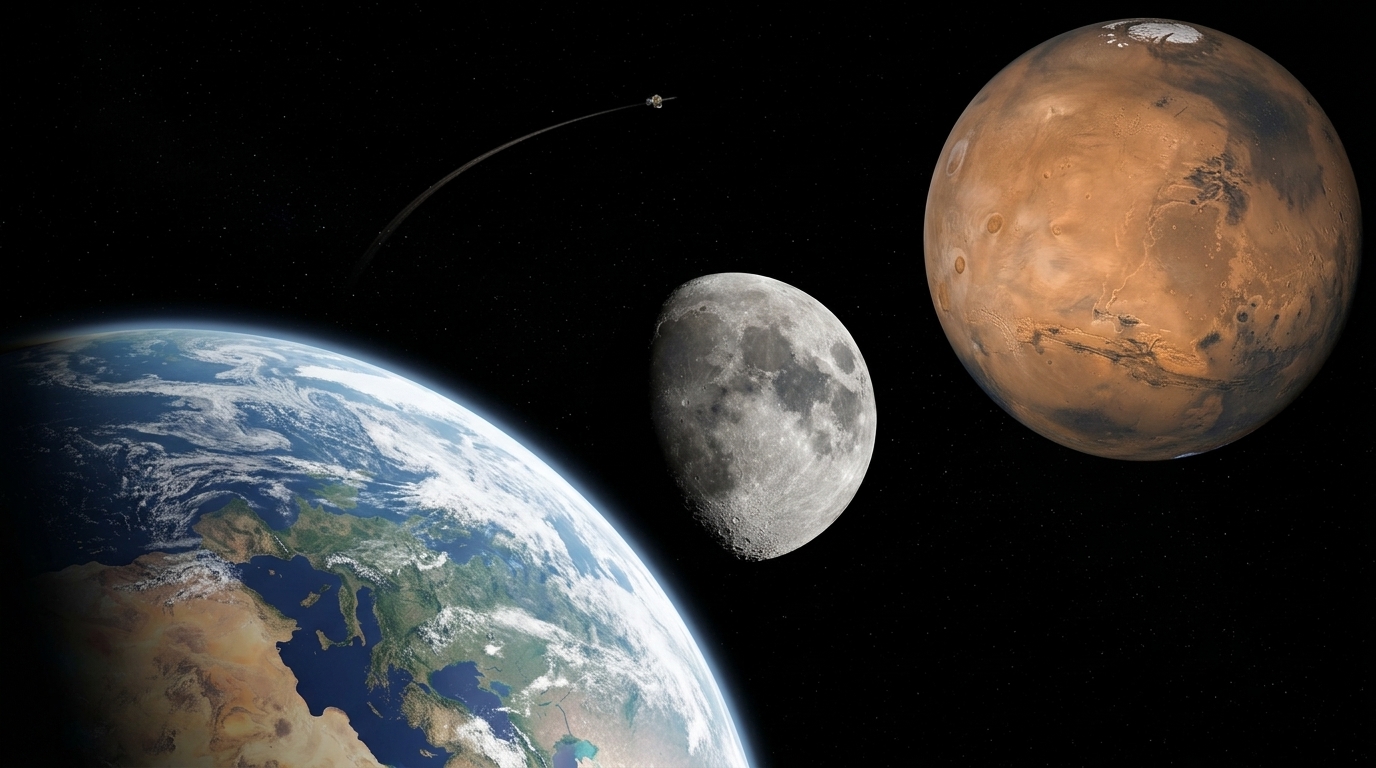
The conquest of Mars is the "Holy Grail" of modern aerospace. From the era of Wernher von Braun to the modern ambitions of Elon Musk, humanity has dreamed of setting foot on the Red Planet. However, the greatest obstacle has never been just rocket technology, but the relentless physics of celestial bodies and time. Using traditional methods, a trip to Mars requires about nine months of transit, a stay on the planet for at least a year and a half until the planets realign, and another nine months to return. In total, a mission of two to three years. A new study, however, is set to overturn these data, proposing a round-trip "flight" lasting just five months.
The Physics of Speed: Beyond the Hohmann Transfer
For decades, space mission design has relied on the Hohmann transfer orbit. This is the most energy-efficient route, where a spacecraft uses gravity to "glide" from Earth's orbit to that of Mars. The price of this fuel economy is time. Researchers who published the new study argue that by using advanced propulsion systems – such as Nuclear Thermal Propulsion (NTP) – and selecting specific timing windows, we can abandon passive cruising in favor of continuous acceleration.
The new approach is not based solely on engine power, but also on a deeper understanding of gravitational interactions. Instead of waiting for the ideal alignment every 26 months, the proposed route uses higher velocities that allow the craft to "cut corners" through the solar system. This requires massive amounts of energy, but the benefits for crew safety are immeasurable.
The Human Factor: Less Radiation, Better Health
Why is reducing travel time so important? The answer lies in biology. Deep space is a hostile environment filled with cosmic radiation and solar particles. The more time an astronaut spends outside Earth's protective magnetosphere, the higher the risk of cancer, genetic mutations, and damage to the central nervous system. Furthermore, prolonged stays in microgravity conditions cause severe bone density loss and muscle atrophy.
A five-month total mission duration (including return) would mean that astronauts would be exposed to a fraction of the radiation they would receive in a traditional mission. Additionally, the psychological effects of confinement in a limited space for years is a factor that is often underestimated. The possibility of a "quick" visit to Mars transforms the mission from a survival ordeal into a manageable scientific operation.
Space Geopolitics and the Role of Technology
This announcement comes at a time when the competition for space dominance is heating up. NASA, through the Artemis program, aims for the Moon as a stepping stone, while China is developing its own plans for manned missions to Mars in the 2030s. The ability to reduce travel time changes the strategic balance. Whichever power manages to first develop nuclear propulsion technology will have the advantage of "rapid response" in space.
- Nuclear Thermal Propulsion: Using a nuclear reactor to heat liquid hydrogen.
- Reduced Logistic Load: Less food and supplies needed due to shorter duration.
- Mission Frequency: More launch windows per decade.
In conclusion, the prospect of a five-month trip to Mars is no longer a science fiction scenario, but a mathematically feasible goal. It requires, of course, political will, massive investment, and the acceptance of a certain risk regarding the use of nuclear energy in spacecraft. But if humanity truly wants to become a multi-planetary species, it must learn to run before it gets exhausted by the long walk into the void.




