In the high-stakes world of professional sports, few things ignite more controversy than a missed call in the dying seconds of a championship game. Adam Silver, the tech-forward Commissioner of the NBA, appears determined to mitigate this human fallibility. His vision isn't to replace referees with robots, but to augment them with the most sophisticated Artificial Intelligence tools ever seen on a basketball court. This move is more than a technical upgrade; it is a fundamental reimagining of justice within the lines of the hardwood.
The Technology Behind the Whistle
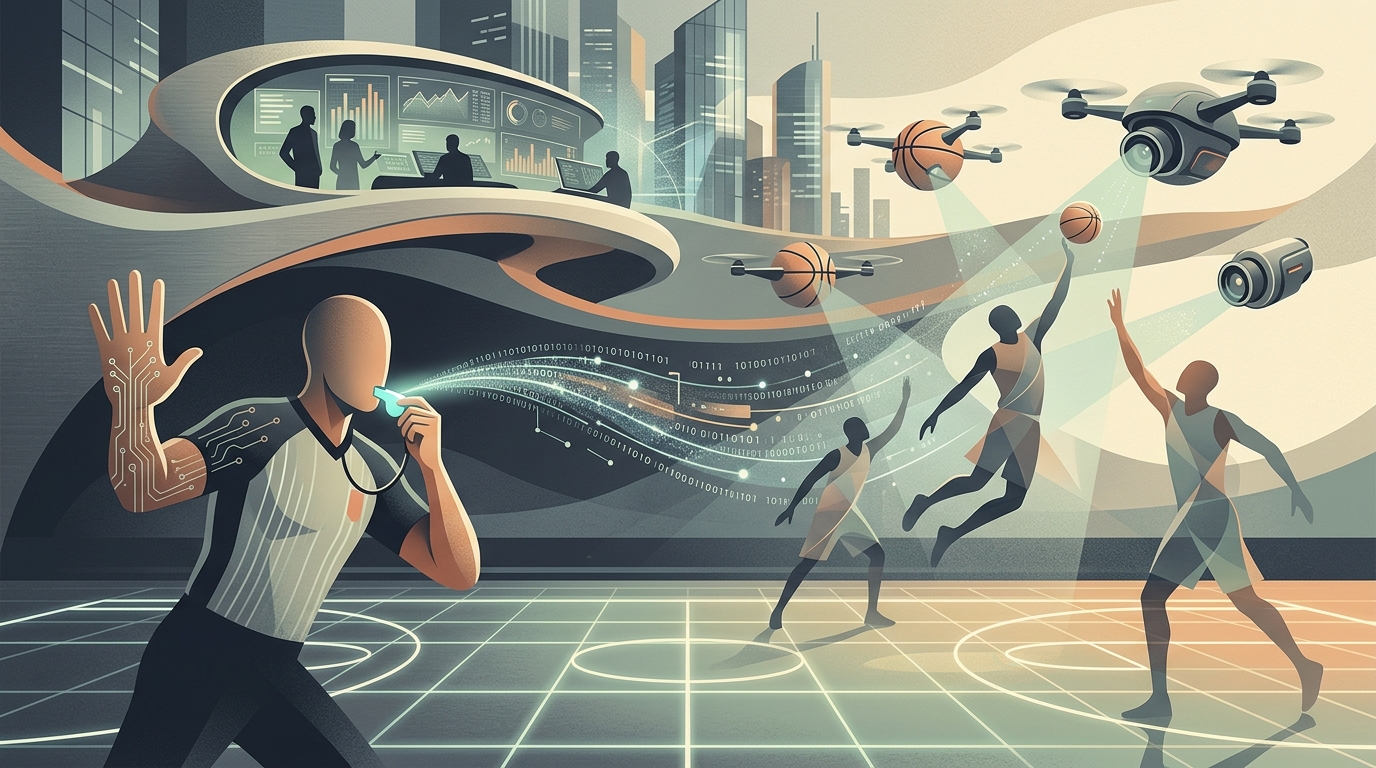
The integration of AI into officiating relies on a dense network of high-speed cameras and optical tracking sensors that monitor every square inch of the arena. These systems, already utilized for high-level analytics and player tracking, are now being trained to detect violations in real-time. From traveling and three-second violations to the often-contentious out-of-bounds calls, AI offers a level of precision that the human eye simply cannot match.
The NBA is collaborating with leading tech firms to develop algorithms capable of analyzing a defender's verticality or the exact moment of contact during a drive to the basket in milliseconds. What distinguishes Silver’s approach is the pursuit of 'seamless officiating.' The goal is not to halt the game for lengthy monitor reviews, but to provide immediate feedback to officials via earpieces or haptic wristbands, ensuring the game’s flow remains uninterrupted.
The Challenge of Judgment and Human Intuition
Despite technical superiority, basketball remains a sport heavily reliant on subjective judgment. Defining 'incidental contact' or distinguishing between a blocking foul and a charge is where the greatest challenge for AI lies. Critics argue that an over-reliance on AI could 'sterilize' the game, penalizing physical play that is an inherent part of the sport’s competitive spirit.
"Our goal isn't to have robots on the floor, but to ensure the humans making the decisions have the best possible data at their fingertips," Silver recently stated.
The NBA's strategy involves a transition period where the AI operates as a 'shadow system.' Its decisions are logged and compared against human calls, allowing the machine learning models to grasp the nuances of the game’s context. This iterative process is crucial for gaining the trust of players and coaches, who frequently voice frustrations over officiating inconsistency. If the AI can prove it 'understands' the spirit of the game, resistance may fade.
Economic and Strategic Implications
Beyond the court, the introduction of AI has massive economic ramifications. The integrity of the game is the bedrock of the sports betting industry, which is now deeply intertwined with the NBA’s commercial ecosystem. Flawless officiating reduces the risk of scandal and bolsters investor and fan confidence. Furthermore, the data generated by officiating AI can be monetized through new fan engagement tools, such as Augmented Reality (AR) overlays that explain complex calls to viewers in real-time.
However, there is also a social dimension. Officiating is an art that involves managing personalities and emotions. A veteran referee often knows when to 'let them play' to maintain the rhythm or how to de-escalate a situation with a superstar. AI lacks this empathy. The future of the NBA under Silver’s guidance will be a constant balancing act between mathematical perfection and the inherently messy human nature of sports.
Conclusion: A New Era for the Hardwood
Adam Silver’s initiative places the NBA at the vanguard of sports technology. While other sports, such as football with VAR, continue to struggle with the efficiency of technological interventions, the NBA is aiming for a fully integrated, low-latency solution. If this experiment succeeds, it will redefine not just basketball, but the standard for every professional league globally. Artificial Intelligence isn't coming to take the whistle away; it’s coming to make it fairer, faster, and ultimately, beyond reproach.