

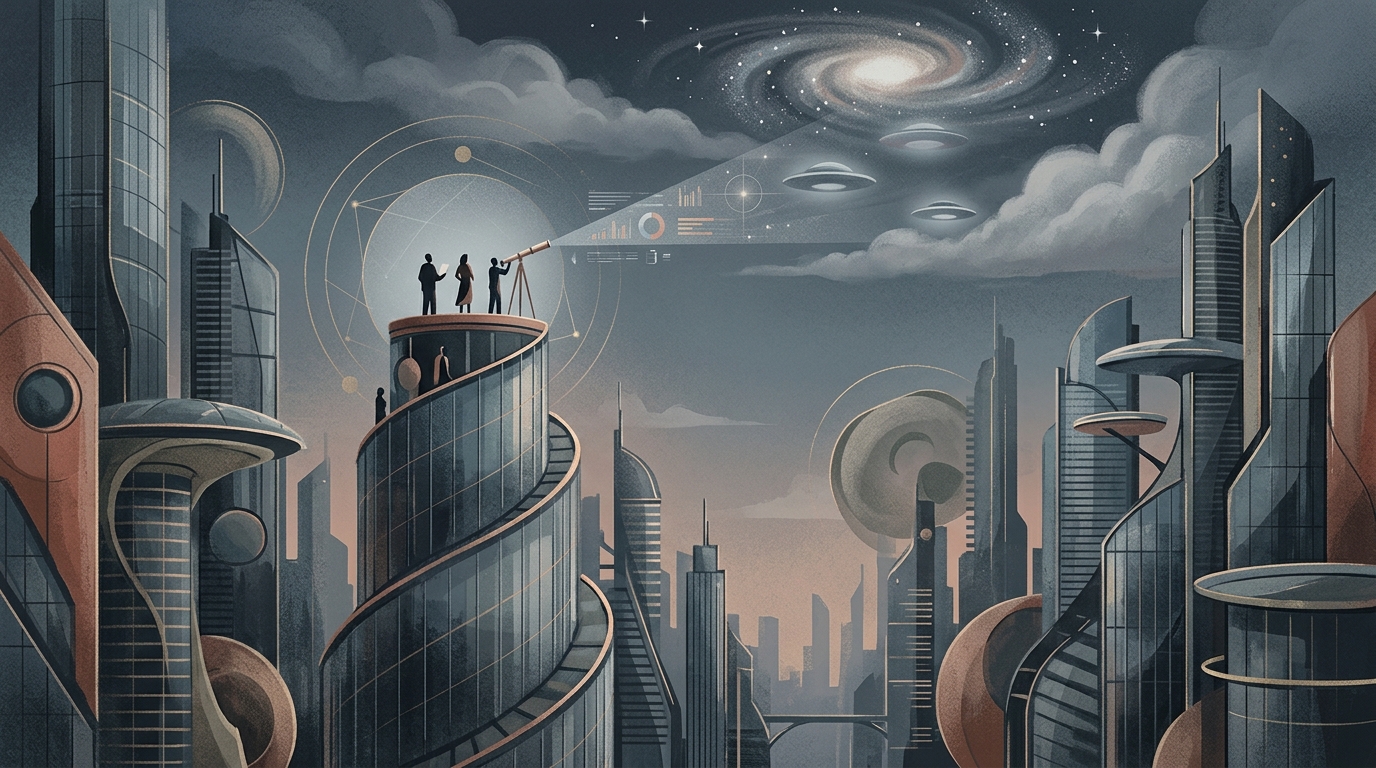
Humanity has always been on a persistent quest to answer the fundamental question: are we alone in the universe? For decades, the subject of UFOs (Unidentified Flying Objects) belonged to the realm of science fiction and conspiracy theories. However, recent statements by NASA officials and collaborators, including billionaire astronaut Jared Isaacman, signal a historic shift. The change in terminology from UFO to UAP (Unidentified Anomalous Phenomena) is not merely a linguistic adjustment, but a concerted effort by the scientific community to shed the stigma and study these phenomena using strictly empirical methods.
The New Transparency and the Science of UAPs
NASA has now established dedicated study groups for UAPs, acknowledging that there is data that cannot be explained by our current aerodynamic or meteorological knowledge. Jared Isaacman, who commanded the Polaris Dawn mission, has confirmed that there are recorded images and videos that challenge our understanding of physics. These objects demonstrate speeds and maneuvers that exceed the capabilities of any known human aircraft, often without visible means of propulsion or thermal signatures.
NASA's approach is now rooted in the use of advanced sensors and artificial intelligence. Instead of relying on grainy eyewitness accounts, the agency is aggregating data from satellites, radar, and infrared sensors. The goal is to create a comprehensive database that will allow scientists to distinguish between natural phenomena, classified military tests, and something truly "extraneous." The admission that "there are things out there we don't understand" represents the first step toward a new era of astrophysical research.
The Statistical Probability of Life in the Universe
Beyond the mysterious objects in our atmosphere, NASA is moving toward an even bolder claim: life likely exists everywhere in the universe. This belief is not based on mere speculation but on the recent discoveries made by the James Webb and Kepler telescopes. We have now confirmed the existence of thousands of exoplanets, many of which reside in the "habitable zone" of their stars, where water can exist in liquid form.
NASA Administrator Bill Nelson has repeatedly stated that in a universe with billions of galaxies, each containing billions of stars, the mathematical probability of Earth being the only planet to host life is nearly zero. Research is no longer focused on "if" life exists, but on "where" and "what kind." From the icy oceans of Europa (Jupiter's moon) to the atmospheres of distant "super-Earths," the search for biosignatures—chemical traces indicative of biological activity—is the top priority of modern astrobiology.
Challenges of Verification and Social Impact
Despite the excitement, the scientific community remains cautious. The gap between "probability" and "proof" is vast. Analyzing UAP data often hits roadblocks due to national security concerns, as much of the data originates from military sources that remain classified. However, the pressure for transparency is mounting, both from the US Congress and the international public.
The potential discovery of extraterrestrial life, whether microbial or an advanced civilization, would constitute the greatest ontological shock in human history. We would be forced to redefine our place in the cosmos, our religions, our philosophies, and our politics. NASA is laying the groundwork for this possibility by investing in programs that study the societal implications of such a revelation. The transition from anthropocentrism to a cosmocentric worldview is perhaps the greatest challenge humanity will face in the 21st century.
Conclusion: Toward a New Cosmic Consciousness
NASA's admission that UAPs are a real phenomenon worthy of scientific study, combined with growing optimism regarding the discovery of life in the cosmos, paves a new path for science. It is no longer a ghost hunt, but a systematic effort to understand the vast and often strange environment we inhabit. Whether the objects we witness are advanced technology, natural paradoxes, or something beyond our current imagination, the truth is out there, and for the first time, we have the tools to seek it with rigor and seriousness.




