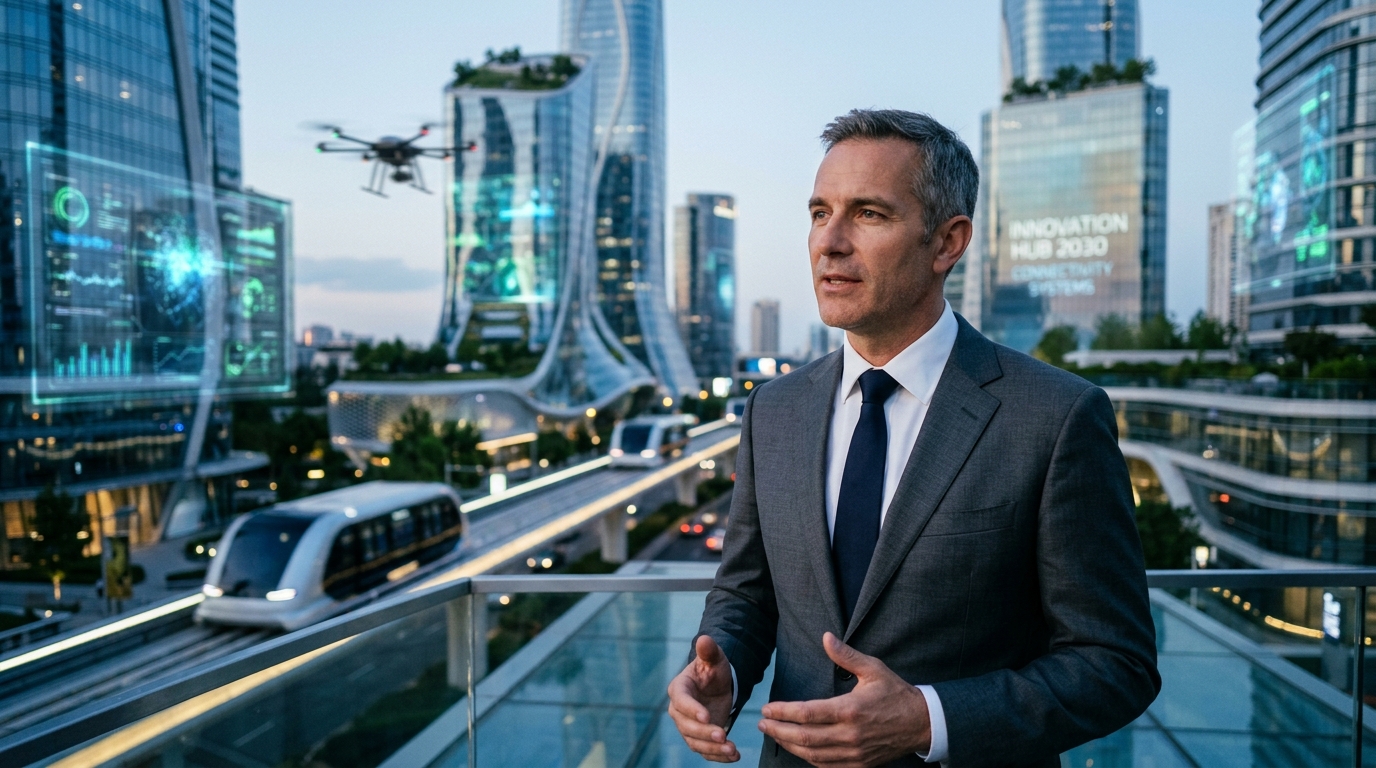
In the historic region of Thermopylae, where the fate of Western civilization was once decided, the Thermopylae Forum 2026 became the stage for a different kind of revelation—a technological one. The keynote speaker, George Karagiannidis, Professor of Digital Communications Systems at the Aristotle University of Thessaloniki and one of the world's most cited scientists in his field, presented a roadmap for a future that transcends the limits of our current imagination. 6G is not merely a faster version of 5G; it is the connective tissue of a new reality where Artificial Intelligence (AI) and physical infrastructure become one.
The Transition to 6G: More Than Speed, a New Perception
During his address, Professor Karagiannidis emphasized that the transition from 5G to 6G, expected to materialize around 2030, is not just about increasing bandwidth. While 5G brought the Internet of Things (IoT) into our daily lives, 6G will usher in the "Internet of Intelligence." The use of Terahertz (THz) waves will enable data speeds reaching 1 Terabit per second, but the true revolution lies in the elimination of latency. In a 6G network, response times will be near-instantaneous, a prerequisite for the full automation of critical systems.
The professor explained that 6G will function as a massive "sensory organ." Networks will not only carry data but will also be able to "sense" the environment, identifying the position of objects and people with centimeter-level precision without the need for GPS. This capability, known as Integrated Sensing and Communication (ISAC), is the key to safety in the future of transportation.
Artificial Intelligence: The Brain of the Network
One of the most compelling points of Karagiannidis's analysis was the role of Artificial Intelligence. Unlike previous generations, 6G is being designed as "AI-native." This means that AI will not be an application running on top of the network but a fundamental building block of its architecture. The network will self-optimize, predict user needs, and manage resources in ways that no human programming could achieve.
"AI in 6G is no longer a tool; it is the very essence of communication. We are talking about networks that think, adapt, and protect the user in real-time," the professor noted.
This intelligence will enable the creation of "Digital Twins" of entire cities. Every vehicle, every traffic light, and every pedestrian will have a digital representation in the network, allowing the system to simulate risk scenarios and prevent accidents before they even occur.
The Future of Transport: Autonomy and Safety
Focusing on transportation, Karagiannidis described a world where human error—the primary cause of traffic accidents today—will be virtually eliminated. Autonomous vehicles will communicate with each other (V2V) and with infrastructure (V2I) at such speeds that intersections may no longer require traffic lights. Traffic flow will resemble the flow of blood through arteries: continuous, efficient, and perfectly coordinated.
- Autonomous Platooning: Trucks moving in tight formations, reducing air resistance and fuel consumption through synchronized movement.
- Urban Mobility: Flying taxis (eVTOLs) managed by the 6G network, ensuring that air collisions are physically impossible through automated coordination.
- Logistics: Fully automated ports and warehouses where AI directs goods with zero downtime or wasted energy.
Greece on the Global Innovation Map
Concluding his speech, George Karagiannidis sent a message of optimism for Greece. With the research potential available in the country, particularly in institutions like the Aristotle University, Greece is not just a spectator of developments but a co-shaper of 6G standards. The Thermopylae Forum highlighted the need for infrastructure investment and the creation of an ecosystem that will retain young scientists within the country.
However, challenges remain. The energy consumption of these new networks and the necessity for absolute cybersecurity are issues that must be addressed. 6G promises a world without boundaries, but its success will be judged by how human-centric it remains. Technology, as the professor reminded the audience, must always serve humanity and its quality of life, transforming transportation from a stressful necessity into an experience of freedom.