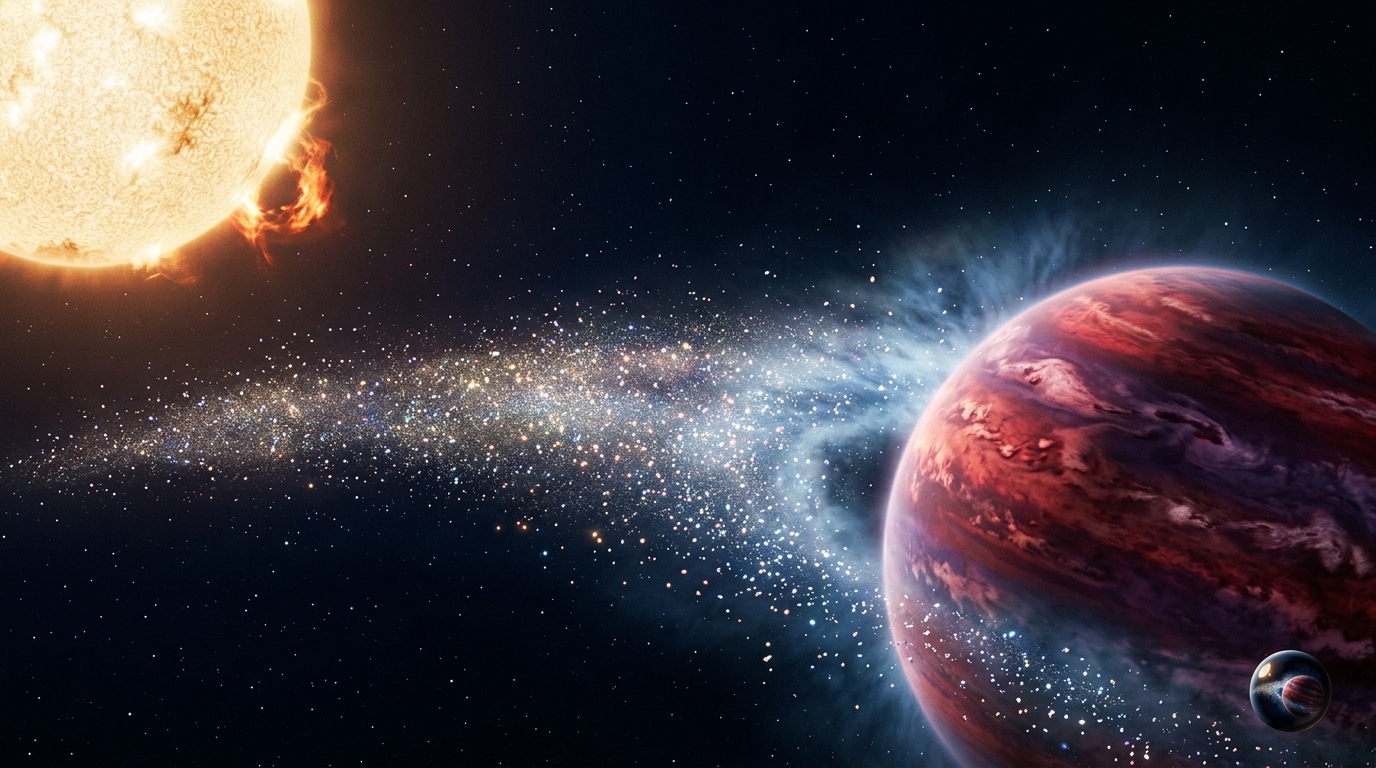
Humanity's quest to understand the cosmos has led us to some of the most stunning discoveries in the history of science. However, few things can compare to the recent revelation from the James Webb Space Telescope (JWST) regarding the exoplanet WASP-121b. Located approximately 850 light-years from Earth, this "ultra-hot Jupiter" is not just another planet in a distant solar system; it is a laboratory of extreme physics and chemistry that defies our imagination.
WASP-121b is a gas giant that orbits its star at such a close distance that its year lasts only 30 hours. This proximity results in the planet being "tidally locked," meaning one side permanently faces its star, experiencing an eternal, scorching day, while the other side remains in perpetual darkness. This dramatic temperature gradient is the driving force behind the most exotic weather phenomena ever recorded.
A World of Extreme Contrasts and Supersonic Winds
Observations from James Webb have allowed scientists to map the atmosphere of WASP-121b with unprecedented detail. On the dayside, temperatures exceed 2,500 degrees Celsius, high enough to vaporize metals and minerals. Conversely, the nightside, while still extremely hot by terrestrial standards (around 1,500 degrees Celsius), allows certain elements to condense.
The massive temperature difference between the two hemispheres generates winds that blow at breathtaking speeds, reaching 18,000 kilometers per hour. These winds transport metal vapors from the hot side to the "cooler" nightside, where something magical happens: these vapors cool down and form clouds. But these are not water clouds like those on Earth. They are clouds of iron, magnesium, and chromium.
The Chemistry of Precious Stones: Rubies and Sapphires
The most striking finding of the study concerns the composition of these clouds. Scientists found that the conditions in the atmosphere of WASP-121b allow for the formation of corundum. Corundum is a mineral that, on Earth, forms the basis for rubies and sapphires. On this exoplanet, corundum is not found in solid form on the ground but condenses into liquid form in the upper layers of the atmosphere during the night.
Imagine, then, a rain of liquid rubies and sapphires falling through a veil of metallic clouds. This image, seemingly plucked from a science fiction film, is the reality on this distant world. The presence of these elements was confirmed through spectroscopy, a technique that allows James Webb to analyze light passing through the planet's atmosphere and identify the chemical "fingerprint" of each element.
The Significance of James Webb in Astrophysics
The JWST's ability to observe in the infrared spectrum is what made this discovery possible. While the Hubble telescope had provided early clues about the strange nature of WASP-121b, James Webb offered the necessary resolution to understand the atmospheric dynamics. Researchers used the NIRSpec (Near-Infrared Spectrograph) instrument to monitor the planet during a full orbit, essentially creating a "weather map" of another world.
This study is not just about an exotic planet. It is a crucial step toward understanding how planets form and evolve in extreme environments. By learning about the chemistry of WASP-121b, astronomers can refine their models of atmospheric circulation, which will then be applied to smaller, rocky planets that more closely resemble Earth.
"The precision of the data from James Webb is staggering. It allows us to see not only what is in the atmosphere, but how it moves and changes," NASA researchers state.
In conclusion, WASP-121b reminds us that the universe is far stranger and more diverse than we could ever have imagined. While the idea of a rain of precious stones may sound romantic, the reality of a world with supersonic winds and temperatures that melt iron is a reminder of the hostility, but also the beauty, of space. James Webb continues to expand our horizons, proving that every new observation is a window into an unknown and fascinating future.