As the 2026 Tribeca Film Festival draws to a close, a palpable shift in the Manhattan air suggests that the first phase of generative AI hype has given way to a more mature, albeit difficult, reality. For two years, the narrative surrounding AI in cinema revolved around the promise that anyone, with a simple text prompt, could create the next blockbuster. However, the projects showcased this year, such as the much-discussed 'Dear Upstairs Neighbors,' prove the opposite: 'vanilla' AI—the use of models in their raw, prompt-based form—is not the future of cinema. It is merely a rough draft.
The Failure of Automation and the Need for Control
The fundamental problem with text-to-video models, like the early versions of OpenAI’s Sora or Google DeepMind’s Veo, was the lack of granular control. For a director, the phrase 'a man walks in the rain' is hopelessly vague. What is the lighting? What is the focal length of the lens? How does his facial expression shift at second four? Generative AI, in its initial form, acted like a talented but erratic artist who refuses to take direction. The results were often visually stunning but narratively useless.
At Tribeca 2026, we witnessed the birth of what experts call 'Controlled Latent Manipulation.' Instead of relying on prompts, creators are now using AI as a highly sophisticated plugin within traditional workflows like Adobe Premiere or Foundry’s Nuke. The AI doesn’t 'write' the scene; instead, it takes over the task of filling in details within an environment already defined by humans through storyboards and 3D layouts. This allows for temporal consistency—the biggest hurdle in AI production to date—to be maintained across shots.
The Case of 'Dear Upstairs Neighbors'
The short film 'Dear Upstairs Neighbors,' created in collaboration with Google DeepMind, stands as a landmark of this new era. Its creators didn't just shout orders at a chat box. They used a hybrid approach where AI was employed for texture generation, lighting, and set extensions, while character movement and emotional beats were guided by traditional motion capture and animation techniques. The result is something that feels like cinema, not a deepfake YouTube video.
What makes 'Dear Upstairs Neighbors' stand out is that the technology is invisible. AI was used to solve budgetary problems that would have previously required hundreds of VFX artists, allowing a small team to produce Pixar-level quality. Herein lies the real revolution: not in the replacement of creativity, but in the democratization of high-end production values. It allows the independent filmmaker to compete with the visual scale of a major studio.
Hollywood and the 'Toolification' of AI
Major studios, from Disney to Warner Bros, have largely stopped fearing AI as an existential threat and have begun treating it as a financial necessity. Using AI for so-called 'in-betweening' in animation or for the 'de-aging' of actors has become routine practice. However, resistance remains strong regarding screenwriting and core creative direction. The 2023 guild agreements (WGA and SAG-AFTRA) and the 2025 updates have set strict boundaries, but technology is moving faster than bureaucracy.
- AI is now used for automated lip-sync adjustment in different languages, effectively ending the era of traditional dubbing.
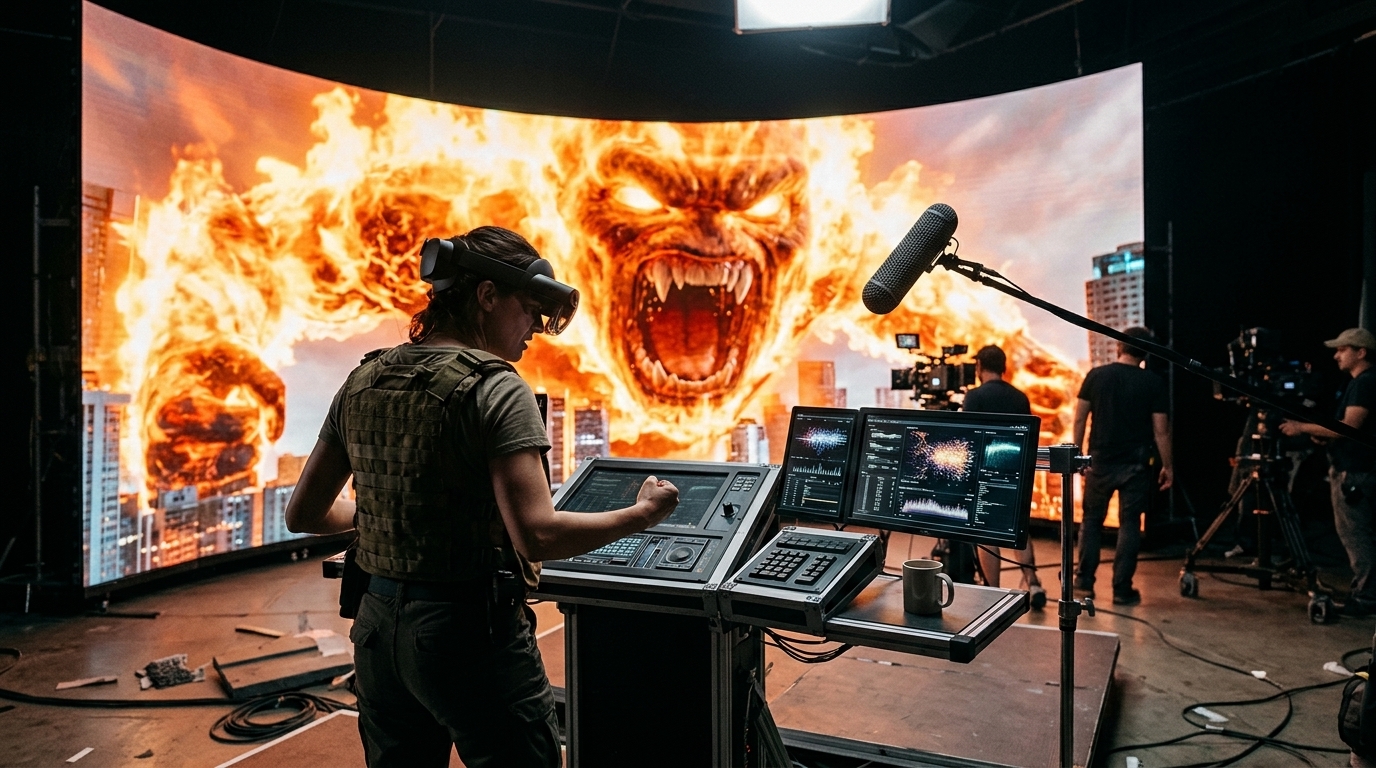
- Virtual sets (like The Mandalorian’s Volume) are being enhanced with AI that generates real-time environments based on camera movement.
- AI data analysis is assisting in the 'greenlighting' process, though this sparks concerns about the homogenization of content.
The conclusion from this year’s developments is clear: the future of Hollywood will not be 'AI-generated' in the sense of automated production. It will be 'AI-augmented.' Human intent remains the only element that cannot be encoded into a Large World Model. The films that will win Oscars in the coming years will have used AI at every stage of their production, but the viewer will never know. And that is, perhaps, the technology's greatest success.