

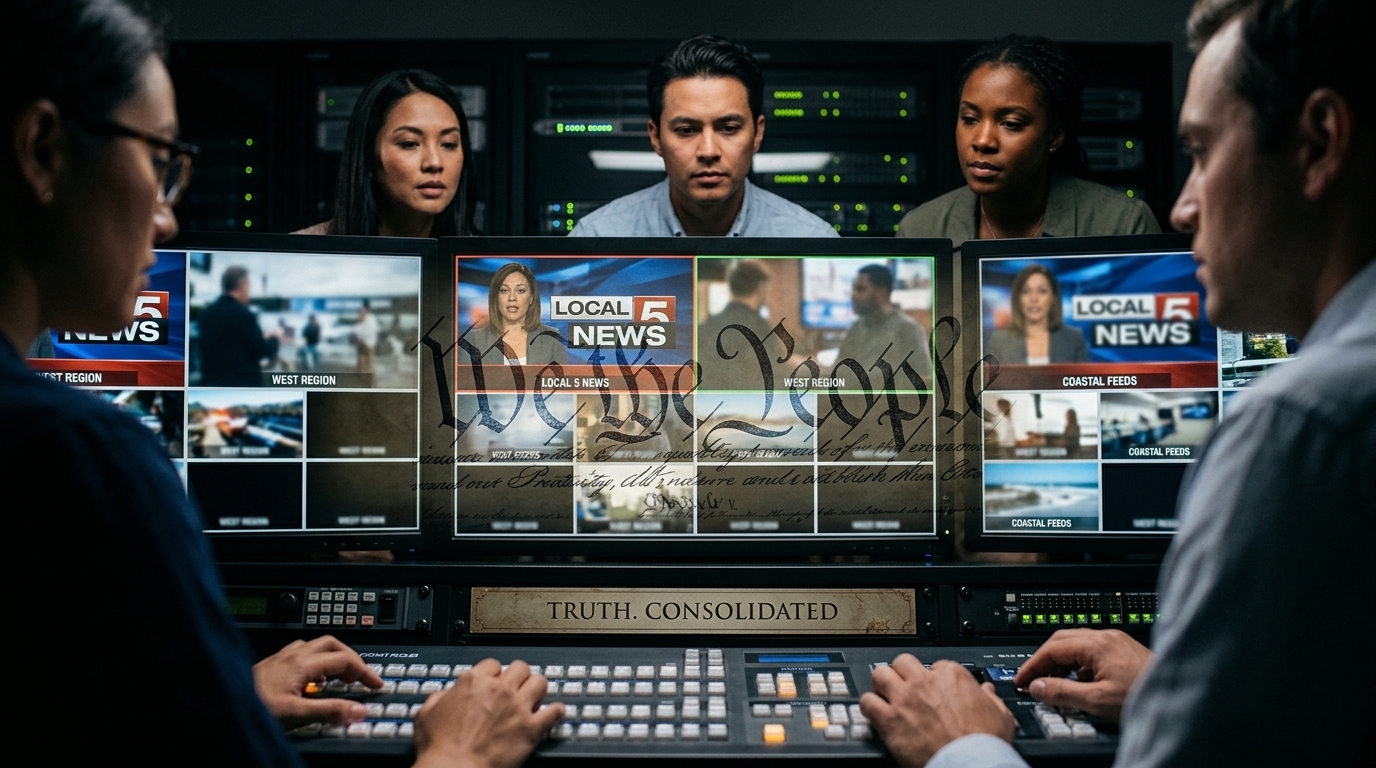
Local television news has traditionally been the bedrock of American democracy. It was the space where citizens learned about school board meetings, local elections, and weather patterns, shielded from the hyper-partisan toxicity of national cable news. However, this landscape is shifting rapidly. The looming merger of giants like Nexstar and Tegna, coupled with a new political agenda favoring radical deregulation, signals a "Trumpian" pivot in how citizens receive their daily information.
The Regulatory Tsunami and the Shadow of the FCC
At the heart of this transformation is the Federal Communications Commission (FCC). With the potential return of an administration that champions total deregulation, figures like Brendan Carr are emerging as the architects of a new media order. The strategy is clear: removing limits on media ownership allows a few powerhouse corporations to control hundreds of local stations. This isn't merely a financial maneuver; it is a question of democratic representation. When a single conglomerate controls the news across multiple states, "local" news ceases to be local. It becomes a centrally managed product that echoes national political narratives, often with a sharp partisan edge.
Nexstar, already the largest owner of TV stations in the U.S., is seeking to expand its dominance. The acquisition of Tegna would create a near-monopoly capable of dictating the agenda to millions of households. The precedent set by the Sinclair Broadcast Group, which famously forced local anchors to read identical scripts with specific political messaging, serves as a grim omen for what lies ahead. Under a deregulatory framework, these "must-run" segments could become the new standard, effectively turning local newsrooms into outposts for national propaganda.
AI as an Accelerator of Homogenization
In this evolving environment, Artificial Intelligence (AI) plays a dual role. On one hand, it promises to slash production costs through automated news writing and the use of virtual anchors. On the other, AI facilitates the centralized distribution of content. Instead of a local reporter investigating a municipal scandal, we see algorithms reshaping national press releases to appear "local." The loss of human judgment and community-specific knowledge leads to what analysts call "news deserts."
- The deployment of AI to generate "local" content without the physical presence of journalists.
- Automation of sports and financial reporting that severs the connection between the station and its community.
- The heightened risk of deepfakes and misinformation at the regional level, where fact-checking resources are increasingly scarce.
Political Implications and the Erosion of Trust
The shift toward a more centralized and politicized model of local TV has direct consequences for electoral behavior. Research consistently shows that citizens trust their local news anchors far more than national commentators on CNN or Fox News. This trust is now the ultimate prize in the media wars. If local news is weaponized to push a specific political agenda—be it the platform of Donald Trump or any other powerful interest—the very concept of objective information collapses.
"Local news is the last bastion of trust. If that falls, social cohesion will suffer a definitive blow," industry analysts warn.
In conclusion, the Nexstar-Tegna case is not just an American issue. It is a global warning of how technology and political will can reshape access to information. As media ownership consolidates, the diversity of voices that once defined the local broadcast era is being replaced by a monolithic, algorithmically-driven narrative. The future of local news may be more efficient and more profitable for its owners, but it risks becoming a hollow shell of its former civic self, serving the interests of the powerful rather than the needs of the public.




