

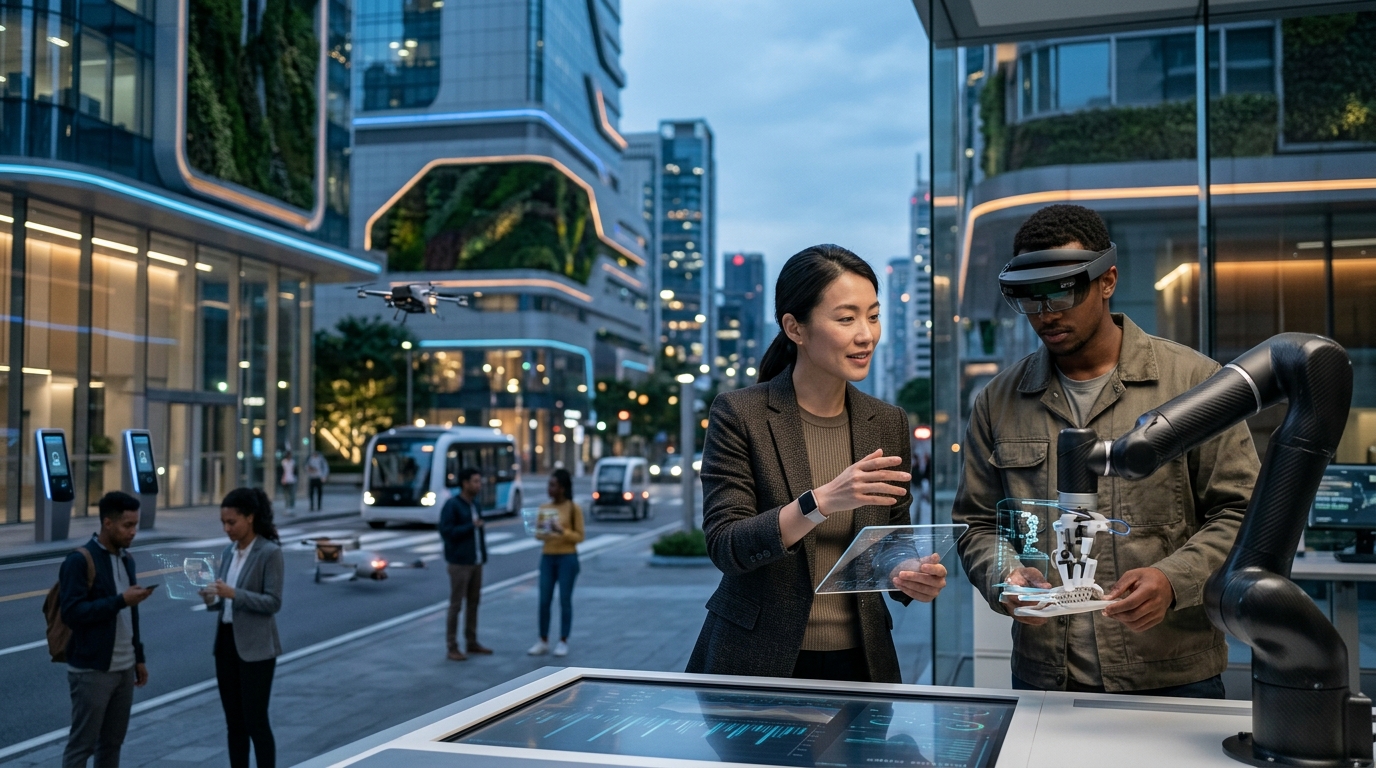
As we reach the middle of 2026, the discussion about the future of work is no longer a theoretical exercise but a daily reality for millions of workers worldwide. Artificial Intelligence (AI) has ceased to be an exotic tool for a few developers and has become the invisible 'colleague' in every office, factory, and hospital. However, the anxiety over mass unemployment is gradually giving way to a more complex picture: one of radical redistribution of roles and skills.
AI Specialization: Beyond Programming
If 2023 was the year of 'Prompt Engineering,' 2026 is the year of 'AI Orchestration.' Businesses are no longer looking for people who simply know how to talk to a chatbot, but professionals who can integrate entire AI ecosystems into business processes. AI Ethicists and Model Maintenance Specialists are now highly sought-after roles. As European Union regulations (AI Act) become stricter, companies need experts to ensure that algorithms are unbiased and that decision-making remains transparent.
- Human-Machine Interface Engineers: Designing how workers interact with robotic systems.
- Next-Gen Data Analysts: Not just collecting data, but interpreting the strategic trends suggested by AI.
- AI-focused Cybersecurity Experts: Protecting systems from attacks generated by other, hostile AIs.
"Jobs are not being lost; they are being transformed. The greatest risk is not AI, but our refusal to learn how to collaborate with it," notes a senior official from the World Economic Forum.
The Green Economy as a Job Engine
Alongside the digital revolution, the climate crisis is creating an entirely new sector of employment. The transition to a circular economy requires specialties that were non-existent a decade ago. Sustainability Managers are no longer PR executives but central figures in decision-making for supply chains and production. Renewable Energy Engineers and Carbon Capture Specialists are seeing their compensation skyrocket as investments in green energy surpass all precedents.
Furthermore, the need for energy upgrading of buildings and the development of smart cities creates demand for technical professions with a digital background. The 'smart' electrician or the plumber specializing in geothermal systems and automation is the new coveted craftsman of our era.
The Renaissance of 'Human' Skills
Perhaps the most interesting trend is the return to the value of human contact. In a world where content production and data analysis are automated, skills that AI cannot mimic—empathy, critical thinking, and emotional intelligence—become the ultimate competitive advantage. Professions in Care and Health, Mental Health, and Education are being upgraded. Caregivers for the elderly in an aging society, and career counselors helping people navigate constant changes, are the pillars of the new economy.
The End of the 'Degree for Life'
The most significant change, however, does not concern *which* profession we will do, but *how* we will approach it. The concept of 'lifelong learning' has turned from a slogan into a survival necessity. The model of 'studying at 20, working until 65' has collapsed. The new normal includes micro-credentials and continuous reskilling every 3-5 years. The ability to 'unlearn' and learn from scratch is now the most critical skill in the 21st century. The labor market of the future does not belong to those who know everything, but to those who are ready to learn everything.





