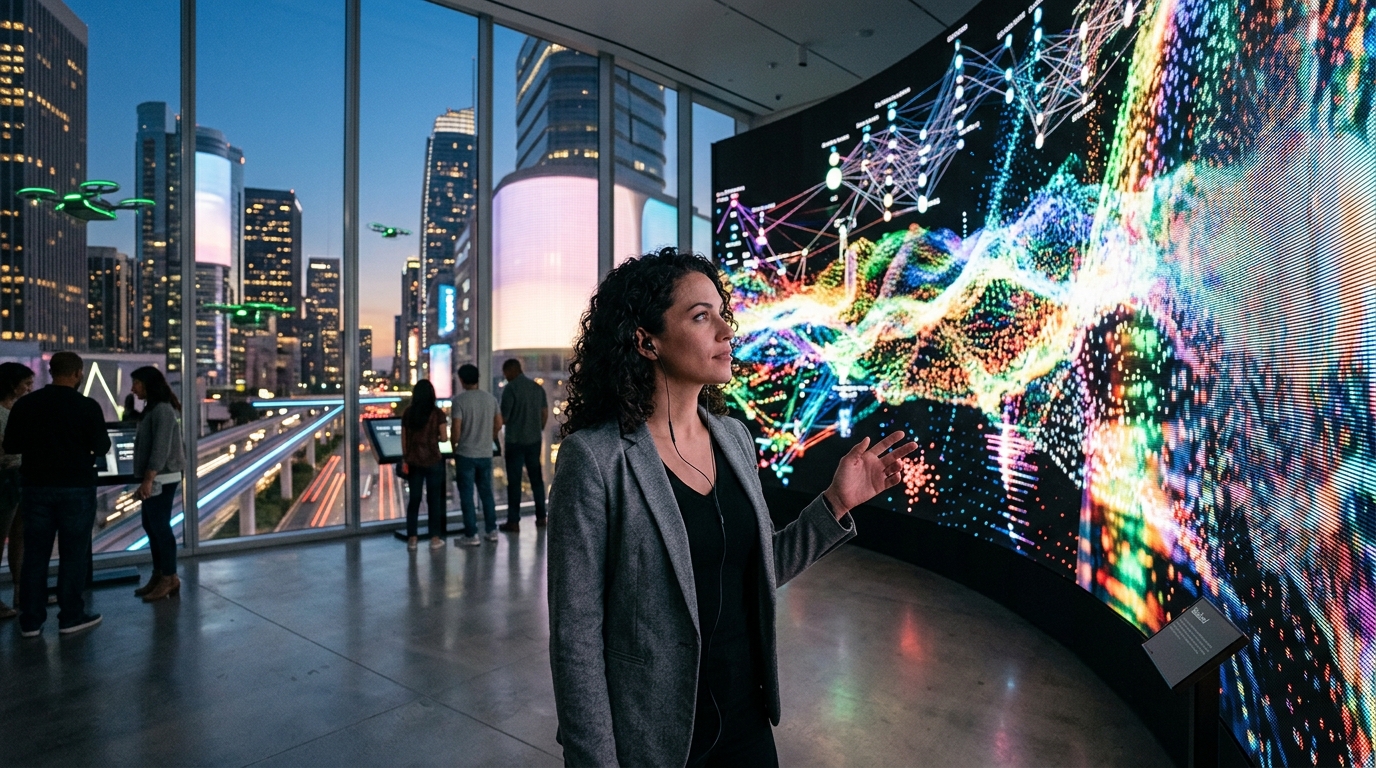
In the beating heart of Los Angeles, where Frank Gehry’s architectural prowess meets the pulse of digital innovation, Dataland is emerging as more than just another museum. It is the realization of a vision that seemed like science fiction a decade ago: the world’s first permanent institution dedicated exclusively to Artificial Intelligence (AI) art. Led by the internationally acclaimed artist Refik Anadol and his studio, Dataland promises to redefine our relationship with the intangible, transforming oceans of data into living, breathing sculptures of light and sound.
The Philosophy Behind Dataland
Located within 'The Grand LA' complex, Dataland is the pinnacle of years of research into 'machine intelligence.' For Anadol, AI is not an automation tool but a collaborator in the creative process. The museum utilizes the 'Large Nature Model' (LNM), the world's first open-source AI model trained solely on data from the natural world. Instead of the usual static images, visitors encounter digital ecosystems that react in real-time, creating an experience Anadol describes as the 'collective hallucination of humanity.'
This approach diverges sharply from traditional art museums. Here, the canvas is the algorithm, and the pigment is the terabytes of data harvested from NASA, the Smithsonian, and other global institutions. The result is an immersive environment where the boundaries between physical and digital reality dissolve, offering a new perspective on how machines can 'remember' and 'dream' about nature.
Technology and Sustainability: Ethical Dilemmas
Despite the excitement, operating a museum based on massive computational power raises questions about its environmental footprint. Dataland addresses these concerns through partnerships with tech giants to utilize green energy and optimize algorithms for resource efficiency. Furthermore, the museum serves as a living archive of biodiversity. In an era of climate crisis, the digital representation of extinct species or threatened ecosystems takes on a profound political and social dimension.
- Utilization of the Large Nature Model to recreate ecosystems.
- Collaboration with top academic institutions for ethical data usage.
- Integration of sensors allowing the public to interact with the artworks.
- Permanent and rotating exhibitions exploring the 'memory' of machines.
Art in the Age of Post-Human Creativity
Dataland is not just about technology; it is about the very essence of creativity. As AI permeates every facet of our lives, the question 'what constitutes art?' becomes increasingly urgent. Anadol argues that AI can expand the human imagination, allowing us to see patterns and connections that the human brain cannot perceive alone.
"We are not trying to replace the artist, but to extend the field of human experience beyond our senses,"he frequently notes in interviews.
The choice of Los Angeles as Dataland's home is no coincidence. The city, a global hub for entertainment and technology, provides the perfect fertile ground for such a convergence. The museum is expected to attract millions of visitors, boosting the local economy and positioning California at the forefront of digital culture. However, its true legacy will be judged by whether it can convince skeptics that an algorithm can indeed possess a 'soul'—or, at the very least, reflect our own.