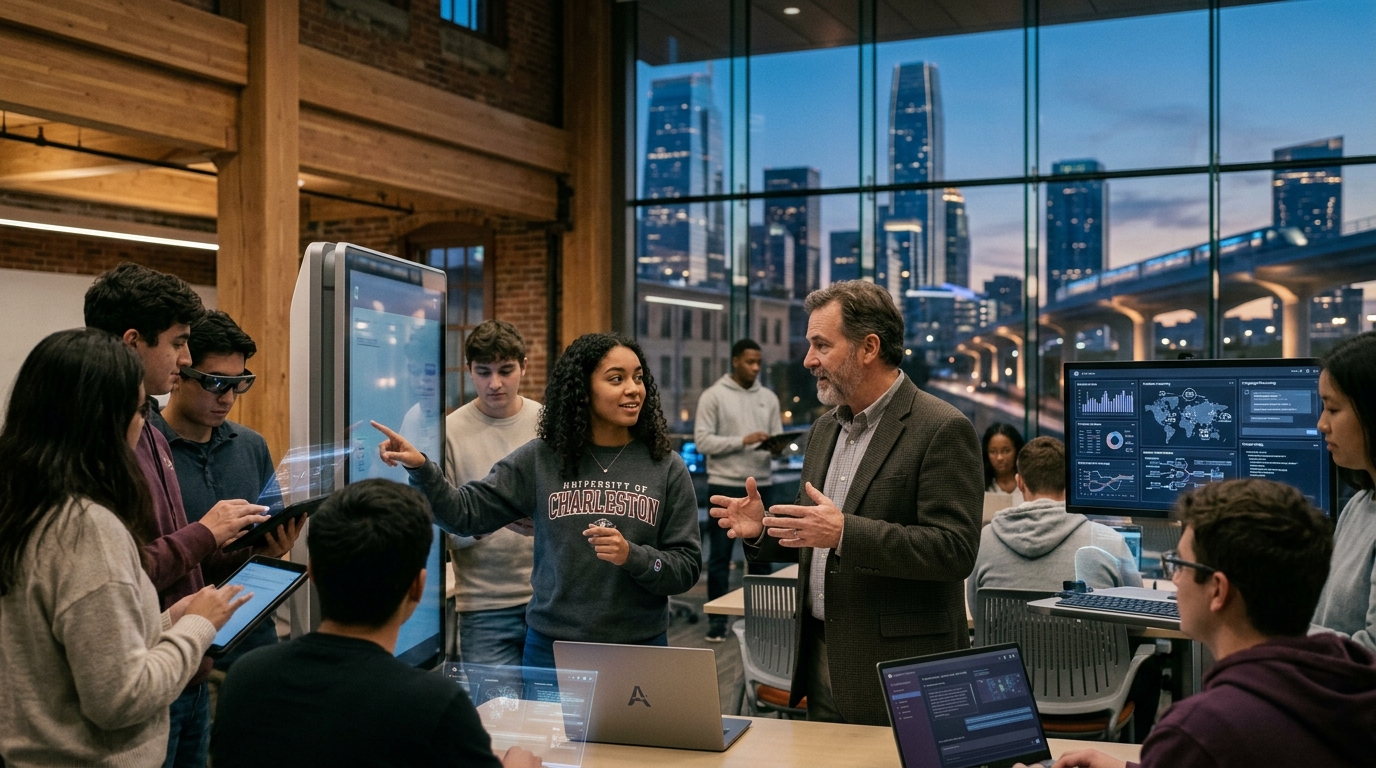
As we navigate the mid-point of 2026, the dialogue surrounding Artificial Intelligence in higher education has undergone a profound transformation. The initial era of reactionary bans and plagiarism panic has given way to a strategic embrace of "AI Literacy." Leading this charge is the College of Charleston, an institution that has chosen to integrate AI into its classrooms not as a necessary evil, but as a fundamental pedagogical tool for the modern age.
The college's approach is multifaceted, focusing on teaching students how to use AI responsibly, ethically, and effectively. In an era where large language models (LLMs) are ubiquitous, the institution recognizes that ignoring the technology is a disservice to the student body. Instead, they are fostering an environment where AI is treated as a collaborative partner in the learning process, pushing the boundaries of traditional education.
From Academic Threat to Educational Asset
In the academic year 2023-2024, the primary concern of university administrators was how to detect AI-generated essays. Today, at the College of Charleston, the focus has shifted to the "human-in-the-loop" model. Faculty members are encouraged to redesign their curricula to include AI as a starting point. By doing so, they elevate the academic challenge; if a machine can write a basic summary, the student's job is now to provide the high-level synthesis, the nuanced critique, and the creative application that remains uniquely human.
This shift requires a significant investment in faculty development. The college has established dedicated workshops and resource centers where professors can experiment with AI tools. The goal is to move away from rote memorization and towards "prompt engineering" and critical verification. Students are no longer just consumers of information; they are becoming editors and architects of knowledge, learning to navigate a world where the line between human and machine output is increasingly blurred.
The Framework of Responsible AI Use
Responsibility is the cornerstone of the Charleston model. The college has implemented clear guidelines that define what constitutes ethical use. This framework is built on three pillars: transparency, verification, and accountability. Students are taught that while AI can assist in brainstorming or structuring an argument, the final responsibility for the accuracy and integrity of the work lies with the human author.
- Transparency: Students must disclose the extent of AI involvement in their assignments, often including an appendix of the prompts used.
- Fact-Checking: Given the tendency of AI to "hallucinate" or present bias, students are trained to verify every claim against primary sources.
- Ethical Literacy: Discussions about data privacy, algorithmic bias, and the environmental impact of AI are integrated into the curriculum.
By bringing these conversations into the classroom, the College of Charleston is ensuring that students do not just use AI effectively, but that they understand the socio-political implications of the tools they are wielding. This creates a generation of graduates who are not just technically proficient, but ethically grounded.
Preparing for the 2026 Global Job Market
The impetus for this educational shift is not purely academic; it is deeply practical. In the job market of 2026, AI fluency is a non-negotiable requirement across almost all sectors. From marketing and law to engineering and the arts, the ability to leverage AI to enhance productivity is what separates successful candidates from the rest. The College of Charleston is essentially future-proofing its students' careers.
"We are not teaching students how to let AI think for them, but how to think with AI," university officials emphasize. This distinction is crucial for maintaining the value of a college degree in a world where information is a commodity.
Ultimately, the College of Charleston's proactive stance serves as a blueprint for higher education globally. By embracing AI, they are not lowering their standards; they are raising the bar for what it means to be an educated citizen in the 21st century. The focus remains on the human element—the critical eye, the moral compass, and the creative spark—empowered rather than replaced by the machine.