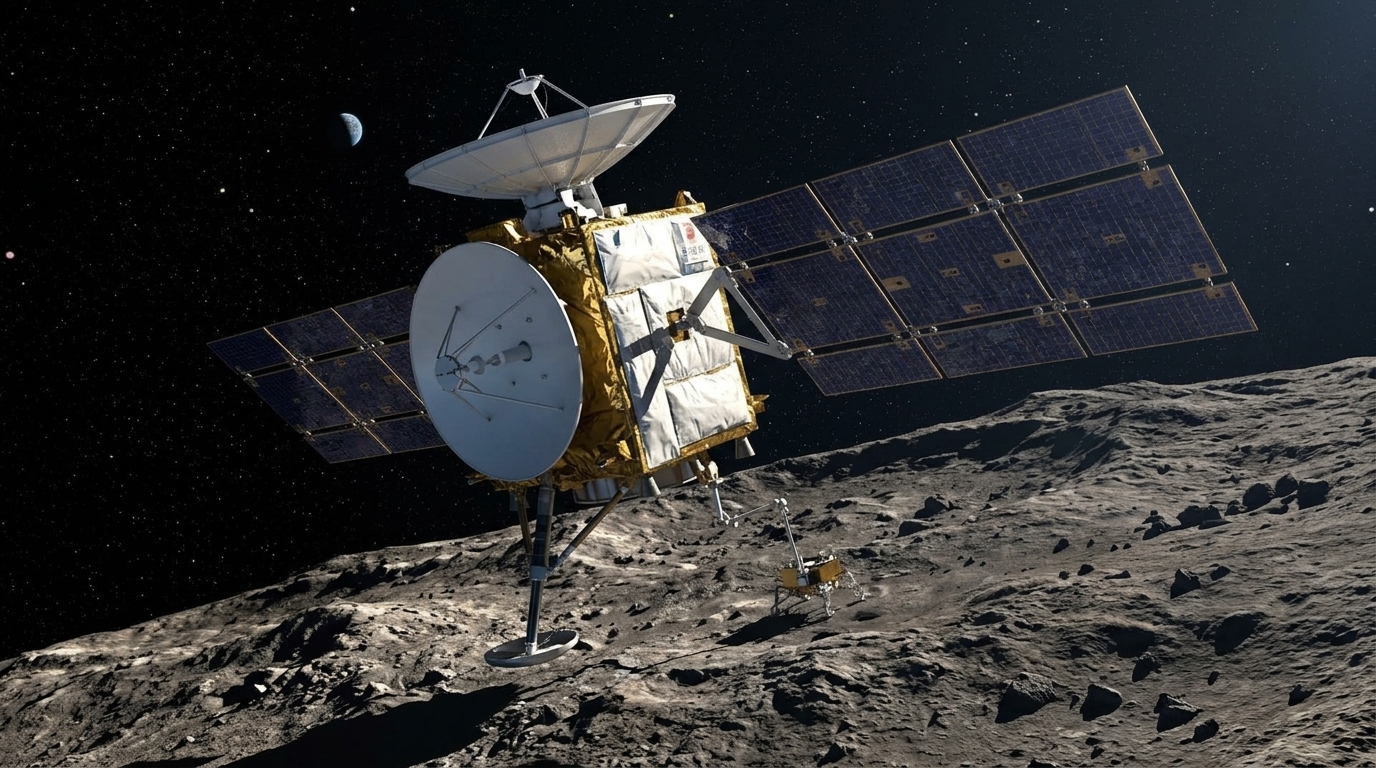
In the vast darkness of space surrounding our planet, a new act in the modern drama of exploration is unfolding. The China National Space Administration (CNSA) has confirmed that the Tianwen-2 spacecraft is now in orbit around Kamoʻoalewa (2016 HO3), a mysterious asteroid that scientists call Earth's 'quasi-satellite.' This mission is not merely a scientific success; it is a powerful statement of intent regarding who will dominate the next phase of the space economy.
The Mysterious Companion of Earth
Kamoʻoalewa, whose name derives from a Hawaiian word meaning 'oscillating celestial body,' was discovered in 2016. Although it orbits the Sun, its trajectory is so synchronized with Earth's that it appears to follow us like a faithful companion. With a diameter of no more than 50 meters, this tiny rock has sparked immense interest because its spectral signature suggests it may be a fragment of the Moon, ejected after an ancient collision.
Tianwen-2's approach is a high-precision technical achievement. The spacecraft must maintain a stable distance from a target with minimal gravitational pull, paving the way for the mission's most ambitious phase: 'touch-and-go' sample collection. If China succeeds in returning these samples to Earth, it will become the third nation in history, after Japan and the US, to complete such a mission to an asteroid, but the first to do so on such a close 'neighbor' of our planet.
Technology and Strategic Significance
The Tianwen-2 mission is not limited to Kamoʻoalewa. After completing the sampling, the spacecraft will use Earth's gravity assist to head toward the Main Asteroid Belt, targeting the comet 311P/PanSTARRS. This dual journey highlights China's capability in planning long-duration missions and the resilience of its propulsion systems.
- Planetary Defense: Studying such bodies is critical for understanding how we can deflect threatening asteroids in the future.
- Resource Mining: Kamoʻoalewa is considered a 'laboratory' for future techniques for mining rare earths and metals in space.
- Geopolitical Prestige: At a time when the US Artemis program seeks to return to the Moon, China is proving it can operate successfully throughout near-Earth space.
"The success of Tianwen-2 will redefine our relationship with the objects surrounding Earth. They are no longer just rocks in the dark, but the next stations of human expansion," Beijing analysts state.
The New Space Race
The arrival at Kamoʻoalewa takes place during a period of intense astropolitical tension. Washington is closely monitoring CNSA's movements, as the technology required to approach an asteroid is identical to that needed to inspect or neutralize hostile satellites. China, however, insists on the peaceful nature of the mission, emphasizing the importance of international scientific cooperation.
The question remains whether humanity will manage to treat these new worlds as common heritage or as the next battlefield for resource dominance. With Tianwen-2, Beijing has taken the lead in a race that is only now beginning to accelerate, turning theoretical astronomy into applied geopolitical power.