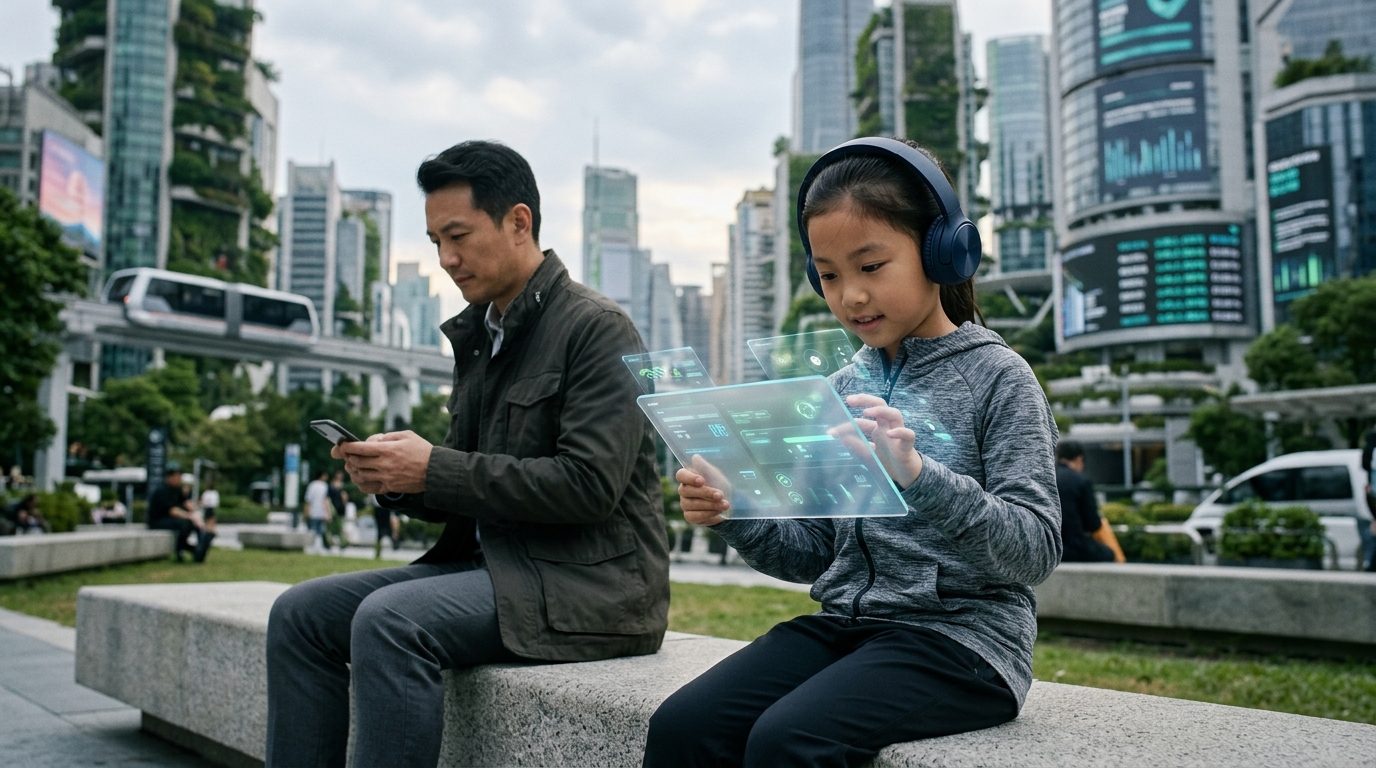
As we navigate mid-2026, the digital revolution is no longer merely knocking at our door; it has moved into our children's bedrooms. According to the latest landmark report by UNICEF, children and adolescents worldwide are adopting Artificial Intelligence (AI) technologies at a rate more than three times faster than adults. This finding is not just a statistical anomaly; it signals a fundamental shift in how the next generation will perceive knowledge, labor, and reality itself.
The transition from "Digital Natives" (those born into the internet era) to "AI Natives" (those born into the era of generative agents) is occurring with geometric progression. While adults often approach tools like ChatGPT, Gemini, or Claude with a degree of skepticism or as secondary productivity aids, children are integrating them as organic components of their learning processes and social interactions. For a teenager today, AI is not a "new technology"; it is the very environment in which they exist.
The Digital Transition at Warp Speed
The report emphasizes that the ease with which younger demographics interact with natural language interfaces is the catalyst for this rapid adoption. Unlike previous generations who had to learn the "syntax" of computers—from DOS commands to graphical user interfaces—today's children simply speak to the machines. This removal of technical barriers allows even pre-schoolers to use advanced models to co-create stories, answer existential questions, or engage in complex play scenarios.
However, this velocity brings profound risks. UNICEF warns that regulatory frameworks and educational infrastructures are failing to keep pace with these developments. "We are witnessing a global-scale experiment where the subject is the cognitive development of our children," the report states. The potential for a lack of critical thinking regarding AI-generated outputs and the creation of "information bubbles" tailored specifically to a child's developmental vulnerabilities are central concerns for sociologists and pediatricians alike.
Educational Revolution or Cognitive Risk?
In the classroom, the impact is already transformative. AI acts as a 24/7 personalized tutor, offering a level of bespoke instruction previously reserved for the elite. Students use the technology to break down complex physics concepts or practice foreign languages through simulated immersive dialogues. This personalization is the "holy grail" of pedagogy, yet its shadow side includes the potential erosion of original thought and research stamina.
- Personalized learning can significantly close the gap for children with neurodivergent needs or learning disabilities.
- Over-reliance on AI may lead to the atrophy of independent problem-solving skills and critical analysis.
- Early exposure to algorithmic biases can bake systemic prejudices into a child's developing worldview.
Furthermore, UNICEF highlights the widening chasm between children in advanced and developing economies. While wealthy nations debate the ethical nuances of AI usage, many regions in the Global South face a lack of basic access. This threatens to create a new class of "digitally disenfranchised" youth, unable to compete in a future labor market where AI fluency will be a prerequisite for employment.
Ethics, Data Protection, and the Road Ahead
The issue of privacy remains the most contentious. Children, in their spontaneous and often unmonitored interaction with AI, share personal thoughts, emotions, and sensitive data that are stored and analyzed by tech conglomerates. The report calls for governments to establish stricter "Child-Safe AI" standards, ensuring that models designed for minors do not exploit their data for targeted advertising or psychological profiling.
In conclusion, UNICEF stresses that the solution is not prohibition, but empowerment. "AI Literacy" must become a foundational pillar of modern education, teaching children not just how to prompt these tools, but how to interrogate their outputs and understand their limitations. The responsibility now lies with the adults—parents, educators, and policymakers—who must guide a generation that is already running much faster than them into an unmapped digital frontier. We are not just raising children; we are raising the first generation of human-AI hybrids.