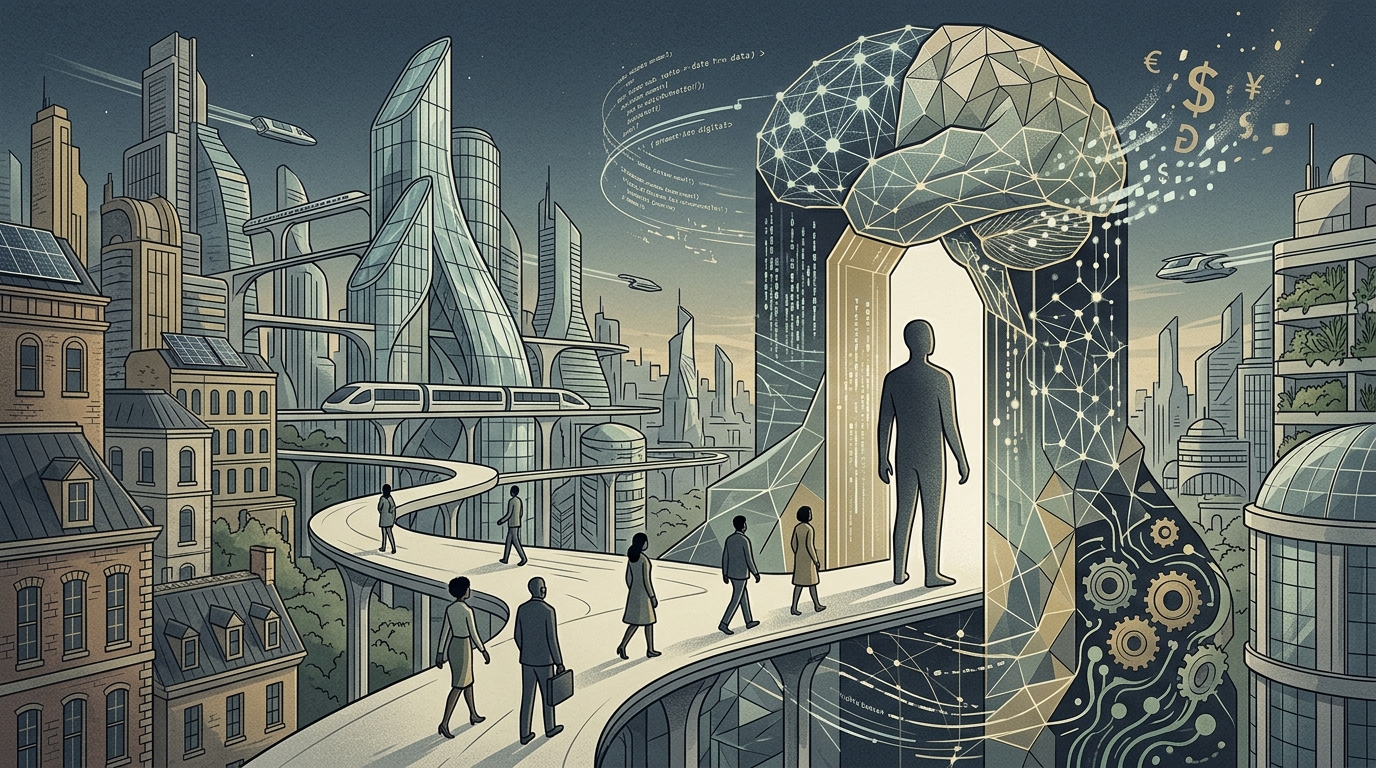
Human history has been punctuated by technological revolutions that reshaped social structures, but none have threatened the core of our economic system as much as Artificial Intelligence (AI) promises to do. In a recent intervention that sent shockwaves through policy circles, Bill Gates—the man who once envisioned a computer on every desk—now envisions a future where the very concepts of work and capital must be redefined. According to Gates, in less than 20 years, AI will have so radically altered productivity and the labor market that capitalism, in its current form, will no longer be sufficient to maintain social cohesion.
The Decoupling of Labor and Production
For centuries, capitalism has relied on the symbiotic relationship between labor and income. Individuals trade their time and skills for capital, which in turn fuels consumption and economic growth. AI, however, threatens to break this cycle. When algorithms and robots can perform not just manual tasks but complex cognitive ones at a near-zero marginal cost, the market value of human labor tends to plummet.
Gates argues that the efficiency gains will be so immense that they will lead to a state of "hyper-abundance." If goods and services can be produced with almost no human intervention, the traditional model of supply and demand begins to fracture. Who will purchase these products if the majority of the population lacks employment or disposable income? This is the paradox that, according to the Microsoft founder, will render capitalism "non-functional."
The Necessity of a New Social Contract
Gates’ prediction is not a dystopian cry for help, but rather a call for proactive policy. He suggests that governments must consider radical solutions, such as a "robot tax" and Universal Basic Income (UBI). The logic is straightforward: if corporations are replacing workers with AI to boost profits, a portion of those profits must be redistributed directly to citizens to keep the economic engine running.
- Automation Taxation: Shifting the tax burden from labor to capital generated by AI infrastructure.
- Educational Reimagining: Focusing on skills that AI cannot easily replicate, such as empathy, strategic ethics, and complex human negotiation.
- Reduced Work Hours: A transition to a three-day work week, as Gates has previously mooted, to share the remaining necessary labor among the populace.
However, this transition is fraught with peril. The concentration of AI power within a handful of tech giants could lead to a new form of "digital feudalism," where the owners of the algorithms control all wealth, while the rest of the population subsists on state-provided stipends.
Geopolitical Implications and the Global Divide
For developed and developing nations alike, these predictions carry immense weight. In economies heavily reliant on services, automation could be a double-edged sword. On one hand, AI can enhance customer experience and streamline logistics. On the other, low-to-mid-level white-collar jobs are more vulnerable than ever. The risk of a widening gap between "AI-rich" and "AI-poor" nations could lead to unprecedented geopolitical instability.
"The challenge isn't whether AI will replace jobs, but whether we can build a system that distributes AI's wealth fairly before social inequality leads to an explosion," industry analysts note.
Gates emphasizes that the next 20 years will be a period of "great adaptation." Capitalism, which survived world wars and the industrial revolution, now faces its most sophisticated adversary: its own success in automating production. If the goal of the economic system was always to maximize efficiency, AI is its ultimate realization—and potentially its undoing.
Conclusion: Toward an Economy of Purpose?
The question Gates poses is not just economic; it is existential. What will humans do when they no longer need to work to survive? Moving beyond capitalism requires a new philosophy of life, where an individual's value is not measured by their productivity, but by their contribution to community, art, and personal growth. AI is forcing us to become "more human," as the machines take over everything else. Whether we head toward a post-scarcity utopia or a permanent crisis depends on the decisions we make today, not 20 years from now.