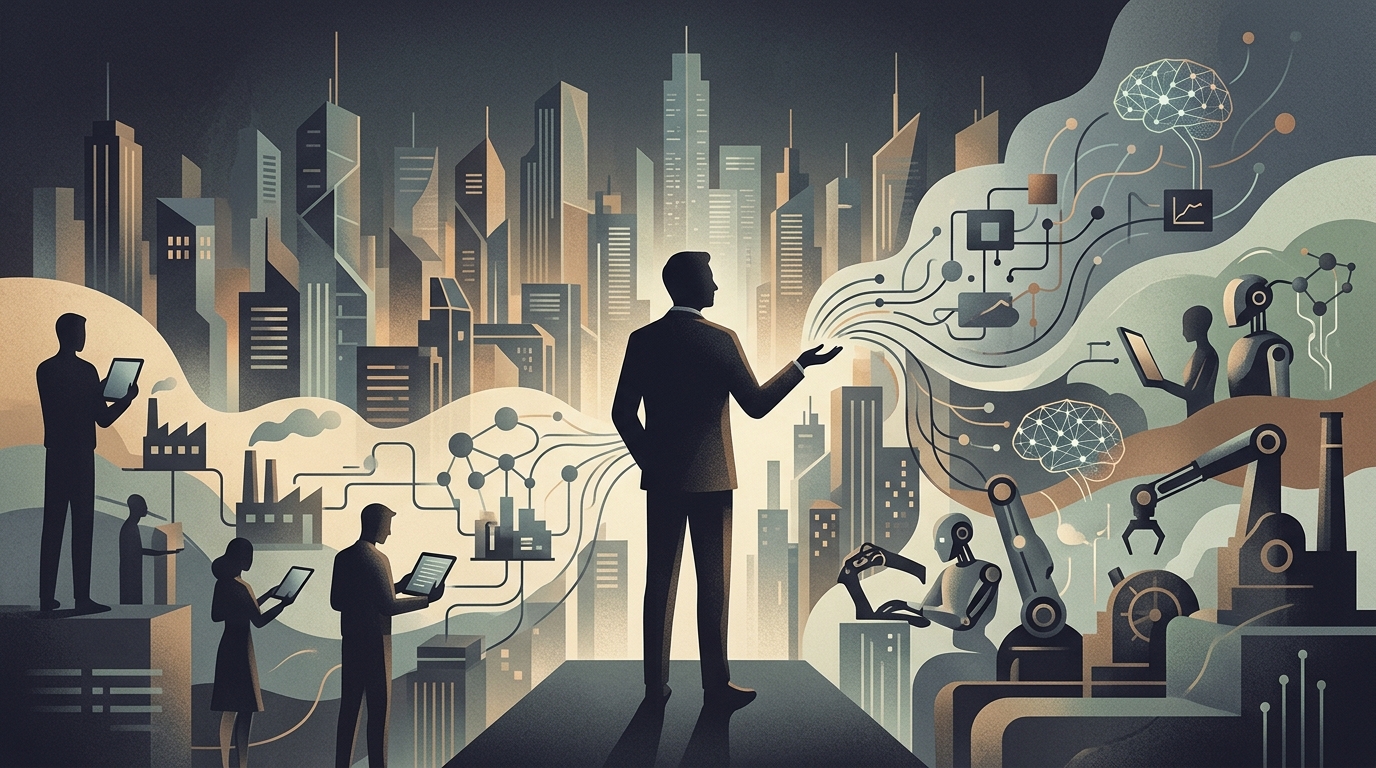
Human history has been defined by technological revolutions that reshaped how we produce and consume. However, according to Bill Gates, the advent of Artificial Intelligence (AI) is not just another step in the evolution of our tools, but an existential challenge to the economic system that has governed the world for centuries: capitalism. In recent analyses and public statements, Gates argues that the speed and depth of AI's penetration into the workforce are such that within 20 years, the concept of "working for survival" might disappear, taking with it the mechanisms of the free market as we know them.
The Decoupling of Labor and Productivity
For centuries, capitalism has relied on a simple equation: humans offer their time and skills in exchange for a wage, which allows them to consume the goods produced by the system. AI threatens to break this cycle. When algorithms and robots can perform not only manual but also complex cognitive tasks—from writing code and diagnosing diseases to making strategic business decisions—the value of human labor in the production process diminishes dramatically. Gates points out that if productivity skyrockets without the need for human intervention, then the model of "wage labor" ceases to be the primary driver of wealth distribution.
This creates a paradox: we will have a world of abundance in goods and services, but without a traditional system that allows people to earn the income necessary to acquire them. This is where Gates' prediction of capitalism's "failure" lies. If the market can no longer self-regulate through the supply and demand of labor, then the state and society will have to invent something entirely new.
The Specter of a Post-Capitalist Society
In Gates' vision for 2045, society will have to address the issue of redistribution on a scale that seems surreal today. Concepts like Universal Basic Income (UBI) and robot taxation are no longer theoretical academic exercises but necessary tools for survival. Gates argues that if a machine replaces a worker who earned $50,000, the company should be taxed on the profit resulting from that replacement to fund social services and population retraining.
- The Reduction of Work Hours: Gates predicts that a three-day work week could become the norm, as the need for human presence will be limited to roles requiring empathy, creativity, and high-level strategy.
- The Crisis of Meaning: One of the greatest challenges will not be economic but psychological. In a world where work no longer defines an individual's identity, humanity will have to redefine its purpose.
- Concentration of Power: There is a risk that the few companies controlling AI will accumulate so much wealth that they become more powerful than nation-states, potentially undermining democracy.
Challenges and Political Response
The transition to this new model will not be seamless. Gates acknowledges that political structures are extremely slow to adapt. While technology moves at an exponential pace, legislation and social perceptions move linearly. The potential for social unrest during this "great replacement" is high, especially if the benefits of AI are reaped only by capital owners.
"AI will allow us to produce more with less effort. The question is whether we are wise enough to share that surplus in a way that benefits all of humanity and not just the few," Gates often remarks in his speeches.
In conclusion, Gates' warning is not a prophecy of doom but a call to action. If capitalism, as a system based on scarcity and human toil, is nearing its end, then the next twenty years will be the most critical period in the history of modern civilization. The challenge is to build a system that harnesses the abundance of AI without sacrificing human dignity and social cohesion.