

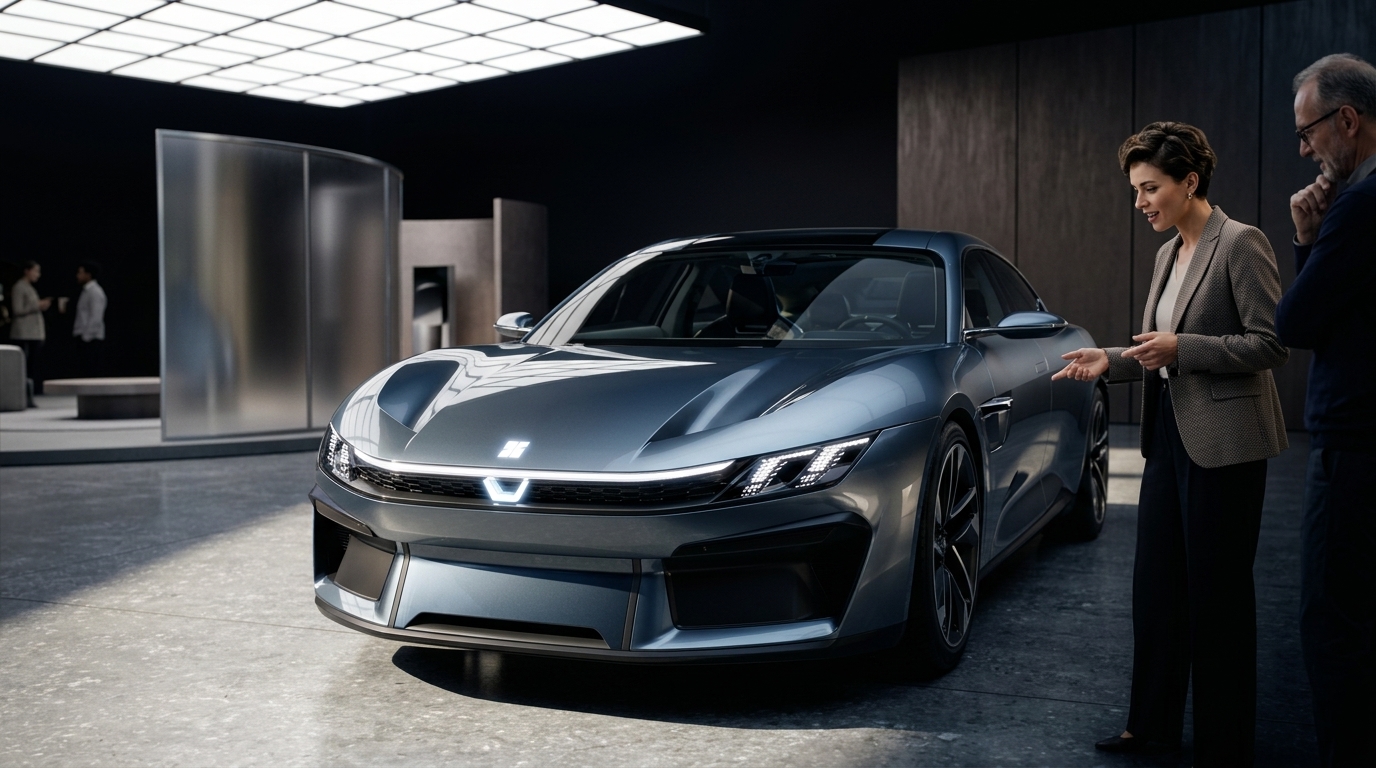
The Beijing Auto Show 2026 (Auto China) is no longer just a regional event; it has become the new center of gravity for the global automotive industry. Where Chinese companies once mirrored Western designs, today Stuttgart, Munich, and Detroit watch with awe—and a fair amount of panic—at the pace of innovation displayed in the Chinese capital. The 19 models that stood out this year are not merely vehicles; they are computers on wheels, equipped with technologies that until last year were considered science fiction.
The AI Revolution and LLM Integration
The dominant theme at Auto China 2026 is the full integration of Large Language Models (LLMs) into vehicle interiors. Xiaomi, with its new SUV, the SU8, stole the spotlight by presenting a digital assistant that doesn't just execute voice commands but understands conversational context and the driver's emotional state. The user experience (UX) has evolved into an ecosystem where the car functions as a seamless extension of the smart home and the office.
Huawei, through its Stelato brand, unveiled the S9 Ultra, featuring the ADS 4.0 system. This is the first commercially available autonomous driving platform that no longer relies on high-definition (HD) maps. Instead, it perceives the environment much like a human, utilizing end-to-end neural networks. The precision with which the vehicle navigates the chaotic alleys of Beijing proves that China has effectively overtaken Tesla in the race for true Full Self-Driving (FSD) capabilities.
Solid-State Batteries: The End of Range Anxiety
One of the most significant milestones of this year's show is the debut of production models featuring solid-state batteries. NIO, with its flagship ET9, promises a range exceeding 1,100 kilometers on a single charge, while 900V charging technology allows for a 500-kilometer top-up in just 8 minutes. This development essentially dismantles the last remaining argument in favor of internal combustion engines.
- BYD Yangwang U10: A super-luxury sedan with active suspension so advanced it allows the car to 'dance' and even drive on three wheels in an emergency.
- Zeekr 001 FR (2026 Edition): Featuring four electric motors and a 0-100 km/h acceleration of 1.9 seconds, redefining the hypercar segment.
- XPeng AeroHT: The first genuinely viable 'flying car' with a modular design, allowing the flight module to detach from the ground vehicle.
The West in Search of Identity
Traditional manufacturers like Volkswagen and Mercedes-Benz showcased models specifically tailored for the Chinese market under the 'In China, for China' strategy. However, the challenge is stark. VW, with its ID.UX series, is attempting to bridge the software gap by partnering with Chinese giants like XPeng. While necessary for survival, this strategy raises questions about the long-term erosion of European technological sovereignty.
"We are no longer in an era where China learns from us. We are in an era where we must run just to keep up with China," remarked a senior executive from a German automaker on the sidelines of the event.
In conclusion, Auto China 2026 demonstrates that the future of mobility is electric, hyper-connected, and predominantly Chinese. The 19 protagonists of the show are not just new models; they are the harbingers of a new global order on our roads.





