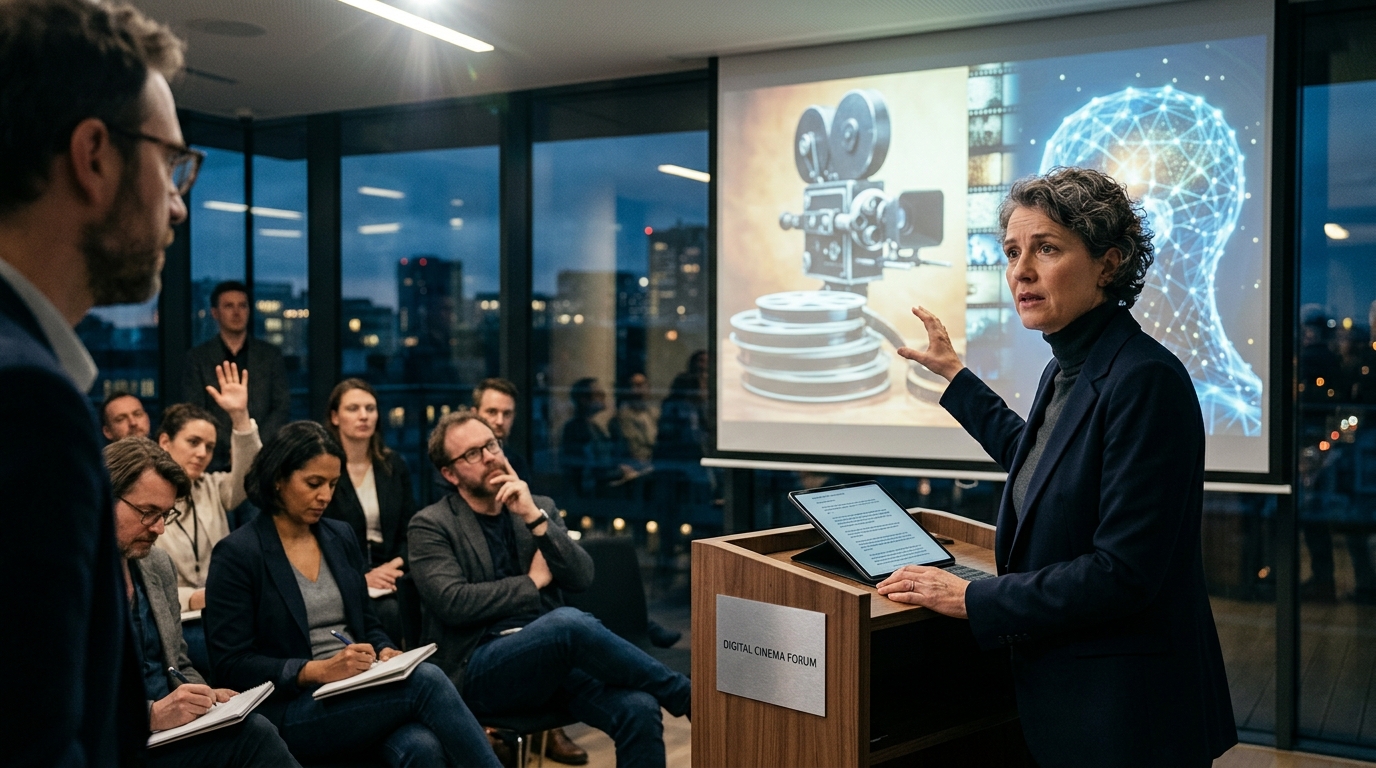
The advent of Artificial Intelligence (AI) in cinema is no longer a science fiction scenario, but a daily reality radically transforming production, distribution, and the creative process itself. However, this technological revolution brings with it one of the greatest legal and ethical challenges of the 21st century: the protection of intellectual property (IP). In a world where algorithms can replicate an actor's voice, mimic a director's style, or create photorealistic environments based on millions of pre-existing images, the lines between inspiration and theft are becoming dangerously blurred.
The Data Hunger and the Training Dilemma
The central issue occupying the international film community today is the source of the training data for Large Language Models and video generators. For an AI, such as Sora or Runway, to create a scene resembling a cinematic masterpiece, it must first have 'consumed' thousands of hours of films, many of which are protected by strict copyrights. Creators argue that this process constitutes a massive infringement of their property, as their work is being used to build tools that may eventually replace them.
On the other hand, technology companies invoke the concept of 'fair use,' arguing that AI does not copy the work but 'learns' from it to create something entirely new and transformative. This legal tug-of-war has now moved into the courtrooms, with decisions expected by mid-2026 set to define the industry's future for decades to come. The need for transparency in training data is now imperative, with the European Union leading the way through the AI Act, requiring companies to disclose their sources.
Digital Resurrection and Personality Rights
Another critical aspect is the use of AI to create 'digital twins' or 'resurrect' deceased actors. While this technology offers impressive possibilities for completing films or preserving an artist's legacy, it raises serious questions about who controls a person's image and voice. Recent strikes in Hollywood highlighted the need for strict agreements ensuring that actors have the final say and are fairly compensated for the use of their digital likeness.
- Protection of voice and likeness from unauthorized use.
- Defining the duration of rights over digital representation post-mortem.
- Distinguishing between human performance and algorithmic generation in awards and credits.
Toward a New Social Contract in Cinema
The solution to the challenge of intellectual property cannot be purely legal; it must also be economic. We are already seeing the emergence of new licensing models where creators and studios receive royalties whenever their content is used to train an AI model or generate new content. This 'new social contract' aims to preserve creativity by ensuring that technology acts as an amplifier of human art rather than a parasite.
"Artificial intelligence can produce images, but only humans can produce meaning. Protecting intellectual property is protecting the very meaning that gives value to our culture."
In conclusion, cinema stands at a crossroads. Protecting intellectual property in the age of AI requires a delicate balance: on one hand, preventing the arbitrary exploitation of human labor and, on the other, avoiding over-regulation that would stifle innovation. The future of the seventh art will be judged by our ability to legislate wisely, honoring the past while embracing the digital future.