

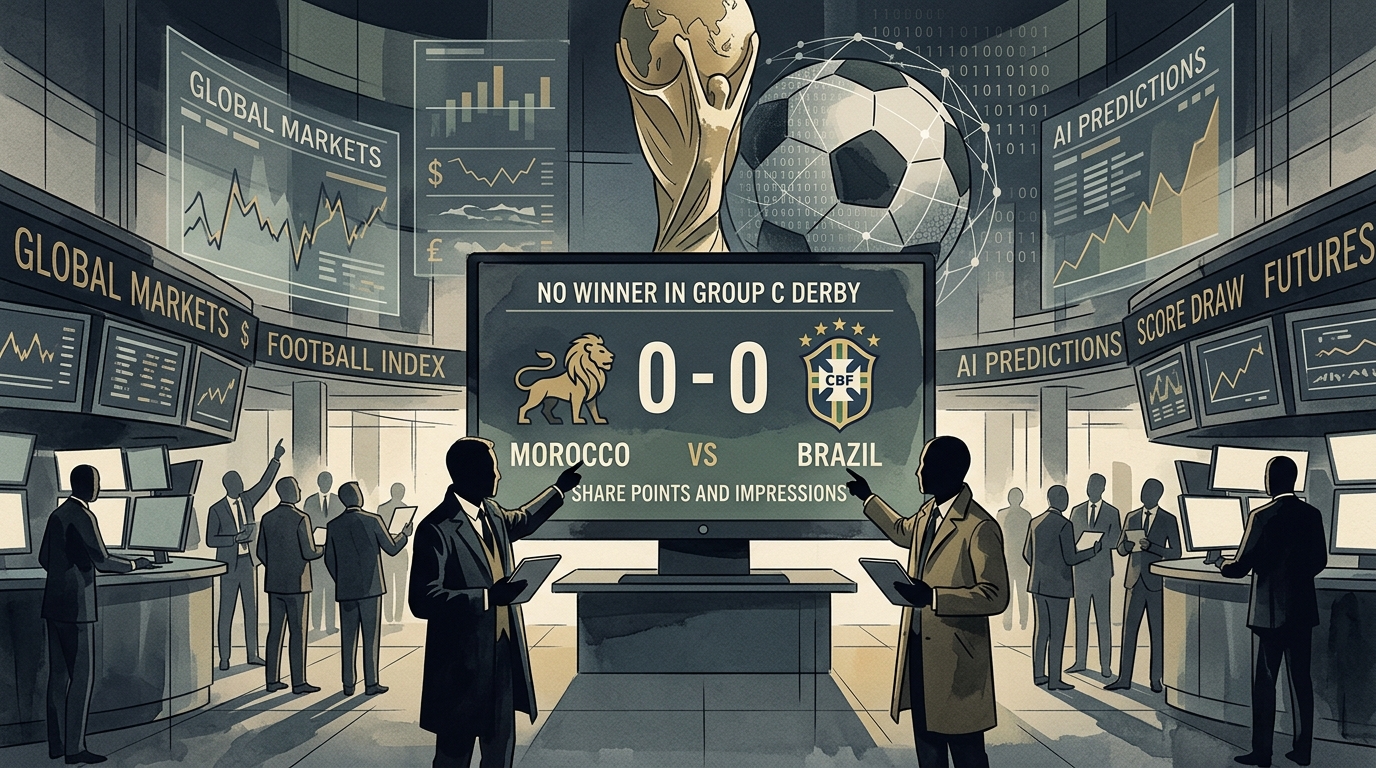
New York City donned its festive attire to welcome the first major 'classic' of the 2026 World Cup. At a packed MetLife Stadium, Morocco and Brazil crossed swords in a match that was not just a football game, but a clash of two different schools, two continents, and two economic realities. The final 1-1 draw leaves both teams with a bittersweet taste but sends a loud message: the gap between traditional powerhouses and rising stars of world football has now been bridged.
The Tactical Chess Match and the Atlas Lions' Surge
Morocco, the team that shocked the world in 2022, proved that their run in Qatar was no fluke. Under the guidance of Walid Regragui, the 'Atlas Lions' presented an exceptionally disciplined unit. From the opening minutes, high-intensity pressing forced Brazil into uncharacteristic distribution errors. Youssef En-Nesyri's goal in the 28th minute, following a textbook counter-attack, silenced the thousands of Brazilian fans who had flooded the stadium.
Brazil, on the other hand, under the leadership of Dorival Júnior, attempted to dictate the tempo through the individual quality of their stars. Vinícius Júnior and Rodrygo tried to penetrate the dense Moroccan defense, but the absence of a pure creative midfielder in the first half was evident. The equalizer eventually came in the 64th minute through an individual effort by Lucas Paquetá, who capitalized on a rare lapse in the Moroccan penalty area.
The Economic Dimension: A Multi-Billion Dollar World Cup
Beyond the touchlines, this encounter highlights the immense economic dynamics of the 2026 tournament. New York, as the world's financial capital, is experiencing an unprecedented tourism and commercial boom. Analysts estimate that ticket revenue and ancillary spending for this specific match alone exceeded $150 million. Secondary market ticket prices reached Super Bowl levels, proving that 'soccer' has become a premium investment product in the US.
Furthermore, the commercial value of the two national teams presents interesting contrasts. Brazil remains the 'golden brand' of football, with sponsorship deals generating hundreds of millions for its federation (CBF). However, Morocco represents the new emerging market. The team's success has attracted massive infrastructure investments in the North African nation, which is already preparing to co-host the 2030 World Cup. Football serves as a vehicle for soft power and economic diplomacy, linking African markets with the West.
The Road Ahead in Group C
With this draw, Group C becomes a 'group of death.' With other teams in the group lurking, every point is vital. Brazil must find scoring solutions, as the pressure to clinch a sixth title is greater than ever. Morocco, conversely, confirms they are a team that can look any opponent in the eye, possessing the experience and confidence required at the highest level.
- Attendance at MetLife Stadium broke all previous records for a football match in the region.
- Global television rights revenue for this specific match is estimated at historic highs.
- Security and logistics in New York functioned exemplarily, despite the challenges of transporting thousands of fans.
The 2026 World Cup has only just begun to show its teeth. With 48 teams and an exhausting schedule, endurance—both economic and physical—will be the deciding factor in crowning a champion. The draw in New York was just the beginning of a storm set to sweep across North America over the next month.





