

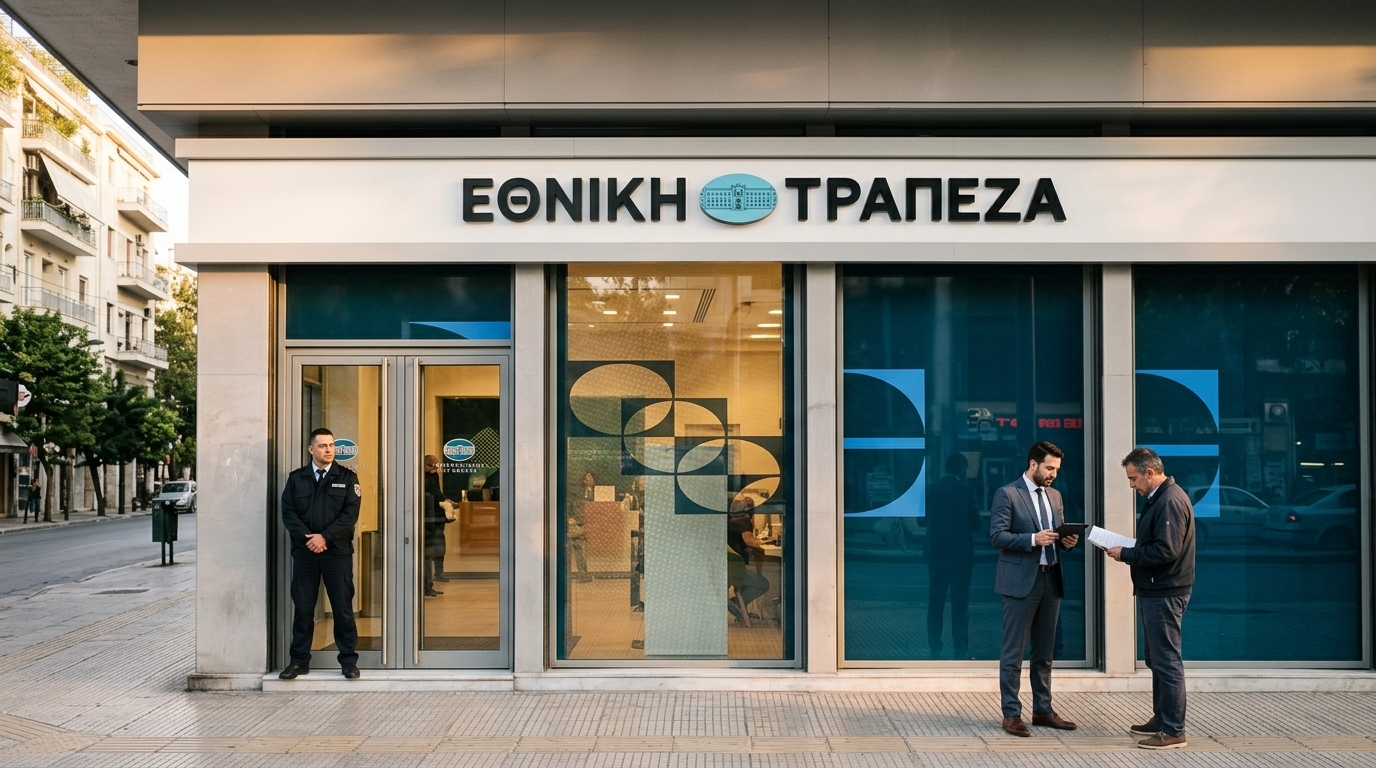
In an era where the global economy appears to be navigating a minefield of geopolitical tensions, inflationary pressures, and climatic uncertainty, the role of financial institutions is being radically redefined. Mr. Vasilis Karamouzis, General Manager of Corporate and Investment Banking at the National Bank of Greece (NBG), speaking recently at the Fortune Greece forum, provided a clear trajectory for the Greek banking system. His central thesis is unequivocal: Greek banks are no longer the 'sick men' of Europe, but fortified organizations ready to anchor the real economy.
From Survival to Leading Resilience
The last decade has been a harsh master for Greek banks. Following a painful process of deleveraging and cleansing balance sheets of Non-Performing Exposures (NPEs), banks entered 2026 with capital adequacy ratios that rival top-tier European groups. Mr. Karamouzis emphasized that this fortification is not accidental; it is the result of strategic planning and rigorous fiscal discipline.
Successive crises—from the pandemic to the energy shock and recent geopolitical upheavals in Eastern Europe and the Middle East—have served as real-time stress tests. The response of the banks was immediate, providing liquidity where needed while maintaining profitability. This balance is critical for maintaining the confidence of international markets, especially now that Greece has firmly established its position within the investment-grade status.
The RRF Catalyst and the Green Transition
One of the most significant tools currently at the disposal of banks is the Recovery and Resilience Facility (RRF). Mr. Karamouzis pointed out that NBG's role in absorbing and channeling these funds is pivotal. It is not merely about lending; it is about providing strategic guidance to businesses toward investments that offer long-term value.
- Energy Autonomy: Financing Renewable Energy Sources (RES) and energy storage infrastructure.
- Digital Transformation: Supporting SMEs in adopting cutting-edge technologies.
- Extraversion: Strengthening export-oriented businesses competing on a global scale.
The green transition represents perhaps the greatest challenge and, simultaneously, the greatest opportunity. Banks are now integrating ESG (Environmental, Social, Governance) criteria into every stage of the lending process. According to Mr. Karamouzis, sustainability is no longer an optional 'luxury' but a prerequisite for the survival and growth of any modern enterprise.
Technology and the Human Element
In the age of Artificial Intelligence, the National Bank of Greece is investing heavily in digitalization. However, Mr. Karamouzis stressed that technology is the means, not the end. Data analytics allow banks to better understand customer needs and offer personalized solutions while simultaneously reducing operational risks.
"The bank of the future is an organization that combines the computational power of AI with the judgment and experience of its human executives," he noted significantly.
Despite digitalization, the relationship of trust remains the cornerstone. Particularly in Corporate Banking, personal contact and deep knowledge of the client’s industry are irreplaceable. NBG aims to be a strategic partner for businesses, offering advisory services that transcend the narrow confines of a traditional loan.
Challenges and Future Outlook
Despite the prevailing optimism, Mr. Karamouzis did not fail to mention the challenges. Persistent inflation and the European Central Bank's interest rate policies create an environment that demands caution. Banks must manage the cost of money in a way that does not stifle growth, while simultaneously maintaining the health of their portfolios.
In conclusion, Mr. Karamouzis's position highlights a new era for Greek banking. With strong capital buffers, digital tools, and a commitment to sustainability, banks are called upon to become the engine of the Greek economy in an uncertain global environment. The fortification achieved in previous years is the springboard for a period of creative growth, provided that stability and commitment to reforms are maintained.





