

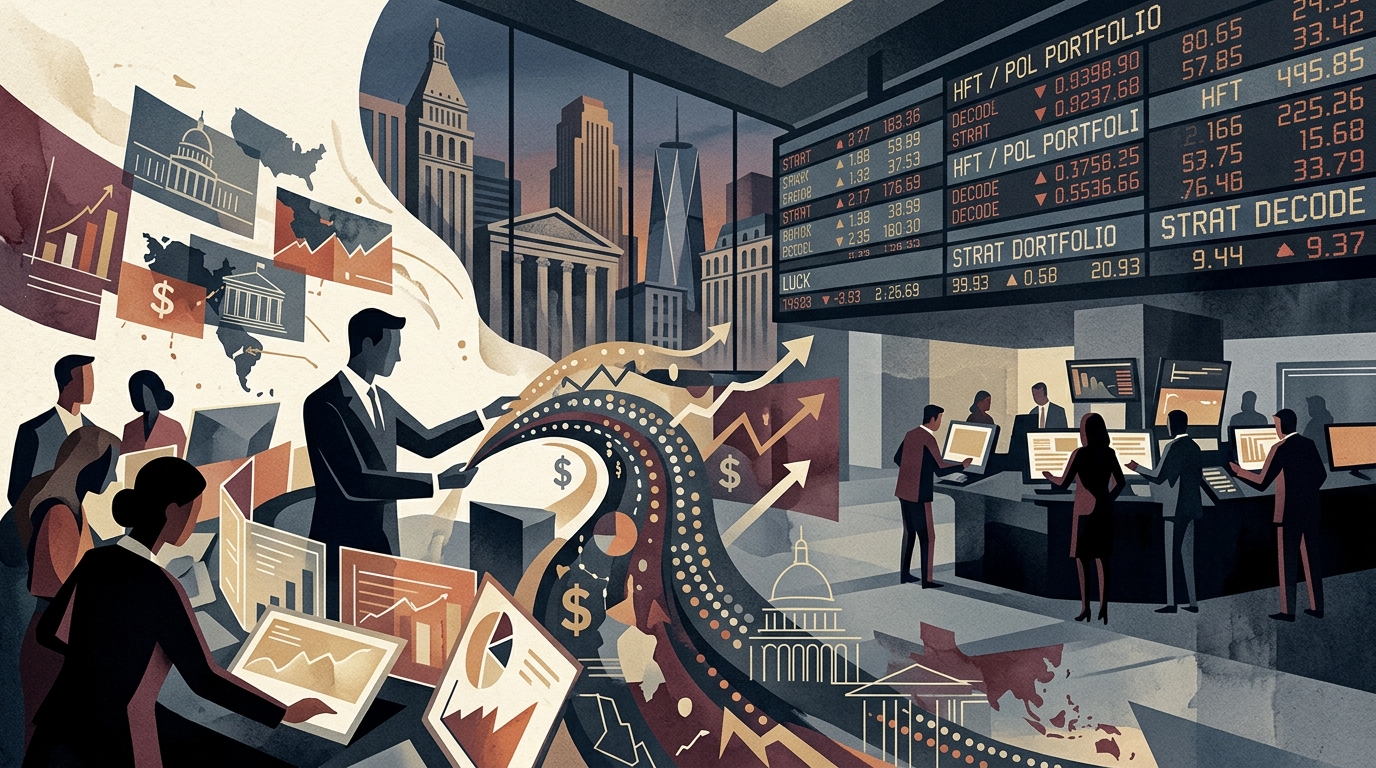
The financial disclosures of major political figures have always been a focus of intense scrutiny, but the latest data regarding Donald Trump’s portfolio in 2026 sets a new benchmark for complexity. With a staggering 3,711 trades executed within a single year, the former President’s holdings no longer resemble a traditional collection of real estate and individual stocks. Instead, they mirror a sophisticated wealth-generation engine utilizing the most advanced tools available on Wall Street. An analysis of these moves reveals a strategy predicated less on personal intuition and more on algorithmic precision and systematic management.
The Supremacy of Automated Management
The first element that strikes observers regarding the massive volume of trades is their frequency. Executing 3,711 transactions suggests that management is not a manual process. Rather, it bears all the hallmarks of institutional-grade automated portfolio management. At this level of net worth, investors employ systems that automatically rebalance positions to maintain specific asset allocations. What we are witnessing is a definitive shift toward indexing—investing in broad market indices rather than picking individual corporate winners and losers. This approach offers two primary advantages: risk diversification and a layer of insulation against conflict-of-interest allegations, as the investor does not personally select the companies but follows the broader market’s trajectory.
However, the complexity does not end with simple indexing. The pattern of trades suggests that many of these moves are overlapping. For instance, the simultaneous sale of one S&P 500 ETF and the purchase of a nearly identical product is not a random occurrence; it is a classic maneuver in portfolio optimization. This leads us to one of the most critical aspects of the Trump portfolio strategy: sophisticated tax mitigation.
The Art of Tax-Loss Harvesting
A significant portion of the 3,711 trades appears to serve a 'tax-loss harvesting' strategy. This is a method where an investor sells securities at a loss to offset capital gains realized elsewhere in the portfolio, thereby reducing the overall tax liability. Within the U.S. tax framework, this practice is legal and widely utilized by high-net-worth individuals, yet the scale at which it is applied here is remarkable.
- Continuous Rebalancing: Algorithms scan the portfolio daily, or even hourly, to identify opportunities to realize losses.
- Substantial Replacement: Upon selling, capital is immediately redeployed into similar assets to ensure the investor remains exposed to market growth.
- Tax Burden Reduction: This strategy can save millions in taxes, particularly during periods of high market volatility where price swings create frequent 'harvesting' opportunities.
This approach highlights a fundamental truth of the modern financial system: wealth management is not just about gross returns, but about net retention. For a political figure of Trump’s stature, the use of such technical tools creates an image of financial power that is increasingly decoupled from traditional, tangible business activities.
Ethical Dilemmas and Political Implications
Despite the legality of these strategies, the sheer volume of transactions makes it nearly impossible for regulators and the public to monitor potential conflicts of interest in real-time. When a portfolio executes ten trades a day through automated systems, the line between 'passive investing' and 'leveraging political insight' (even if done inadvertently through policy shifts) becomes exceedingly blurred. As Fortune AI points out, the difficulty in 'disentangling' these strategies might very well be part of their design.
"Complexity is not just a tool for profitability; it is also a veil of opacity," market analysts observe.
In an era where artificial intelligence manages the lion's share of global capital, the Trump case serves as the ultimate example of how political power intersects with algorithmic economics. The question remaining for 2026 and beyond is whether existing ethics and transparency laws are sufficient to cover portfolios that move with the speed of light and the precision of a quantum computer. Transparency now requires more than just the disclosure of data; it requires the ability to interpret the algorithms that drive it.





