

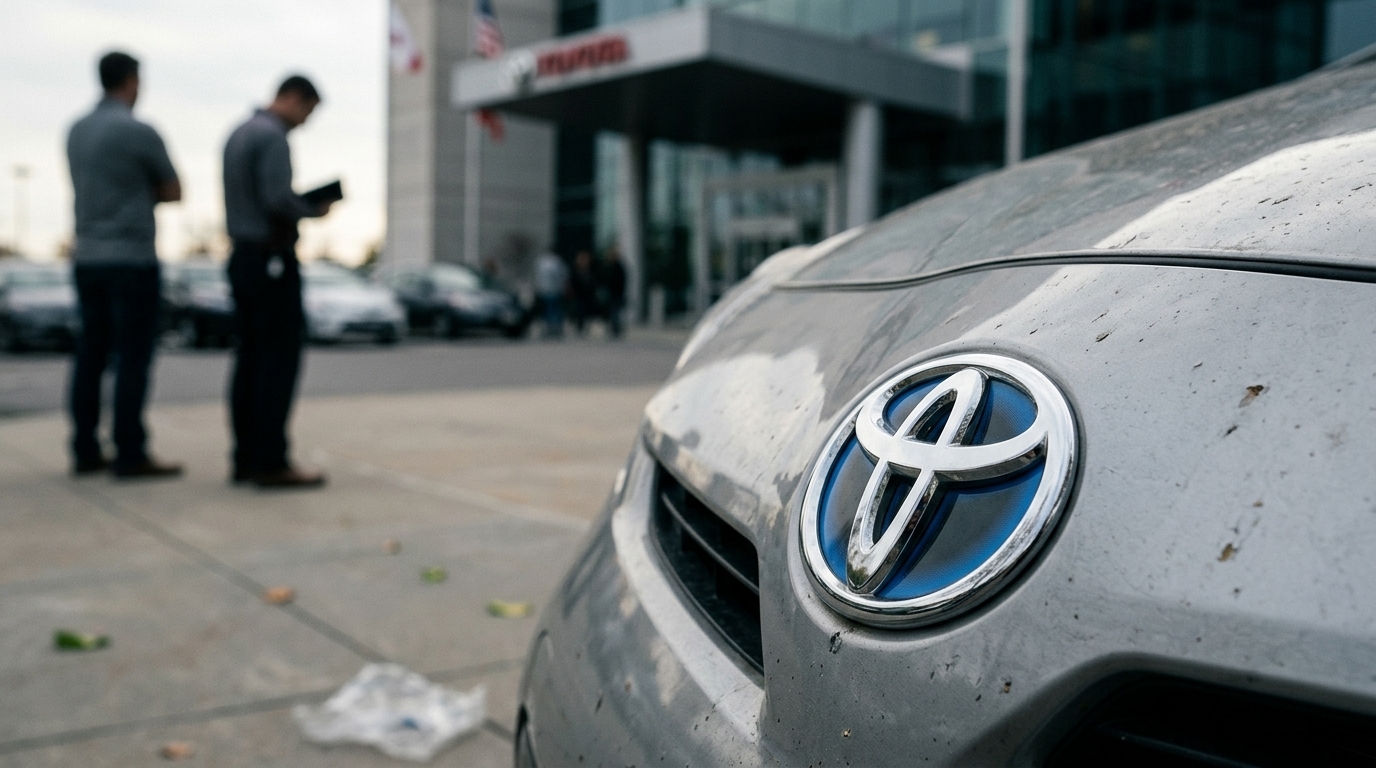
The news reverberated through global financial hubs like a seismic shock, although whispers of a slowdown for the Japanese titan had been growing for months. Toyota Motor Corp., the world’s largest automaker by volume, reported a staggering 49% drop in operating profit for the latest quarter. Despite a marginal revenue increase of 1.89% to 12.6 trillion yen, the company’s profitability is under siege from multiple directions: the aggressive rise of Chinese electric vehicles (EVs), ongoing production disruptions due to certification scandals, and the mounting uncertainty of global trade tariffs.
The China Trap and the Price War
For decades, China was Toyota’s reliable engine of growth. However, the landscape has shifted fundamentally. Chinese automakers, led by giants like BYD, have launched a ruthless price war, bolstered by state subsidies and a vertically integrated battery supply chain. Toyota, which famously chose a more cautious path toward battery electric vehicles (BEVs) in favor of hybrids, now finds itself on the defensive.
In the Chinese market, consumers are pivoting rapidly toward domestic brands that offer cutting-edge software and lower price points. Toyota has been forced to ramp up marketing spend and sales incentives just to maintain its market share, a move that has severely eroded margins. This profit slump in China is not merely a financial metric; it is a warning sign that the traditional manufacturing model for foreign legacy automakers in the region is under existential threat.
Internal Bleeding: Scandals and Production Halts
Internal factors have been equally damaging. Toyota has been rocked by a series of safety and certification scandals involving its subsidiaries, including Daihatsu and Toyota Industries. These revelations led to temporary production suspensions at key domestic plants, directly impacting sales volumes and tarnishing the brand’s hard-earned reputation for unimpeachable quality.
Management, led by CEO Koji Sato, has pledged a “return to basics,” but the cost of this organizational overhaul is substantial. The need for staff retraining, more rigorous oversight, and compensation for suppliers has created a significant financial burden. Furthermore, component shortages for high-demand models hindered the company’s ability to capitalize fully on the robust demand for hybrids in the US and Europe, where consumers are increasingly wary of full EVs.
The Hybrid Bet: Vindication or Cul-de-sac?
There is a profound irony in Toyota’s current predicament. While profits are diving, its long-term strategy favoring hybrids appears to be vindicated in markets outside of China, as EV demand cools in the West. However, this may be a pyrrhic victory. Toyota must now walk a high-wire act: funding the massive transition toward electrification and software-defined vehicles (SDVs) while managing declining profitability from its core internal combustion and hybrid business.
Analysts warn that unless Toyota can drastically reduce the production costs of its upcoming EV lineup, it will continue to see its margins compressed. Investments in breakthrough technologies like solid-state batteries are promising but remain years away from large-scale commercialization. Until then, the Japanese giant must navigate a world of rising protectionism, where shifting tariffs between the US, EU, and China are redrawing the map of global trade and manufacturing.
- A 49% profit drop highlights the severe competitive pressure in the Chinese EV market.
- Certification scandals in Japan have caused costly production delays and reputational damage.
- Toyota’s hybrid-first strategy faces a critical test as it balances R&D for future EVs.
- Global trade tensions and tariffs are complicating the company’s supply chain and pricing strategy.





