

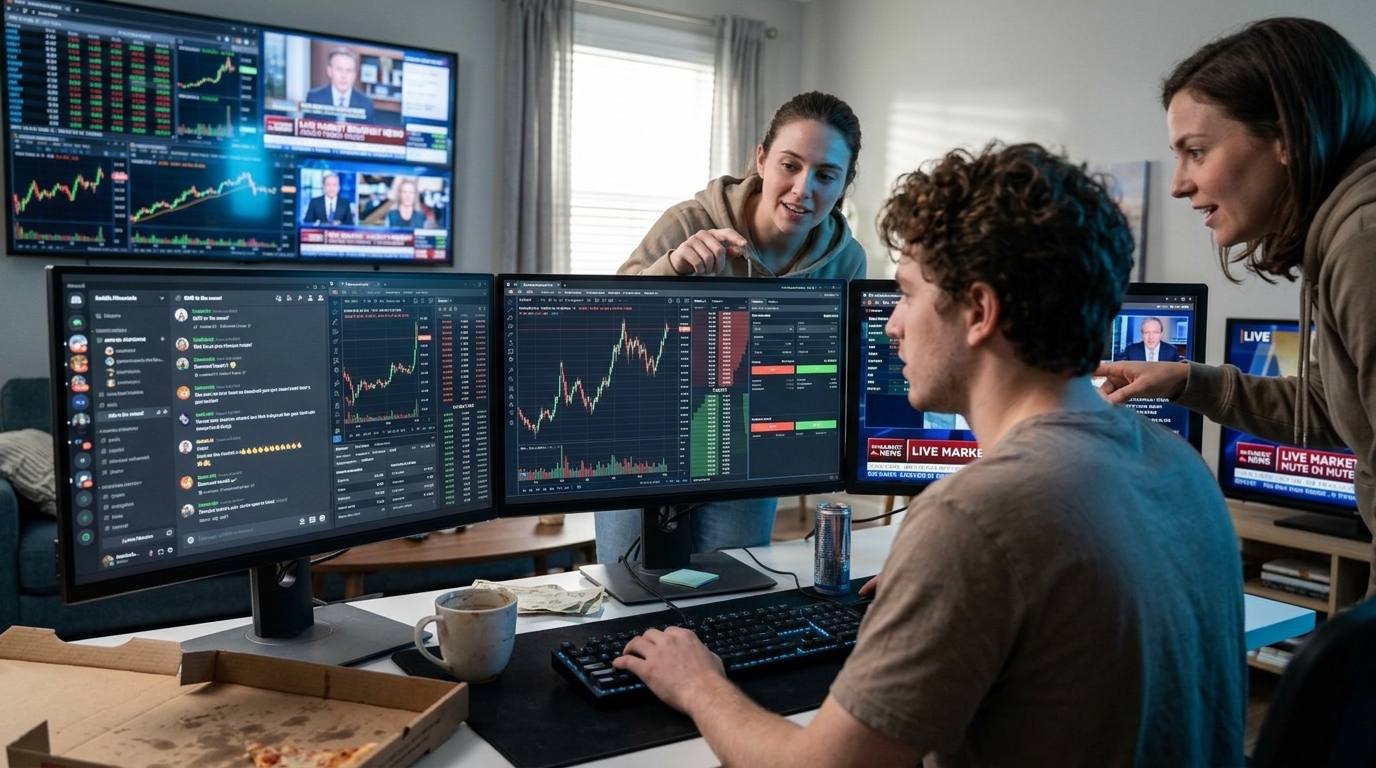
For decades, within the hallowed halls of major investment banks on Wall Street and in the City of London, the term 'dumb money' was used with a mixture of irony and superiority. It referred to retail investors—everyday people putting their savings into the markets without access to Bloomberg terminals, armies of analysts, or the high-frequency algorithms owned by institutional giants. 'Dumb money' was traditionally seen as the last link in the chain: entering the market when a rally had already peaked and selling in a panic at the absolute bottom.
The Great Reversal: From the Margins to Center Stage
However, the last five years have signaled a structural shift that few predicted. The revolution began quietly with the elimination of trading commissions by platforms like Robinhood and reached its zenith during the pandemic, when millions of people, confined to their homes, discovered the allure of stock indices. What was once an elite activity transformed into a mass social networking phenomenon. The GameStop saga of 2021 was not a fluke; it was the warning shot of a new reality: 'amateurs' can now coordinate, attack short-sellers, and inflict billions of dollars in losses on hedge funds.
This power stems not just from the number of participants, but from access to information. Today, a teenager in their bedroom can use Artificial Intelligence tools to analyze balance sheets, track options activity in real-time, and read research that was previously locked behind expensive paywalls. Information asymmetry—the traditional 'moat' protecting professionals—has begun to crumble.
AI: The Great Equalizer
If the 2010s were the era of social media, the 2020s are the era of AI. Retail investors no longer rely solely on 'gut feeling' or Reddit rumors. They are utilizing Large Language Models (LLMs) to summarize central bank minutes, perform back-testing on strategies, and create their own trading codes. What Wall Street dismissed as 'dumb money' is becoming increasingly sophisticated, using the same technology as the banks but with greater agility and fewer bureaucratic hurdles.
- Democratization of data through open-source platforms.
- Utilization of sentiment analysis algorithms to predict market trends.
- Participation via fractional shares, allowing access to high-priced stocks with minimal capital.
"The market is no longer a closed club for gentlemen in suits. It is a global network where the intelligence of the crowd often surpasses the wisdom of the experts," says a senior market analyst.
The Dangers of Gamification
Despite the progress, the amateur revolution is not without its dark side. The 'gamification' of investing—with casino-like graphics and dopamine-inducing notifications—has led many into excessive risk-taking. Markets have become more volatile, as mass movements by retail investors can trigger sharp spikes or crashes without fundamental justification. Furthermore, the ease of access to derivatives (options) has turned the stock market into a high-stakes gambling arena for many who do not fully grasp the risks involved.
The question now is whether regulatory bodies, such as the SEC in the US or ESMA in Europe, can protect investors without stifling market freedom. The battle over 'Payment for Order Flow' (PFOF)—the mechanism by which brokers profit from their customers' orders—is at the heart of a political and economic confrontation that will define the future of stock exchanges.
Conclusion: A New Equilibrium
'Dumb money' is no longer dumb. It is organized, technologically equipped, and conscious of its power. Institutional investors are now forced to monitor social media and retail forums to avoid being blindsided. The market is transforming into a more democratic, yet simultaneously more chaotic environment. In this new world, knowledge remains the most valuable currency, but the source of that knowledge has permanently changed hands.





