

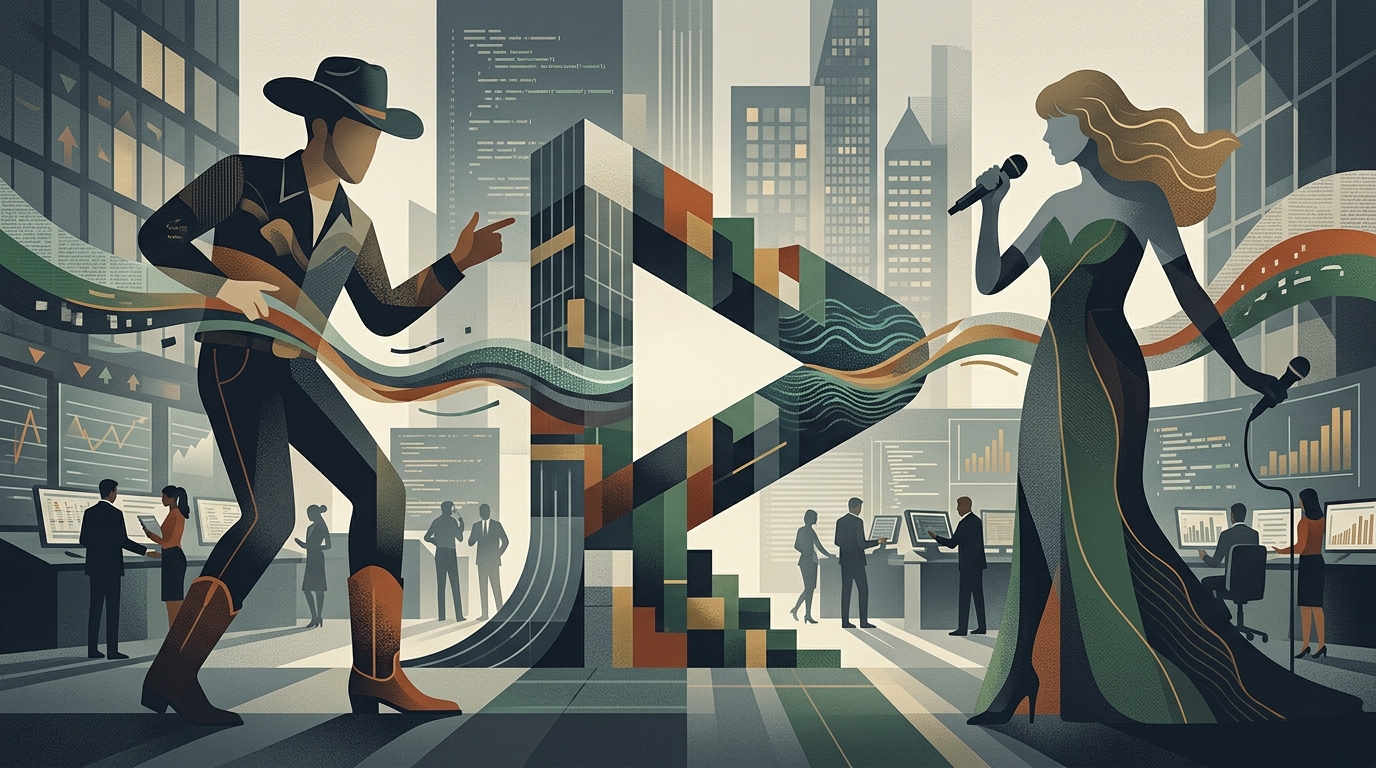
In today's digital arena, success is no longer measured by gold records hanging on studio walls, but by the relentless rhythm of algorithms and billions of real-time streams. Spotify's latest reports confirm what many have long suspected: we are living in the era of the absolute dominance of Taylor Swift and Bad Bunny. These two artists are not merely musicians; they are economic phenomena who have managed to crack the code of globalized attention, each in their own unique way.
The Taylor Swift Strategy: From Ownership to Empire
The case of Taylor Swift is a masterclass in business strategy that will be studied for decades. It is not just about her songwriting; it is about how she reclaimed control over her intellectual property. Her decision to re-record her early albums—the famous 'Taylor’s Versions'—was not only an artistic statement of independence but a brilliant financial move that forced Spotify and other platforms to redirect revenue streams directly to her pocket.
With the release of 'The Tortured Poets Department' and the continued juggernaut of the 'Eras Tour,' Swift has created an ecosystem where every stream acts as an advertisement for a broader brand. Her fans, the 'Swifties,' do not just listen to music; they participate in an ongoing narrative, hunting for 'easter eggs' and boosting platform metrics to levels previously thought impossible. Swift is the first artist to successfully turn digital listening into a form of modern 'religion' with immense economic impact, effectively becoming a billionaire through her craft and business acumen.
Bad Bunny: Ambassador of the Global South
If Swift represents the perfection of the English-speaking pop machine, Bad Bunny is the definitive proof that the music industry's center of gravity has shifted. The Puerto Rican artist has dominated Spotify’s charts for consecutive years while singing exclusively in Spanish. This achievement shatters the old dogma that global success must inevitably pass through the English language.
Bad Bunny's rise reflects a demographic and cultural shift in content consumption. His reggaeton and trap rhythms have resonated not only in Latin America but also in markets like Europe and Asia, proving that Spotify's algorithm is now blind to linguistic borders, provided the rhythm and authenticity are present. Bad Bunny is no longer a 'Latin' artist; he is the definition of a global superstar, leveraging the mass scale of streaming services to impose his own aesthetic on the world stage.
Streaming Economics and the Creator Gap
However, behind the dazzling numbers of Swift and Bad Bunny lies a harsh reality for the music industry. Spotify's model disproportionately favors the top of the pyramid. While these two artists generate billions in revenue, the 'middle class' of musicians struggles to survive on streams alone.
- Concentration of streams among a few 'super-artists' reduces the visibility of emerging creators.
- Payouts per stream remain notoriously low, forcing artists to rely on touring and merchandising for actual profit.
- The power of curated playlists (like 'Today’s Top Hits') acts as the new industry gatekeeper, replacing traditional radio programmers.
The dominance of Swift and Bad Bunny confirms that in the age of Big Data, attention is the most expensive currency. Spotify, as a platform, needs these titans to retain its subscribers, but at the same time, the artists themselves have become so powerful that they can dictate their own terms to the market. The music industry of 2026 is no longer about 'who is the best singer,' but about 'who can dominate the data ecosystem.'
"Music is no longer a product you buy, but a service you rent, and Swift and Bad Bunny are the landlords of the most expensive real estate in this digital landscape."
In conclusion, the trajectory of these two artists signals the future of entertainment. It is a future where borders are fluid, languages blend, and economic power stems from an artist's ability to remain at the center of the digital conversation every single second of the day.





