

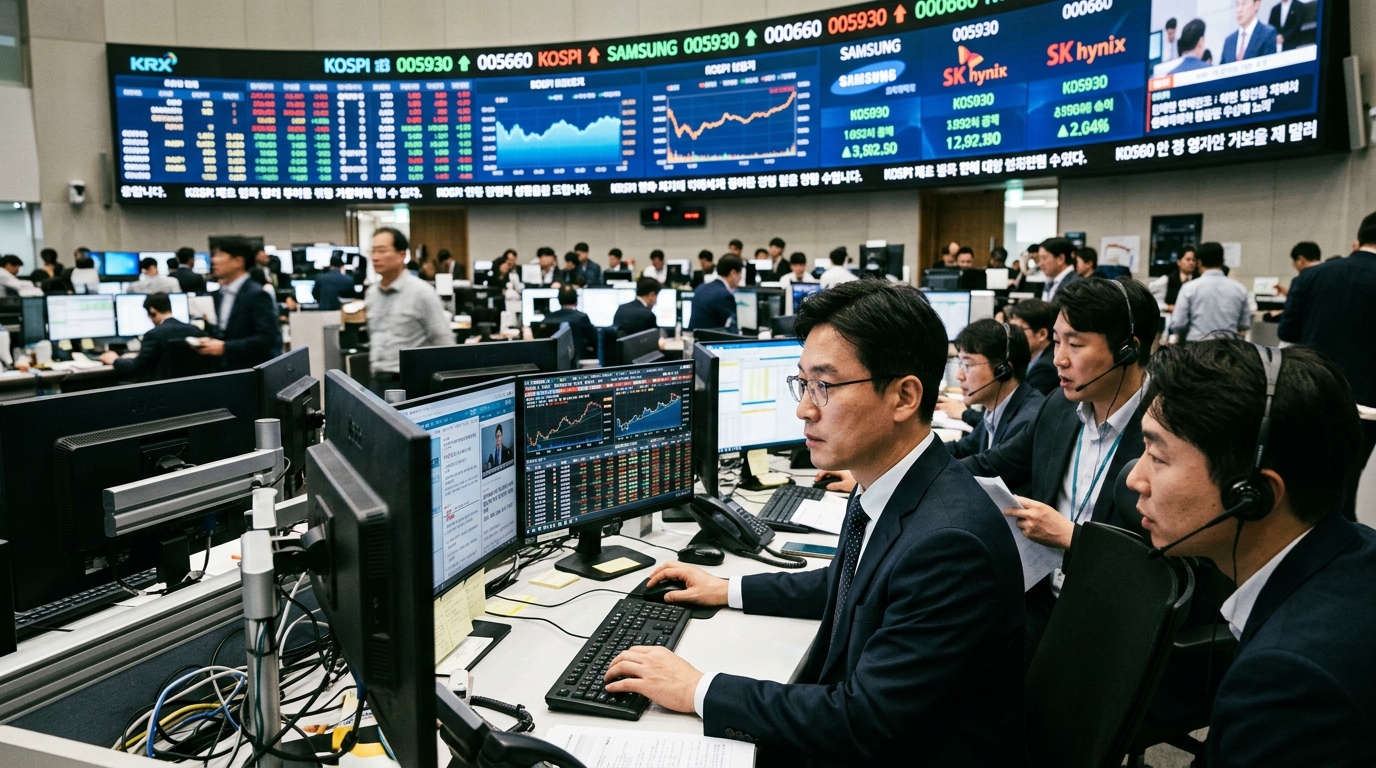
In the global theater of technology, semiconductors are no longer mere components; they are the "oil" of the 21st century, and South Korea has no intention of abdicating its throne. Through a series of aggressive maneuvers reminiscent of its golden era of industrial rise, Seoul is accelerating its investments, aiming to become the ultimate hub for Artificial Intelligence (AI). The recent announcement to bolster the semiconductor "Mega Cluster" in Gyeonggi Province marks the culmination of a national strategy that transcends economic boundaries, touching upon national security.
The Gyeonggi Mega Cluster: A $470 Billion Vision
The heart of South Korea’s strategy beats in Gyeonggi Province, where the government, in collaboration with giants like Samsung Electronics and SK Hynix, is constructing the world’s largest semiconductor production complex. The plan envisions investments totaling 622 trillion won (approximately $470 billion) by 2047. The objective is clear: creating 13 new fabrication plants (fabs) and three research centers, adding to the existing 21 facilities.
This move is not just about quantity; it’s about quality. South Korea seeks to vertically integrate production, from chip design to advanced packaging—an area where it has traditionally lagged behind Taiwan’s TSMC. President Yoon Suk Yeol's administration has made it clear that semiconductors are a "war," and in this war, speed is everything. Tax breaks of up to 25% for strategic investments serve as the bait to keep domestic players within borders and attract foreign equipment suppliers.
The HBM Factor: Securing the AI Memory Throne
If semiconductors are the engine, High Bandwidth Memory (HBM) is the high-octane fuel for AI. Here, South Korea maintains a significant advantage. SK Hynix, the world’s second-largest memory chipmaker, has successfully become the primary supplier for Nvidia, the company dominating AI processors.
However, competition is ruthless. Samsung Electronics, after missing the first wave of HBM3, is striking back with HBM3E and the development of the next generation, HBM4. The battle for AI memory supremacy is not just a corporate rivalry; it is a test of whether South Korea can transition from producing "commodities" (commodity DRAM) to specialized, high-value-added solutions required by the algorithms of OpenAI and Google.
"It is no longer about who makes the most chips, but about who makes the chips that allow the machine to think faster," notes a market analyst in Seoul.
Navigating the Geopolitical Tightrope: Between Washington and Beijing
South Korea’s strategy unfolds within an extremely complex geopolitical environment. Washington, through the CHIPS Act, is pressuring Seoul to limit high-tech exports to China, which remains South Korea’s largest trading partner. The balance is delicate: Samsung and SK Hynix operate massive production units in China that they cannot abandon overnight.
Seoul is attempting to use its technological prowess as a "silicon shield." By strengthening domestic production and self-sufficiency in critical materials, South Korea reduces its dependence on global supply chains exposed to political volatility. Simultaneously, the partnership with the Dutch firm ASML to create a research center in Korea demonstrates an intent for closer ties with the West without provoking a frontal collision with Beijing.
Infrastructure Hurdles: The Thirst for Power and Precision
Despite the billions in investment, the road to the top is fraught with obstacles. Semiconductor production is an extremely energy-intensive process. The Gyeonggi Mega Cluster will require vast amounts of electricity at a time when South Korea is striving to meet climate change goals. A pivot back to nuclear energy seems to be the solution favored by the Yoon administration, reversing the phase-out policy of the previous government.
Furthermore, the shortage of specialized personnel is a "ticking bomb" at the foundation of this vision. With the country’s population shrinking at one of the fastest rates in the world, finding the 30,000 new engineers required for the new cluster is a challenge that may necessitate radical changes in the educational system and immigration policy. South Korea is not just investing in machines; it must also invest in its own demographic future.





