

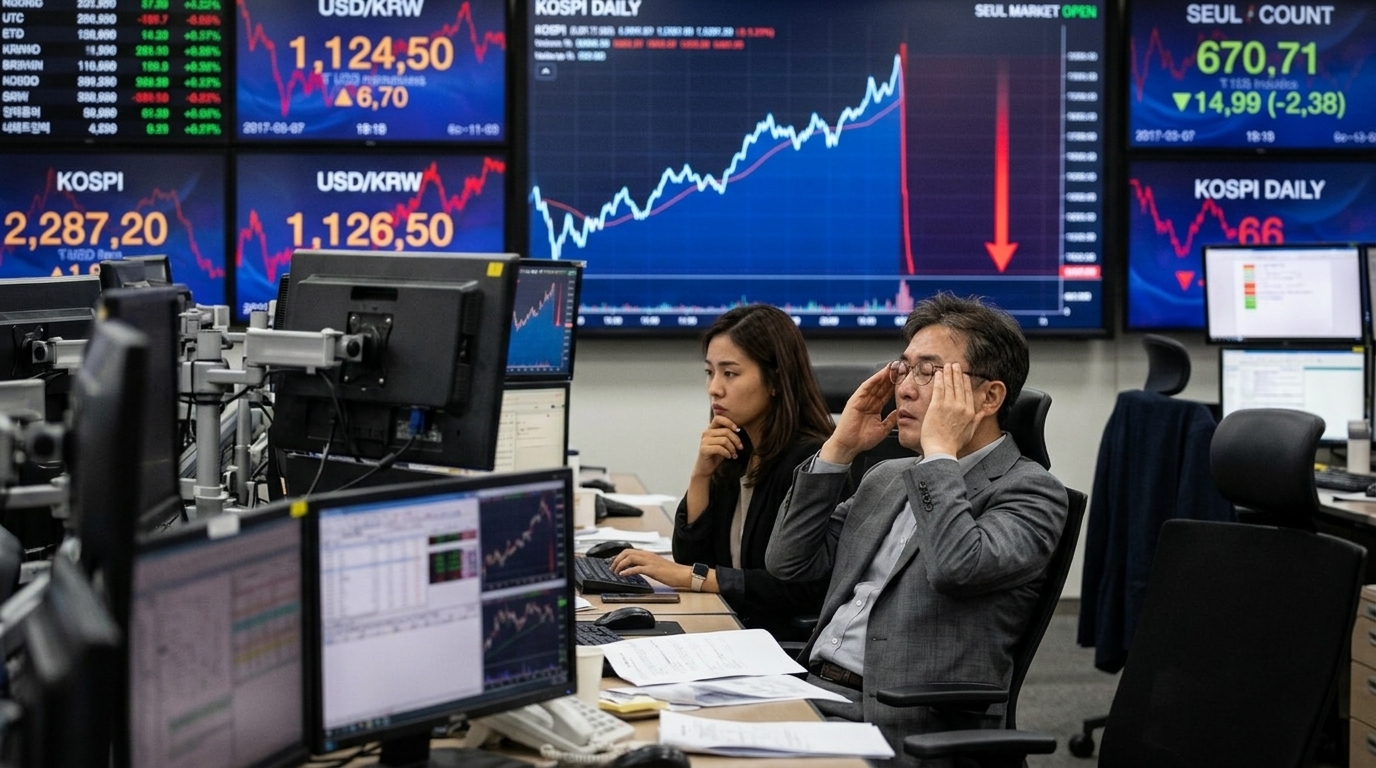
South Korea's stock market is at a critical juncture. While the Kospi index has recorded performances that would be the envy of many Western markets, the recent move by foreign investors to liquidate positions worth billions of dollars is causing concern among analysts. On Monday, net sales amounted to a staggering 1.24 trillion won (approximately $801 million), a move that stands in stark contrast to the climate of euphoria that the Seoul government is trying to cultivate.
The Chronic Problem of the 'Korea Discount'
For decades, Korean stocks have traded at lower price-to-earnings multiples compared to their global peers. This phenomenon, known as the 'Korea Discount,' is mainly attributed to the opaque structure of chaebols (large family-owned conglomerates like Samsung and Hyundai), low dividend yields, and geopolitical tensions with North Korea. President Yoon Suk Yeol's administration introduced the 'Corporate Value-up Program,' inspired by Japan's successful model, aiming to force listed companies to improve their governance and return more value to shareholders.
However, the mass exodus of capital shows that foreign investors remain skeptical. Despite promises of tax incentives and stricter governance rules, the market seems to perceive the measures as voluntary and lacking the necessary 'teeth' to change a decades-old culture. Investors are not convinced by declarations; they demand tangible results in capital management.
The AI and Semiconductor Trap
Another factor that fueled the recent rally, but also the subsequent liquidation, is Korea's heavy reliance on the semiconductor industry. Samsung Electronics and SK Hynix form the backbone of the Kospi. The Artificial Intelligence (AI) boom drove the shares of these giants to record highs, as demand for High Bandwidth Memory (HBM) skyrocketed.
"The Korean market has turned into a bet on AI. When investors feel that the sector's global valuation has reached saturation, Seoul is the first to feel the pressure," says a senior investment bank executive.
The recent sell-off is interpreted by many as a 'profit-taking' move. Foreign fund managers, seeing uncertainties in the global economy and the upcoming US elections, prefer to withdraw liquidity from emerging or regional markets considered high-risk, despite the positive fundamentals of individual companies.
Macroeconomic Pressures and the Won
Monetary policy also plays a decisive role. The strength of the US dollar against the Korean won makes investments in Seoul less attractive for foreigners, as the depreciation of the local currency 'eats' into stock returns. The Bank of Korea (BoK) is in a difficult balancing act: it must keep interest rates high enough to support the currency and fight inflation, without strangling domestic consumption and growth.
- Uncertainty surrounding Federal Reserve moves directly affects capital flows to Asia.
- Geopolitical frictions between the US and China directly impact Korea's supply chain.
- Internal political instability and opposition reactions to economic measures create a climate of anticipation.
In conclusion, the massive sale of Korean stocks is not necessarily a vote of no confidence in corporate profitability, but a reminder that structural changes require time and consistency. For foreign investors to return with a long-term horizon, Seoul must prove that 'Value-up' is not just an election slogan, but a deep incision into the country's capitalist model.





