

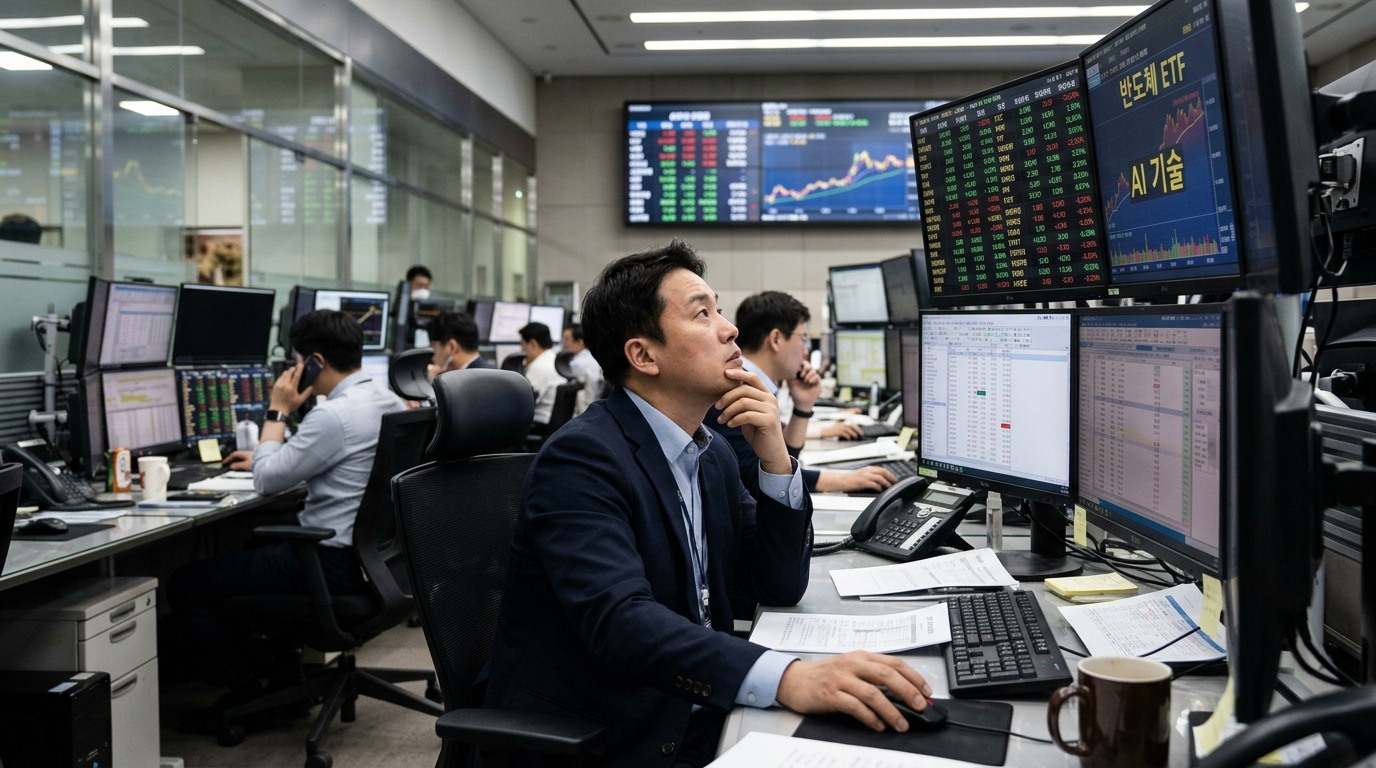
In the heart of Seoul, the South Korean stock exchange (KRX) is undergoing an unprecedented transformation. As global demand for Artificial Intelligence (AI) infrastructure continues to soar in 2026, the country once known as the "granary of memory chips" is evolving into the ultimate investment destination through Exchange-Traded Funds (ETFs). The recent surge in specialized AI and semiconductor-themed ETFs is not merely a market trend but a strategic alignment of the Korean economy with the future of computing power.
The HBM Dominance and the Asset Manager War
The key to understanding this explosion lies in three letters: HBM (High Bandwidth Memory). High Bandwidth Memory is the indispensable component for processors from Nvidia and other giants powering Large Language Models (LLMs). South Korea, through SK Hynix and Samsung Electronics, controls nearly 90% of the world's HBM production. This near-monopoly has led local asset managers, such as Mirae Asset Global Investments (TIGER) and Samsung Asset Management (KODEX), into a race to create the most efficient ETF vehicles.
New ETFs are no longer limited to broad tech exposure. Instead, we are witnessing a shift toward hyper-specialization. For instance, the 'TIGER AI Semiconductor Core Process' ETF focuses exclusively on companies handling packaging and testing stages, which have become critical for AI chip performance. Investors are no longer just buying "tech"; they are buying specific segments of the supply chain that offer the highest profit margins.
On-Device AI: The Next Investment Frontier
While 2024 and 2025 were dominated by cloud infrastructure and data centers, 2026 marks the era of "On-Device AI." This refers to the ability of devices—smartphones, laptops, and wearables—to run complex AI algorithms locally, without an internet connection. South Korea, as the home of Samsung, is at the forefront of this revolution.
- Strategic Diversification: ETFs focusing on On-Device AI include low-power chip design firms and component manufacturers for the next generation of Galaxy devices.
- Capital Inflows: In the first half of 2026 alone, inflows into semiconductor ETFs in South Korea exceeded $5 billion, with a significant portion coming from foreign institutional investors seeking alternatives to the overextended US market.
- Resilience: Despite geopolitical pressures, Korea's expertise in memory semiconductors makes it an irreplaceable link in the global chain.
"South Korea is no longer just manufacturing parts; it is manufacturing the brain of the global AI economy," says a leading analyst in Seoul.
Geopolitics and Risks: A Tightrope Walk
Despite the optimism, the ETF landscape in South Korea is not without risks. Dependence on exports to China and strict US restrictions on cutting-edge technology exports create a complex environment. ETFs containing companies with heavy exposure to the Chinese market have shown higher volatility. However, the "Chip 4 Alliance" (US, Japan, South Korea, Taiwan) strategy seems to be strengthening Seoul's position in the long run.
Furthermore, internal competition among asset managers has led to a significant reduction in management fees (expense ratios), making these products highly attractive to retail investors. The "Ant Movement" (Korea's retail investors) has shifted en masse from individual stocks to thematic ETFs, seeking the risk diversification offered by well-structured portfolios.
Conclusion: A New Era for K-Finance
The rise of AI and Semiconductor ETFs in South Korea serves as a blueprint for how national economies can capitalize on technological revolutions. As we move into the second half of 2026, Seoul's ability to innovate not only in chip manufacturing but also in the financial packaging of these assets will define its economic standing for the next decade. For the global investor, Korean ETFs offer a unique gateway to the heart of the AI revolution, where software meets hardware.





