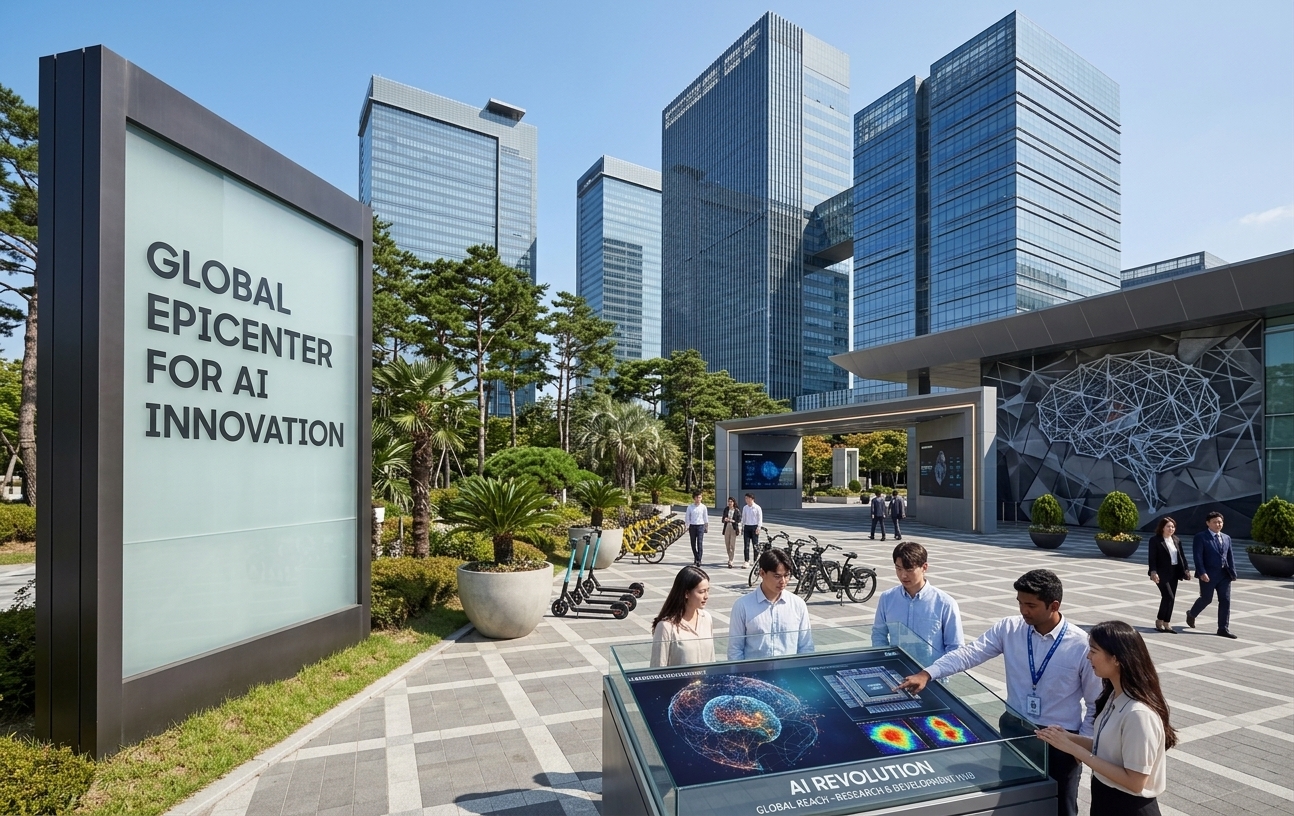
In a move that redefines the global map of technology and geopolitical power, Samsung Electronics, in close coordination with the South Korean government, has announced a gargantuan investment plan totaling $648 billion (approximately 622 trillion won). This initiative is far more than a mere corporate expansion; it is a national strategy for survival and dominance in the Age of Artificial Intelligence (AI). At the core of this endeavor lies the creation of a massive semiconductor "mega-cluster," set to become the largest and most sophisticated hub of its kind on the planet, cementing the nation’s status as the undisputed leader in chip production.
The Silicon Valley of the East: Birth of the World's Largest Chip Hub
The ambitious roadmap envisions the development of a sprawling manufacturing complex in Gyeonggi Province, near Seoul, with significant extensions into regions outside the metropolitan area. Samsung’s move aims to construct 13 new chip fabrication plants (fabs) and three research facilities by 2047. This total investment, spanning over two decades, is heavily backed by the state through tax incentives, energy and water infrastructure support, and the streamlining of regulatory hurdles.
The strategic choice of location is deliberate. While Seoul remains the economic epicenter, the emphasis on regional areas outside the capital reflects a need for balanced national growth and a reduction in urban congestion. Furthermore, the creation of such an ecosystem is expected to attract hundreds of suppliers and fabless design firms, building a value chain that will be difficult for any other nation to emulate. According to government estimates, the project is projected to generate over 3.4 million jobs, providing a monumental boost to the South Korean economy.
The Geopolitics of Silicon: The AI Stakes
Artificial Intelligence demands immense computational power and specialized memory. This is precisely where Samsung is focusing its efforts. The demand for High Bandwidth Memory (HBM) chips, essential for training large-scale AI models like GPT-5, has skyrocketed. Samsung is currently locked in a fierce competition with SK Hynix to supply NVIDIA, the dominant player in AI graphics processing units. The $648 billion investment plan ensures that Samsung will have the manufacturing capacity to lead this nascent but explosive market.
However, the stakes are also deeply geopolitical. With the United States pushing for the reshoring of chip production via the CHIPS Act and China investing billions in technological self-reliance, South Korea risks being caught in the crossfire. By investing domestically on such a scale, Samsung and Seoul are ensuring that the country remains an indispensable partner for the West while keeping control of critical technology within its own borders. It is a strategy of "fortress development" aimed at protecting national security through technological supremacy.
Challenges and Competition: The 2nm Battle
Despite the astronomical investment figure, the path forward is fraught with challenges. Samsung faces the formidable TSMC of Taiwan, which currently holds the lion's share of the foundry market—manufacturing chips for giants like Apple and Qualcomm. The battle for supremacy at the 2-nanometer (nm) node is the next major milestone. Samsung’s ability to improve its production yields on these advanced nodes will determine whether the mega-cluster becomes a profitable engine of growth or a costly infrastructure project without a corresponding client base.
"This isn't just about factories. It's about building a new cultural and economic paradigm where information and matter merge through semiconductors," say industry analysts in Seoul.
Furthermore, the energy challenge is immense. A cluster of this magnitude requires vast amounts of electricity. South Korea has committed to utilizing nuclear energy and renewable sources to power the cluster, a decision that has sparked debates regarding the project's environmental sustainability. Ultimately, the success of the plan will hinge on Samsung’s ability to innovate faster than its rivals, effectively converting massive capital into technological leadership.
Conclusion: A New Era for Korea
The $648 billion investment plan is a declaration of power. In a world that is becoming increasingly fragmented, South Korea is choosing to double down on what it does best: manufacturing excellence. For Samsung, the success of this plan will mark its transformation from an electronics giant into an indispensable pillar of global AI infrastructure. For the world, it means that the heart of the digital revolution will continue to beat strongly on the Korean peninsula for decades to come.