

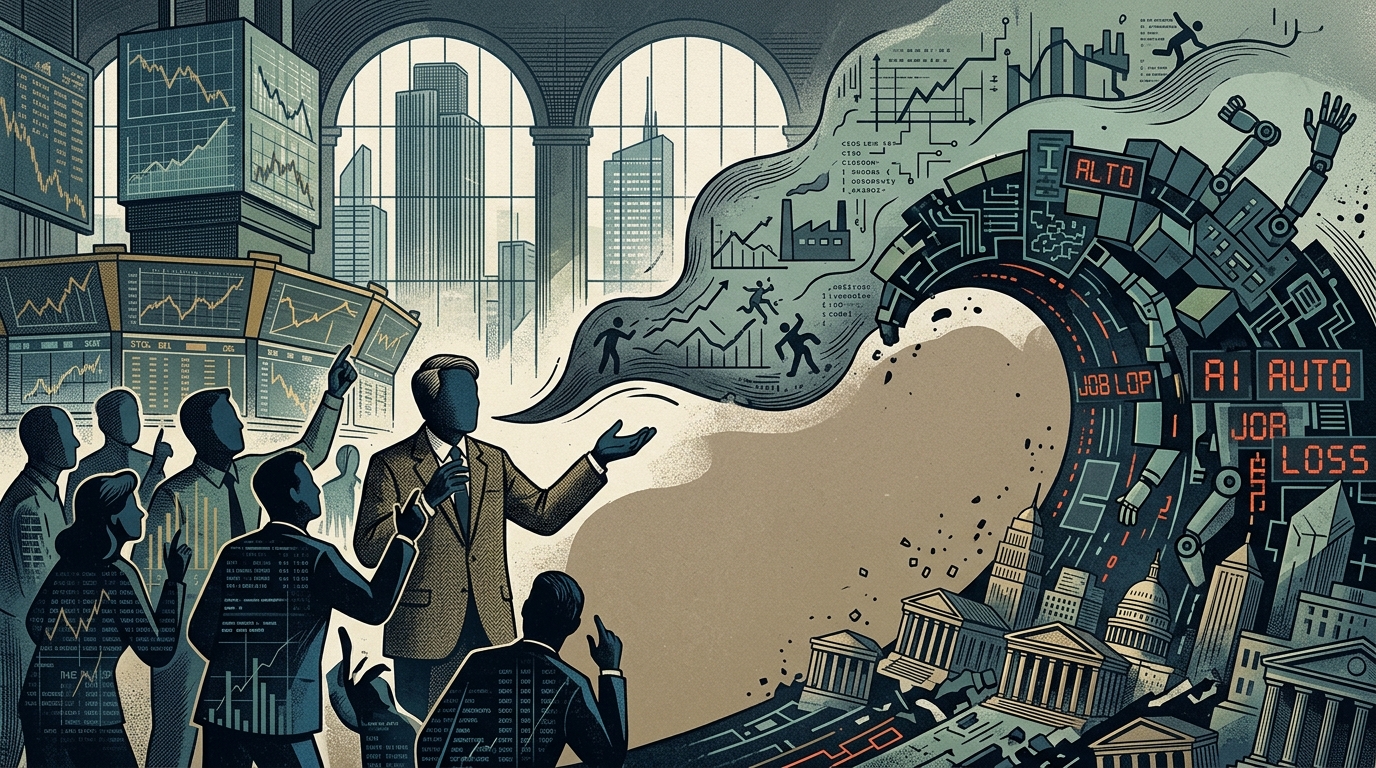
As we navigate the middle of 2026, the discourse surrounding Artificial Intelligence (AI) has shifted from technical feasibility to existential economic anxiety. Robert Shiller, the Yale University Nobel laureate economist renowned for his timely warnings regarding the dot-com and housing bubbles, is now intervening in one of the most critical debates of our era. His warning is both clear and unsettling: our very fear of an "AI job apocalypse" may be the catalyst that brings it to fruition.
Narrative Economics and the AI Specter
Shiller, who pioneered the concept of "Narrative Economics," argues that the stories we tell ourselves and others have the power to drive economic trends more effectively than fundamental macroeconomic data. In the case of AI, the dominant narrative is one of replacement and the obsolescence of the human workforce. When millions of people—from C-suite executives to entry-level employees—make decisions based on negative expectations, a self-reinforcing downward spiral is created.
"When people fear they will lose their jobs in two years, they stop spending today," Shiller explains. "When businesses believe their workforce will become obsolete, they cease investing in human capital. This preemptive contraction of economic activity can lead to a recession, which we will then erroneously blame on the technology itself, when in fact it was the result of our collective psychology."
The Mechanism of the Self-Fulfilling Prophecy
The phenomenon of the self-fulfilling prophecy in economics is not new, but the velocity of information in 2026 makes it more dangerous than ever. Shiller points out that corporations, under pressure from shareholders for immediate AI-driven profitability, may engage in "preemptive layoffs." These are not layoffs mandated by current necessity, but by the fear that failing to automate immediately will result in falling behind the competition.
- Reduced Consumption: Insecure workers increase their precautionary savings, dampening overall market demand and slowing GDP growth.
- Investment Freezes: Companies bypass long-term projects requiring human expertise in favor of automated solutions, even if those solutions are not yet fully optimized.
- Social Destabilization: The sense of inevitable unemployment fuels political polarization and resistance to innovation, creating a hostile environment for growth.
The Need for a New Narrative
According to Shiller, the solution is not to halt technological progress—which he deems impossible—but to change the narrative. Instead of "apocalypse," we must focus on "augmentation." Historical precedence shows that every major technological revolution, from the steam engine to the internet, has eventually created more jobs than it destroyed, though the new roles were often unimaginable before they appeared.
"Human history is a story of adaptation. If we allow fear to dominate, we will sabotage our own transition to a more productive economy," Shiller emphasizes.
The Nobel laureate calls upon political leaders and CEOs to take responsibility for their rhetoric. Discussions regarding a "useless class" of humans are not only ethically reprehensible but economically hazardous. Market stability relies on confidence, and that confidence is shattered when technological progress is framed as a hurricane that will sweep away everything in its path.
Conclusion: Toward a Balanced Perspective
In conclusion, Robert Shiller’s warning serves as a vital wake-up call. Artificial Intelligence is a tool, and like any tool, its impact depends on how we utilize and perceive it. If we continue to feed the narrative of destruction, we risk creating an economic reality where unemployment and stagnation are the results of our own choices rather than the intelligence of machines. The challenge for 2026 and beyond is to manage not just the algorithms, but human expectations.





