

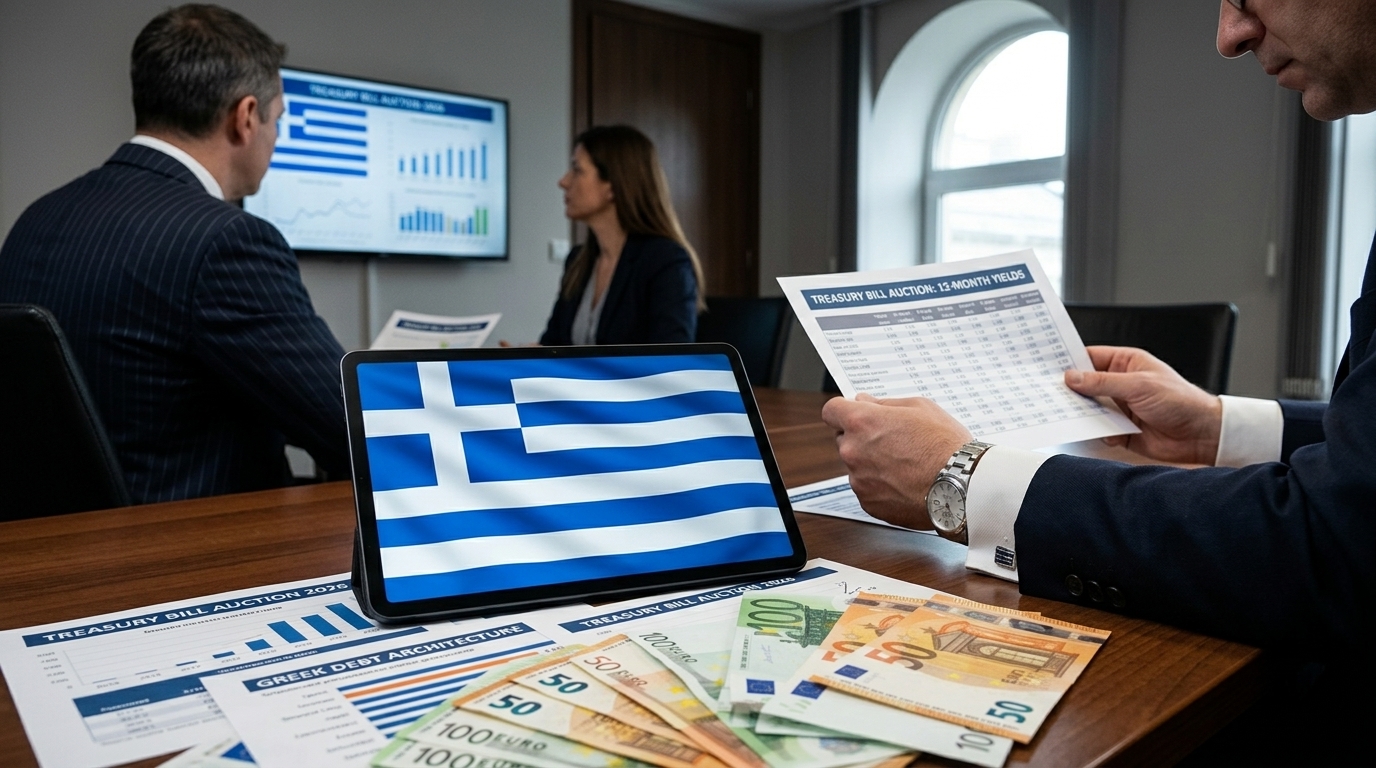
The announcement by the Public Debt Management Agency (PDMA) regarding the auction of 6-month Treasury bills on June 24, 2026, totaling 400 million euros, is more than a routine entry in the Greek economic calendar. Rather, it serves as a critical barometer of market confidence and the strategic direction the country is pursuing in the post-investment grade era. These 26-week securities, maturing on December 28, 2026, arrive at a time when the Greek economy is striving to consolidate its stability within a global environment that remains volatile.
Liquidity Strategy and the Role of Retail Investors
The Greek State, through the PDMA, continues to implement a policy of prudent borrowing, focusing on maintaining a robust cash buffer and the smooth refinancing of its short-term obligations. This specific €400 million issuance aims to cover current needs while enhancing the secondary market for securities. One of the most compelling aspects of the upcoming auction is the opportunity for retail investors (individuals) to participate through public subscription.
At a time when systemic banks in Greece maintain deposit rates at relatively low levels despite previous interest rate hikes by the European Central Bank (ECB), Treasury bills are emerging as an exceptionally attractive alternative. For the average Greek saver, purchasing sovereign debt is no longer a remote investment act but a move to safeguard capital with yields often exceeding 3%, accompanied by tax exemptions on interest, provided the securities are held until maturity.
The Macroeconomic Context and the ECB
The June 24 auction takes place under the shadow of decisions made in Frankfurt. As we move through the first half of 2026, the ECB appears to be adopting a more cautious stance regarding monetary easing. While Eurozone inflation has shown signs of deceleration, structural pressures persist, directly impacting sovereign bond yields. Greece, having regained its credibility in international markets, now enjoys spreads that compare favorably with those of core European countries like Spain and Portugal.
- The auction will be conducted using the competitive bid method via Primary Dealers.
- Provisions are made for non-competitive bids of up to 30% of the auctioned amount.
- Retail investors can acquire securities up to €15,000 per individual, ensuring the same yield as the auction.
This "democratization" of debt is a strategic objective of the economic team. By encouraging domestic savings to flow toward state Treasury bills, the government reduces its reliance on foreign institutional investors for short-term needs while offering an outlet for citizens whose purchasing power is squeezed by the cost of living.
Challenges and Outlook for the Second Half
Despite the positive outlook, challenges remain. Managing Greek debt in 2026 requires surgical precision. With public debt as a percentage of GDP on a downward trajectory, maintaining investor confidence is vital. Markets are closely monitoring not only fiscal targets but also the progress of reforms linked to the Recovery and Resilience Facility (RRF).
"The stability of the Greek economy is not judged solely by the big numbers, but by the state's ability to provide security and returns to its own citizens," market analysts note.
In conclusion, the June 24 auction represents another step toward the full normalization of the Greek economic reality. In a world where geopolitical tensions and energy challenges continue to create uncertainty, the PDMA's ability to raise capital on competitive terms is the strongest weapon in Athens' arsenal. Retail participation will be the final test of whether the recovery narrative has truly permeated the grassroots of society.





