

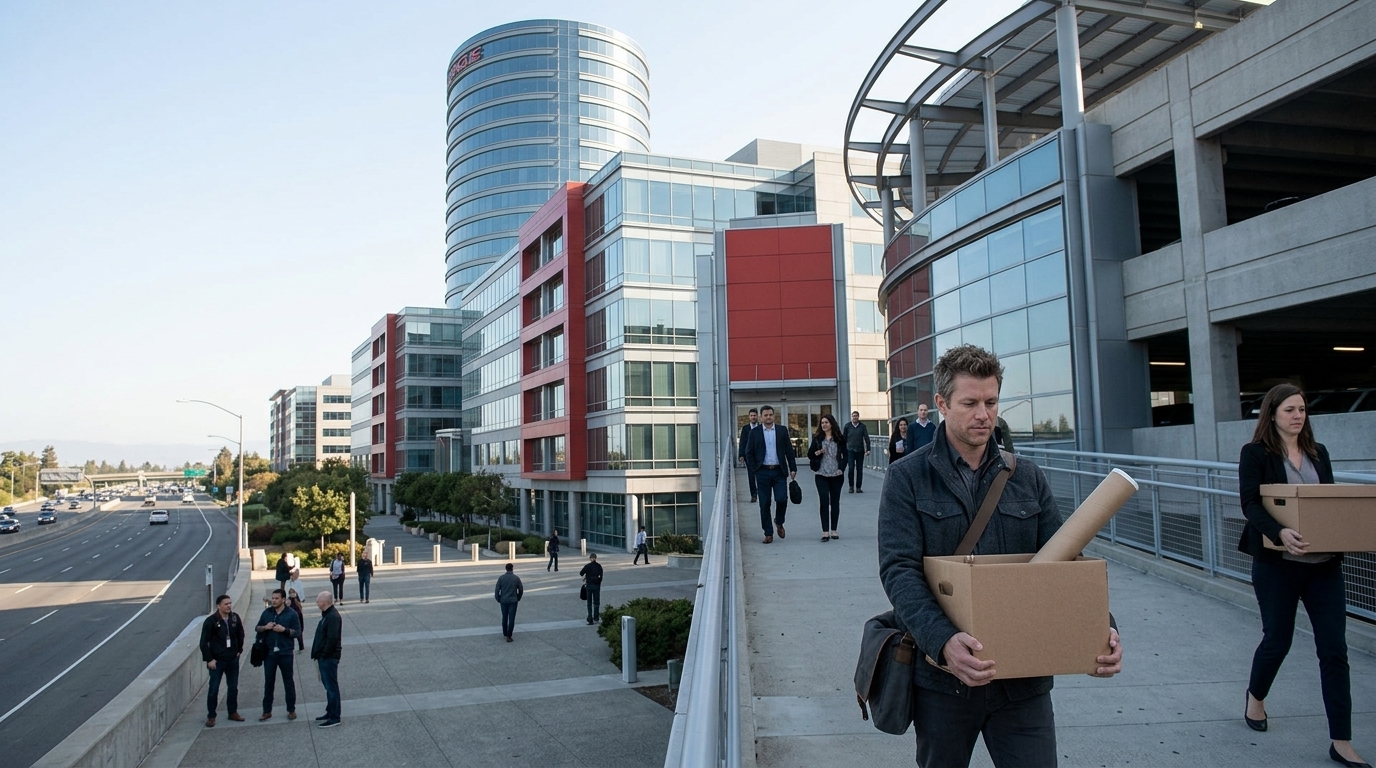
The news of Oracle reducing its workforce by 21,000 positions in just twelve months is not merely a statistical blip on the balance sheets of a tech giant. It serves as the loudest signal yet of how Artificial Intelligence (AI) is transforming the global labor market—not gradually, but with dizzying speed. While the company reports record profits and its stock price surges on Wall Street, this massive workforce reduction highlights the paradox of the new digital economy: soaring financial metrics at the expense of job security.
The Efficiency Doctrine and the Shadow of AI
Oracle, under the leadership of Larry Ellison and Safra Catz, has made it clear that the transition to the cloud and the integration of Generative AI are its absolute priorities. The reduction of 21,000 jobs, representing a significant portion of its total headcount, is not attributed to financial distress. On the contrary, Oracle is seeing its revenues grow, driven primarily by the demand for AI infrastructure (OCI - Oracle Cloud Infrastructure).
Management has repeatedly stated that the use of internal AI tools allows for the automation of tasks that previously required thousands of human hours. From software coding and debugging to customer service and sales management, AI is horizontally replacing segments of the corporate hierarchy. As industry analysts point out, Oracle is not "shrinking"; it is "mutating" into an entity that requires fewer hands and more processing power.
"This is not a crisis of survival, but a crisis of workforce identity. Companies are discovering that technology can perform the work of middle management at a fraction of the cost," says a senior industry executive.
The Cerner Acquisition and Violent Integration
A critical factor in this massive headcount reduction is the absorption of Cerner, the health IT giant that Oracle acquired for $28 billion. The merger of the two companies led to significant job overlaps. However, instead of a traditional restructuring, Oracle chose to use technology to "modernize" (a common euphemism for automation) Cerner’s legacy systems.
The implementation of AI tools in medical data management and hospital system administrative support rendered thousands of jobs—primarily those involving manual data entry and first-level technical support—redundant. This model of "optimization" through technology is expected to serve as a roadmap for other major acquisitions in the tech sector in the coming years.
The Future of Work in the Tech Sector
Oracle’s case is not an isolated incident. It follows the lead of Meta, Google, and Amazon, all of which made similar moves in 2023 and 2024. The difference lies in the scale and the transparency with which AI is identified as the primary catalyst. Tech workers, once considered the most "secure" in the labor market, are now facing a new reality: the necessity for constant upskilling.
- Code Automation: AI tools can now write foundational code, drastically reducing the demand for junior developers.
- Customer Support: Advanced chatbots are replacing entire call centers.
- Marketing and Sales: AI-driven data analysis allows for hyper-targeted customer acquisition with minimal human intervention.
In conclusion, Oracle is sending a clear message to the markets: profitability in the AI era does not come through expanding the workforce, but through streamlining it. For investors, this is a success story. For society and the global workforce, it is a stark warning of the structural challenges that lie ahead.





