

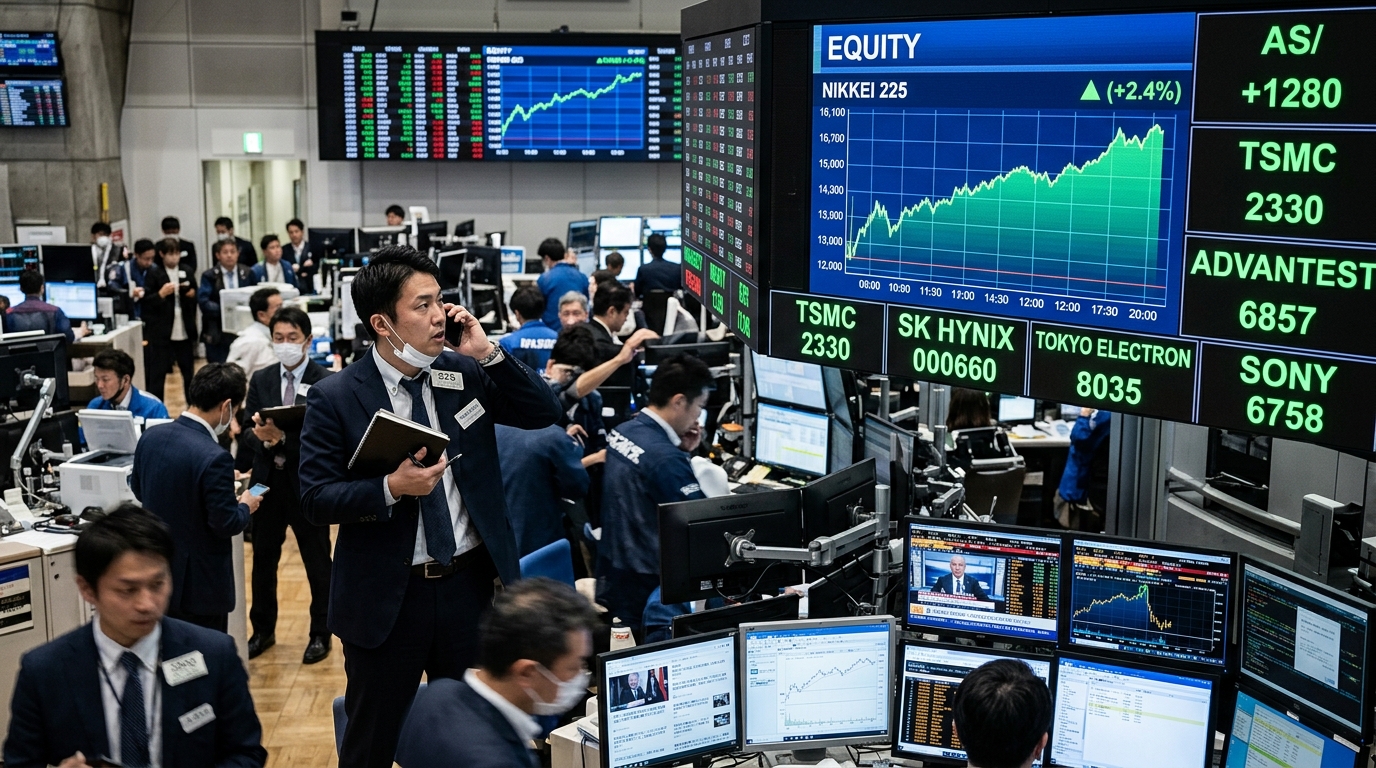
May 3, 2026, will likely be remembered as the day the global markets realized that Artificial Intelligence is no longer confined to our screens. A recent report revealing that Nvidia Corp. has increased its supply chain reliance on Asia to a staggering 90% is not just a statistic; it is a geopolitical and economic manifesto. As the semiconductor giant pivots toward "Physical AI"—the convergence of software intelligence with robotics and real-world automation—its Asian partners are emerging as the ultimate gatekeepers of the new industrial revolution.
The Transition from Chatbots to Robots
For years, Nvidia’s dominance was built on training Large Language Models (LLMs). However, 2026 marks the maturation of the Isaac platform and the Omniverse, tools that enable the development of AI capable of perceiving and interacting with the physical environment. This "Physical AI" requires an entirely new hardware architecture, where processing speed meets the need for ultra-low latency and industrial-grade durability.
Markets in Taipei, Seoul, and Tokyo responded with fervor. TSMC shares climbed 4.5%, while SK Hynix and Samsung Electronics saw significant gains, as demand for High Bandwidth Memory (HBM4) for Nvidia’s next-generation "Rubin" processors outstrips all previous projections. This shift isn't just about chips; it’s about the components that enable motion: sensors, actuators, and advanced power systems.
Asia as the Global Intelligence Factory
The revelation that 90% of Nvidia’s supply chain is now based in Asia highlights a truth that Washington often attempts to bypass: "decoupling" is practically impossible in the high-tech sector. From Hon Hai Precision Industry (Foxconn) assembling Blackwell server racks to Advantech providing the industrial hardware, Asia is the backbone of AI.
According to analysts, this concentration of power creates a "Silicon Shield" for the region, particularly for Taiwan. Nvidia isn't choosing Asia solely for cost, but for the ecosystem. The ability to move from design to scale production within weeks is something the West, despite efforts via the Chips Act, still struggles to emulate. Physical AI requires a proximity between designers and manufacturers that only Asian industrial hubs currently offer.
Risks and Geopolitical Balances
Despite the stock rally, extreme reliance carries inherent risks. Geopolitical instability in the Taiwan Strait remains the "black swan" for investors. However, Nvidia CEO Jensen Huang seems to be betting on interdependence. His strategy is clear: AI will be the operating system of the physical world, and Asia will be the factory that builds it.
- TSMC remains the sole manufacturer for the most advanced 2nm nodes.
- SK Hynix maintains a near-monopoly on the next generation of HBM4 memory.
- Japanese robotics firms, such as Fanuc, are now integrating Nvidia Isaac directly into their systems.
In conclusion, the surge in Asian stocks is not a transient bubble but the recognition of a new reality. Artificial Intelligence has gained a "body," and that body is being manufactured in the East, powered by an American "brain." The challenge for the future will be maintaining this delicate balance in an increasingly polarized world.





