

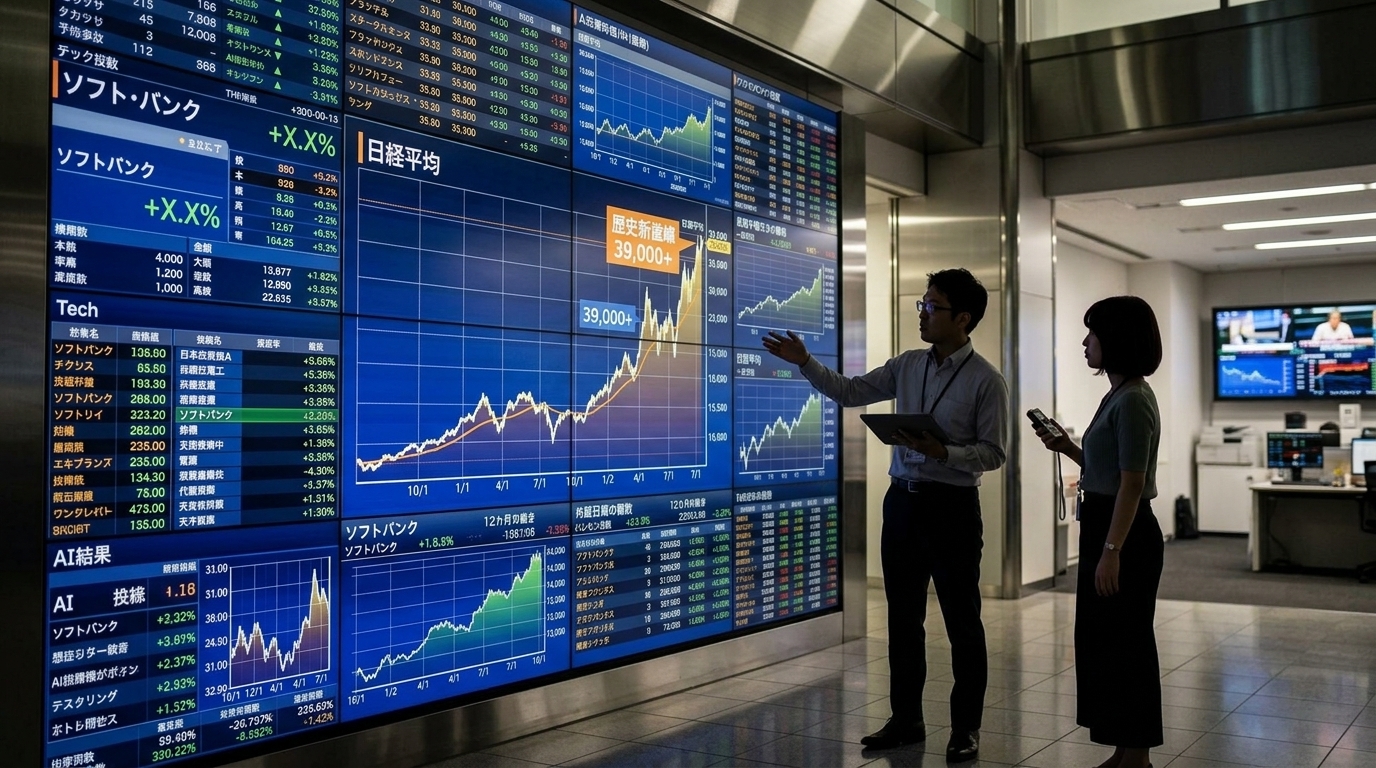
The Japanese stock market is witnessing a historic moment that many analysts deemed unthinkable just a few years ago. The Nikkei 225 index, the barometer of the Land of the Rising Sun's economy, has surged to a new, unprecedented all-time high, breaking through the psychological and technical barrier of 62,000 points. This rally is not merely a market fluctuation but the result of a profound structural shift fueled by the Artificial Intelligence (AI) revolution and a global re-evaluation of Japan as a central hub in the technology value chain.
The AI Revolution as the Primary Growth Engine
The primary "fuel" behind this rally is undoubtedly Artificial Intelligence. Global investors are searching for companies that not only develop AI software but, more importantly, those that control the hardware and infrastructure. Japan, with its strong presence in the semiconductor and precision electronic components sectors, has become the favored destination for capital shifting away from China toward more stable and technologically advanced markets.
Companies such as Tokyo Electron and Advantest, which hold dominant positions in chip-making equipment, have seen their shares skyrocket. The demand for high-performance chips required to train Large Language Models (LLMs) has created a "golden age" for Nvidia's suppliers in Japan. The market appears to be pricing in a pivotal role for Japan in building the next generation of AI infrastructure.
Softbank’s Return and the ARM Catalyst
At the heart of this surge is Masayoshi Son’s Softbank Group. After a period of intense scrutiny and significant losses from the Vision Fund, Softbank has quite literally "taken off," with its stock recording double-digit gains in just a few sessions. The main driver is ARM, the British chip design firm in which Softbank holds a majority stake.
ARM is now considered the "Nvidia of Europe/Japan," as its chip architecture is essential for the energy efficiency of AI data centers. The explosive rise of ARM’s market value on Wall Street translated directly into massive gains for Softbank’s portfolio, allowing Son to feel vindicated in his vision of "Artificial Super-Intelligence." The market no longer views Softbank as a troubled investment vehicle but as the primary proxy for the AI ecosystem in Asia.
Structural Reforms and the End of Deflation
Beyond technology, the Nikkei’s rise is anchored in macroeconomic foundations. The Tokyo Stock Exchange (TSE) has pushed Japanese corporations to improve governance and increase shareholder returns. Share buybacks and increased dividends have attracted foreign institutional investors, including Warren Buffett, who has repeatedly expressed confidence in Japanese trading houses (Sogo Shosha).
Furthermore, Japan seems to be decisively exiting the deflationary spiral that plagued it for three decades. Mild inflation is allowing companies to raise prices and improve margins, while the Bank of Japan’s (BoJ) maintenance of relatively low interest rates, despite minor adjustments, keeps the Japanese Yen attractive for carry trades, further boosting liquidity in the equity market.
Bubble or Sustainable Growth?
Despite the enthusiasm, voices warning of overheating remain. Comparisons to the 1989 bubble are inevitable, but analysts point to a key difference: valuations. In 1989, the Nikkei traded at price-to-earnings (P/E) ratios exceeding 60, whereas today the index trades at much more reasonable levels, around 16-18, suggesting that the current rise is supported by actual corporate earnings.
However, the heavy reliance on AI carries risks. If the expectation of immediate profits from AI implementation is not soon reflected in corporate financial statements, the correction could be sharp. For now, Japan is enjoying its status as Asia’s "safe haven," combining technological leadership with stability in a world desperately searching for the next major source of growth.





