

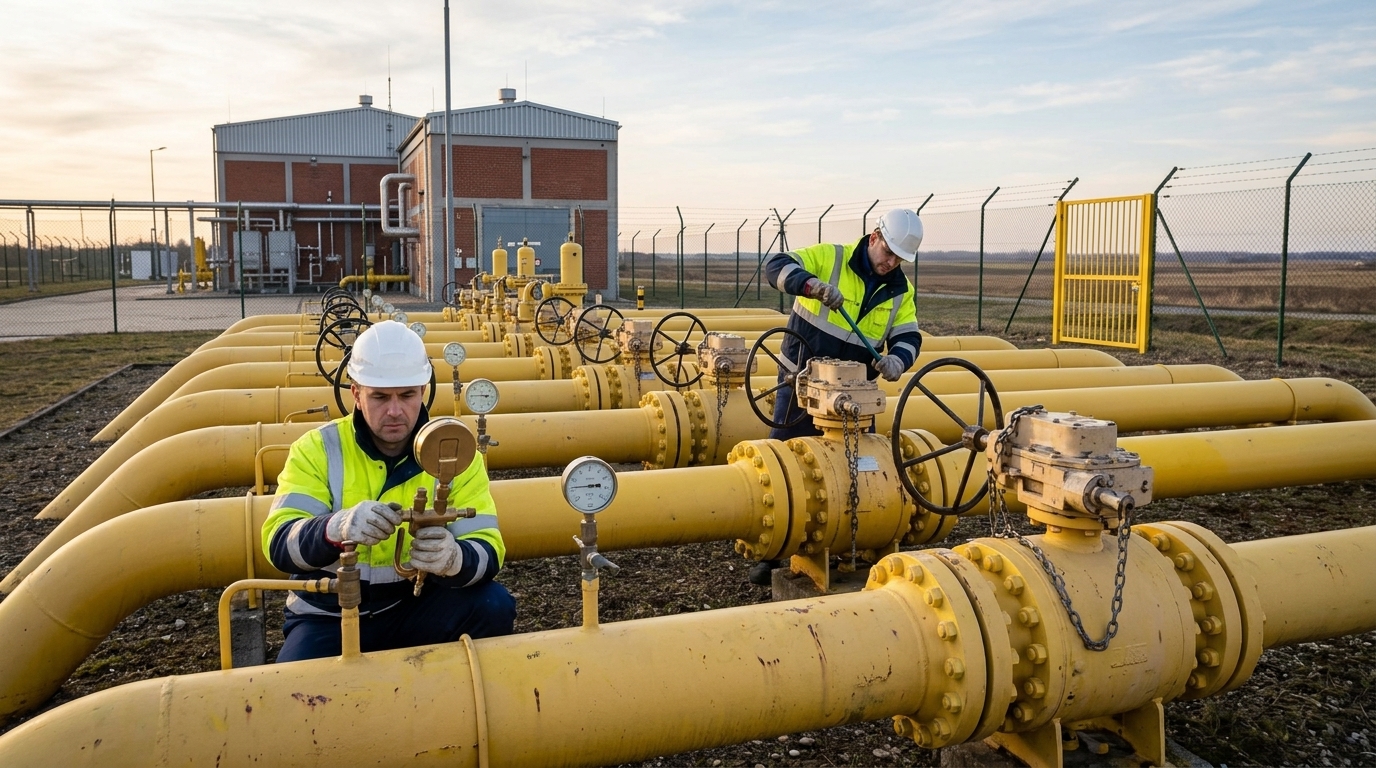
As June 2026 unfolds, Europe finds itself in a predicament hauntingly reminiscent of the darkest days of the 2022 energy crisis. Despite Brussels' repeated assurances regarding the continent's energy resilience, the cold reality of the data is unforgiving. European natural gas storage facilities, which in the previous two years managed to reach occupancy levels exceeding 90% before the onset of winter, are now projected to conclude the current injection season with a mere 76% capacity, according to the latest estimates from Wood Mackenzie. This discrepancy is not merely a statistical outlier; it represents a vanishing 'safety cushion' that leaves European industry and households precariously exposed to the whims of global markets and geopolitical volatility.
The Illusion of Stability and the New Reality
For nearly two years, Europe enjoyed a relative lull in energy prices, aided by successive mild winters and an aggressive procurement strategy for Liquefied Natural Gas (LNG). However, 'luck' is not a strategy. The current replenishment period (April-October 2026) is proving exceptionally challenging. Reduced flows from Norway due to extensive maintenance works, coupled with surging demand from Asia, have severely limited the volumes available for the European continent. Furthermore, the total cessation of Russian gas transit through Ukraine—a legacy of the 2024 contract expirations—is now being felt in its full magnitude, as alternative supply routes struggle to fill the void at comparable costs.
Wood Mackenzie emphasizes that a 76% storage level marks the lowest threshold in years for the start of the heating season. This implies that if the upcoming winter is even slightly colder than average, storage levels will deplete at a rate that could trigger panic in the spot markets. Already, prices at the Dutch TTF hub are showing upward momentum, pricing in a difficult fourth quarter. Europe appears to be paying the price for delaying the construction of permanent storage infrastructure and over-relying on 'opportunistic' LNG, which invariably flows toward the highest bidder.
The Asian Factor and the Global LNG Tug-of-War
A primary driver behind the difficulty in replenishing European stocks is the resurgence of Chinese industrial activity and India's strategic shift toward gas-fired power generation. Asia, acting as Europe's chief competitor for LNG cargoes, is currently offering higher premiums, attracting tankers that would otherwise have docked at European ports. This global bidding war renders natural gas an expensive commodity, with Europe at a disadvantage due to its lack of long-term contracts. Many European governments hesitated to commit to decades-long agreements, fearing they would conflict with ambitious green transition targets.
Analysts suggest that Europe requires approximately 100 billion cubic meters (bcm) of storage capacity to maintain a sense of security. With the current forecast of 76%, the deficit is roughly 15-20 bcm relative to the 'safety zone.' While this gap may seem marginal, during a deep freeze, it equates to several weeks of consumption for the industrial sectors of Germany and Italy. This uncertainty translates directly into higher production costs, severely undermining the international competitiveness of European manufacturing.
Social and Political Implications
The prospect of a new wave of energy inflation is not just an economic concern; it is profoundly political. European governments, already strained by persistent inflation and fiscal deficits, have limited room for new subsidies for electricity and gas bills. A fresh spike in prices during the 2026-2027 winter could ignite social unrest and bolster populist movements that question the EU's broader energy strategy. Greece, situated at the periphery of the network, remains particularly vulnerable despite efforts to become an energy hub through the FSRUs in Alexandroupolis.
- Reduced supply from Norway due to maintenance directly impacts flows to Northern Europe.
- The absence of Russian gas through Ukraine creates a structural deficit in Central Europe.
- High summer temperatures increase air conditioning usage, consuming gas that should be stored.
- The lack of long-term LNG contracts leaves the EU at the mercy of spot market volatility.
In conclusion, Europe stands at a critical crossroads. The 'firefighting' strategy employed over the past few years seems to have reached its limits. Without a more coordinated European procurement policy and a faster decoupling from imports through domestic production—be it renewables, nuclear energy, or even the utilization of domestic reserves—the continent will remain a hostage to global energy balances. Wood Mackenzie's 76% figure is not just a number; it is a warning that the energy nightmare may not be over yet.





