

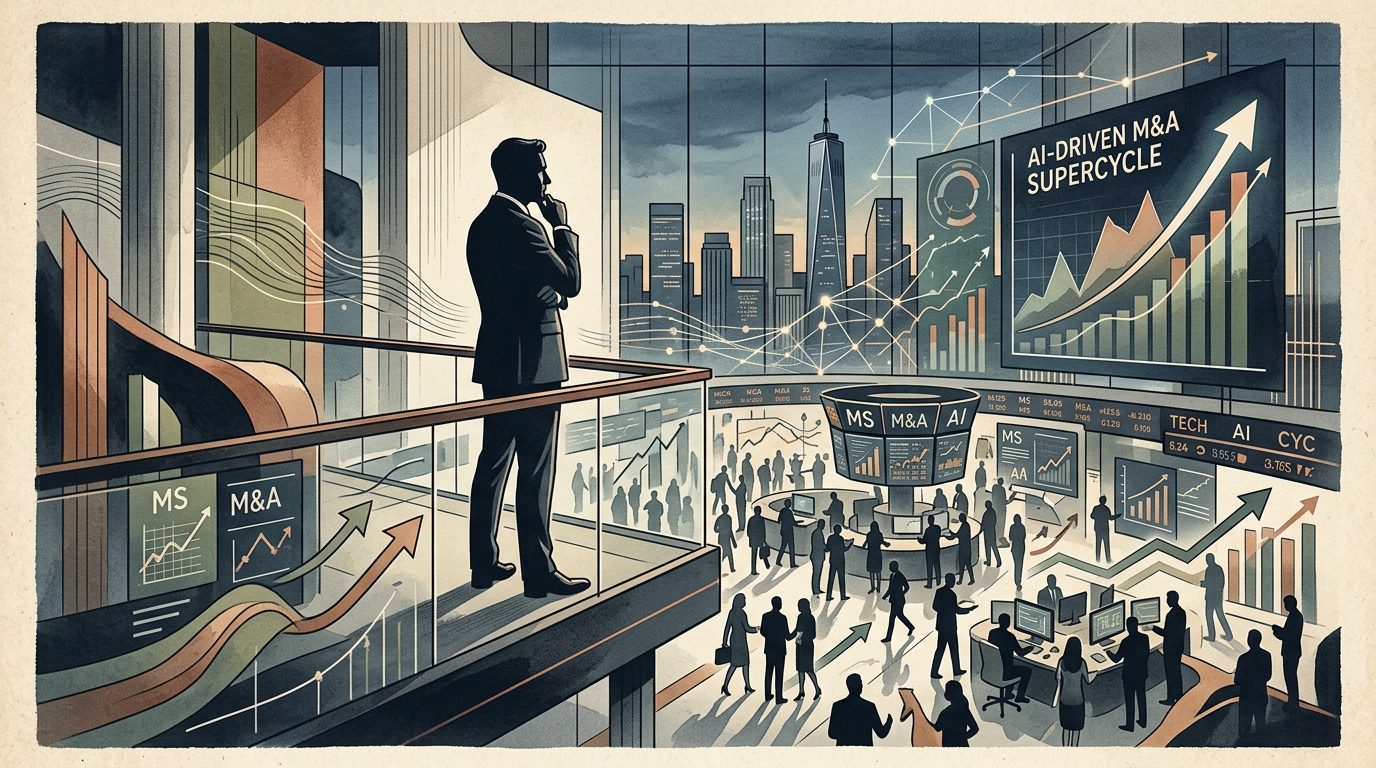
At the Milken Institute Global Conference in Beverly Hills, Dan Simkowitz, Co-President of Morgan Stanley, painted a remarkably bullish picture of the global markets. His central thesis is clear: we are at the beginning of a significant "resurgence" in mergers and acquisitions (M&A), with Artificial Intelligence acting as the primary catalyst—not just as a technological tool, but as the foundation for a new corporate capital structure in 2026.
The Transition from Promise to Infrastructure
According to Simkowitz, 2026 marks the pivotal shift from excitement over AI's potential to the massive, real-world financing of its infrastructure. We are no longer just discussing software or generative chatbots; the focus has shifted to the immense capital requirements for data centers, power grids, and specialized hardware. This "capital intensity" necessitates the involvement of major investment banks to structure complex financing vehicles. Morgan Stanley observes a shift toward large-scale project financing where AI is no longer an experiment but the central nervous system of the global economy.
The M&A Rebound: Why Now?
After a period of relative stagnation caused by the interest rate hikes of previous years, the M&A landscape is transforming. Simkowitz highlights three primary drivers:
- Dry Powder: Private Equity funds are sitting on historically high levels of cash that must be deployed.
- Strategic Necessity: Legacy corporations realize that acquiring AI expertise through acquisitions is significantly faster than building it in-house.
- Macroeconomic Stabilization: Despite rates being higher than the previous decade, the market has accepted the "new normal," allowing for more accurate risk pricing.
The Role of Energy and Infrastructure
An intriguing aspect of Simkowitz's analysis is the nexus between AI and energy. Acquisitions are no longer confined to the tech sector. We are witnessing a convergence where tech giants seek partnerships or acquisitions in the energy sector to secure the power needed for their systems. This creates a new ecosystem of deals that transcends traditional industry boundaries. Morgan Stanley is positioning itself as the intermediary for these multi-layered agreements, emphasizing the importance of strategic advisory in an era where industry lines are blurring.
Challenges and the Regulatory Landscape
Despite the optimism, Simkowitz does not ignore the hurdles. Regulators in the US and the EU remain vigilant regarding large-scale acquisitions, fearing the creation of AI monopolies. However, the prevailing view is that the market will adapt by focusing on more targeted, strategic moves rather than gargantuan mergers that might be blocked. The ability of corporations to navigate this complex legal environment will be the deciding factor for the success of deals in the coming year.
"We aren't just seeing a recovery in transaction volumes; we are seeing the redefinition of what strategic investment means in the age of intelligence," Simkowitz noted during the discussion.
In conclusion, Morgan Stanley predicts that the latter half of 2026 will be one of the most active periods in the history of investment banking, with AI serving as the engine behind every major capital move. The synergy between technology, finance, and infrastructure is creating a supercycle that could redefine the global corporate hierarchy.





